



Dr Jake Robinson starts most mornings on a hospital ward. He is an intern doctor at the Mater Misericordiae University Hospital in Dublin, completing the clinical rotations that are part of every medical graduate's first year after qualification. By the time the shift ends, he switches to a different kind of work: running OnWard Education, an AI-assisted clinical training platform he co-founded while still a medical student, now backed by Learnovate and holding a Bronze EduEvidence Efficacy Badge (EduEvidence is an independent certification body that reviews EdTech platforms against evidence of effectiveness).
He is not the only person doing this. Ciarán Stone has been teaching at a DEIS (Delivering Equality of Opportunity in Schools, the Irish government programme for schools in disadvantaged areas) school in Dublin 12 for over a decade. He is also the CEO of Square Root Solutions, which has built EdTech platforms for CJ Fallon, Druid Learning, MLI International Schools, and others.
Two practitioners. Two different disciplines. The same structural insight: the best EdTech products for a specific profession are almost always built by someone who works in that profession, not by someone who studied it.
This piece is about what that insight produces in product terms, why it matters for EdTech founders who are neither clinicians nor teachers, and what the practitioner-founder pattern can teach about the gap between products that get adopted and products that do not.
Key takeaways
The practitioner-founder advantage is a brief advantage, not a technology advantage. A clinician or teacher who builds knows what the product brief should contain before anyone opens a design tool. A non-practitioner has to research their way to the same starting point, often imperfectly.
OnWard Education is a direct example. Robinson built the platform around what a medical student actually encounters on a ward, not around what a curriculum document says they should encounter. The gap between those two briefs is what most medical education technology misses.
Ciarán Stone's dual role produces the same effect in the Irish primary school context. Square Root Solutions products built by a practitioner-CEO reflect the specific planning formats, MIS (Management Information System, the school's core database) integrations, and administrative workflows that Irish schools actually run, not the ones that a vendor imagines they run.
The advantage is not automatic. A practitioner who builds without consulting the practitioners they are building for can be more badly wrong than a non-practitioner, because their confidence in their own experience blinds them to variation across the profession.
For non-practitioner founders, the equivalent discipline is a structured practitioner research process. Not user interviews. Not focus groups. A sustained research relationship with practitioners who will tell you when your assumptions are wrong, before the product ships.
EduEvidence certification is the independent quality signal that a practitioner-built product has been tested against evidence of effectiveness, not just built from professional instinct.
What the practitioner-founder pattern actually is
A practitioner-founder is someone who builds a product for the profession they work in. Not someone who studied the profession, consulted for the profession, or married someone in the profession. Someone who turns up to the job on Monday morning and builds the software on Tuesday evening.
The pattern appears repeatedly in EdTech. Deirdre Lyons founded Acuru (formerly Examfly, built by Square Root Solutions) while working full time in professional services and studying for accounting qualifications simultaneously. She built the product because she had lived the experience of studying complex technical material in short windows between client work and found every available tool inadequate. Rita Treacy built WordsWorth Learning after being diagnosed with dyslexia at Trinity College Dublin in 1986, spending the subsequent decades working in educational support, and eventually building the platform she wished had existed for the students she worked with. Avril McMonagle built MOSAIC (also built by Square Root Solutions) after years of working to improve early childhood education locally, regionally, and nationally, and identifying the documentation gap that the platform now fills.
In each case, the product brief started from inside the profession. Not from a market analysis. Not from a competitive landscape review. From a specific, named gap that the founder had encountered in their own professional practice.
Dr Jake Robinson's story follows the same pattern. OnWard Education is an AI-assisted clinical training platform that helps medical students log patient encounters, get AI-generated gap analysis comparing what they asked with what guidelines recommend, and give faculty real-time visibility into clinical skill development across a cohort. The idea came from Robinson's own experience as a medical student encountering patients on ward rounds and having no structured way to capture what he had learned from each interaction or compare his clinical reasoning to expert reasoning in real time.
What Robinson built and why the brief started from inside the profession
Clinical education has a specific problem that most medical education technology does not address: the gap between what a medical student is taught in a lecture and what they encounter on a ward is enormous, and most of the learning happens in the encounter, not in the teaching.
A medical student on a ward round sees patients presenting in ways that do not match the textbook. They ask questions they have not been taught to ask, miss questions they should have asked, and have no mechanism to know which is which until a senior clinician comments, which may not happen at all for a busy registrar managing a ward under pressure.
OnWard Education's AI does not replace the clinical supervisor. It compares what the student asked in a patient encounter against what clinical guidelines would suggest asking, surfaces the gap, and gives the student a structured reflection prompt before the next encounter. The faculty dashboard shows supervisors where a cohort is developing and where it is stalling, without requiring each supervisor to individually debrief every student interaction.
That brief is specific in a way that general medical education platforms are not. It addresses a gap that is invisible unless you have stood on a ward as a student and felt the specific texture of not knowing whether your clinical reasoning was adequate. Robinson had. The brief reflects that.
The EduEvidence Efficacy Bronze badge, held by OnWard Education, is a quality signal that goes beyond the product existing. EduEvidence requires platforms to demonstrate evidence of impact against their stated learning goals. A Bronze badge means the platform has demonstrated early-stage evidence of effectiveness. It does not guarantee outcomes, but it does mean the claims about the product have been independently reviewed.
The teacher-founder parallel: what Ciarán Stone's dual role produces
The parallel in the Irish primary school context is direct.
An Irish primary school teacher's week includes planning against the NCCA (National Council for Curriculum and Assessment, the body that develops school curricula in Ireland) curriculum documents, producing Cuntais Mhiosúla (monthly planning records required by the Irish primary curriculum), managing class records in Aladdin (the MIS used by approximately 90% of Irish primary schools), and preparing for Cumaisc (the Irish term for integrated curriculum planning across subjects). None of those specifics appear in generic lesson planning tools built outside Ireland. They appear in EduSmart Planner because the person commissioning and reviewing the build works in a school where those are daily realities.
The 75% reduction in curriculum administration time reported by EduSmart Planner's 4,500+ users is not a technology outcome. It is a brief outcome. The platform saves time because it was built around the specific formats, workflows, and constraints of the Irish primary curriculum, not around a generic model of what curriculum planning might look like.
The same pattern appears in the NameDown school admissions platform (also built by Square Root Solutions): defensible lottery processes, criterion-based ranking, and integration with POD and PPOD (the Irish primary and post-primary school administration systems) are all features that only make sense if the brief started from inside an Irish school's admissions process, not from a general description of "school admissions software."
None of this is accidental. It reflects the specific insight that a practitioner-founder brings: the brief does not need to be researched because the founder already lives it.
Why the practitioner-founder advantage is harder to copy than it looks
The practitioner-founder advantage sounds straightforward: build from experience, get the brief right. The reason it is not straightforwardly replicable is that the experience has to be current, specific, and honest about its own limits.
Current. A founder who left clinical practice five years ago to build a medtech company has practitioner knowledge that is five years stale. Medical guidelines change. Ward protocols change. The clinical education landscape in Ireland in 2026 is not the clinical education landscape of 2021. Robinson is on the ward now, which means his brief is current in a way that a founder who left practice years ago cannot replicate.
Specific. Clinical practice in a tertiary referral centre is not the same as clinical practice in a rural district general hospital. Primary teaching in a DEIS school in Dublin 12 is not the same as primary teaching in a fee-paying school in south Dublin. A practitioner-founder whose experience is from one corner of the profession can be badly wrong about another corner. The advantage is specific to the context the founder works in.
Honest about its limits. This is the most important one. A practitioner-founder who does not actively test their brief against other practitioners' experiences will build a product that works brilliantly for people exactly like them and fails for everyone else. Robinson's clinical experience is from Irish medical training. A platform built exclusively from that experience might miss patterns in UK or European medical education. Ciarán's teaching experience is from a DEIS urban primary school. A platform built exclusively from that context might miss the needs of a rural Gaelscoil (an all-Irish medium primary school).
The practitioner-founder advantage is a starting point advantage. It is not a substitute for the research discipline that should follow it.
Pro tip. Ask any practitioner-founder one question before investing in or building with them: "How many practitioners outside your own institution have validated your product brief?" If the answer is fewer than ten, the brief is built from personal experience rather than from the profession. That is a meaningful distinction.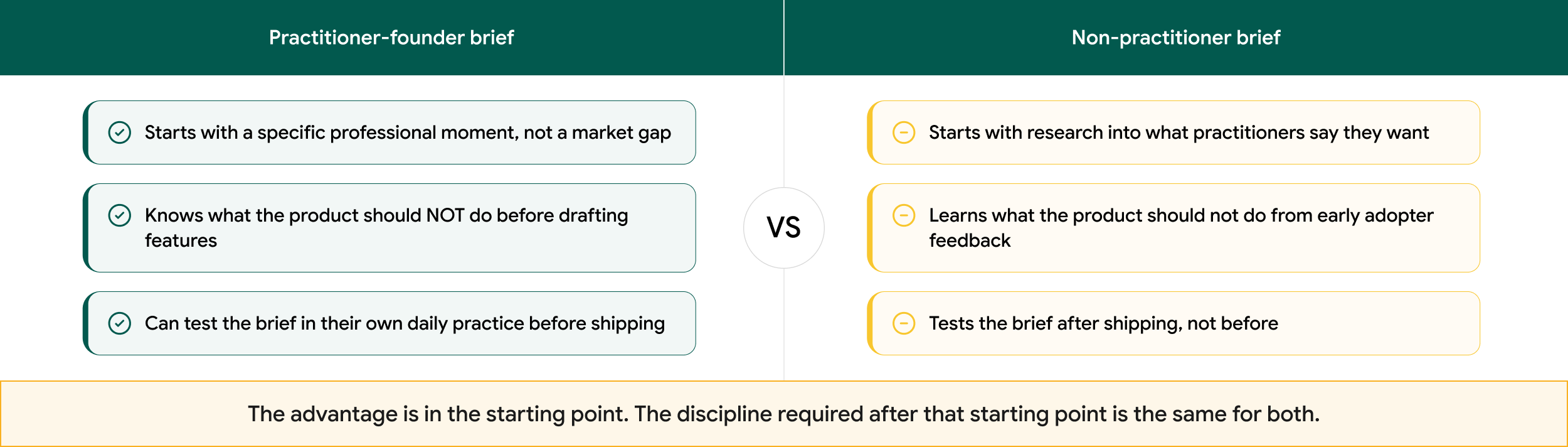
What non-practitioner founders can actually do about it
The practitioner-founder advantage is real. It is not the only route to a product that gets adopted.
The non-practitioner equivalent of practitioner knowledge is a structured, sustained research relationship with the profession you are building for. Not a user interview conducted once before the product ships. A sustained relationship where practitioners have the ability to tell you when your assumptions are wrong, before the product ships and after it ships.
Three things make that relationship work:
Access to the real work, not the described work. Practitioners describe their work differently when asked about it than when doing it. A teacher asked "what takes the most time in your week" will give one answer. A teacher observed while planning on a Sunday evening will give a different answer. The useful data is in the observation, not the interview.
Specificity about the context. "Teachers in Irish primary schools" is not specific enough. "Year-three class teachers in DEIS schools in Dublin with mixed-ability classes" is specific enough to produce a useful brief. The more precisely the practitioner cohort is defined, the more useful the research.
A structured feedback loop post-launch. The brief is not finished at launch. The first year of a real deployment with real practitioners is the most valuable research process available. The platforms that achieve sustained adoption are almost always the ones where the founding team treated the first year as a research year, not a revenue year.
Square Root Solutions runs a Discovery Sprint before any significant build specifically to surface the practitioner knowledge that the client team holds and translate it into product decisions before any code is written. The output is a mapped route based on what the practitioners who will use the platform actually need, not what a brief written without practitioner input assumes they need.
If Your Product Brief Looks Right on Paper, But Hasn’t Been Tested by Practitioners, Take Another Look.
It surfaces gaps in the brief, clarifies what practitioners actually need, and turns that insight into clearer product decisions before development begins.
The risk the practitioner-founder carries
Practitioner-founders carry a specific risk that non-practitioner founders do not: the risk of being confidently wrong.
A practitioner who has spent ten years in a specific clinical or educational context has a detailed, accurate model of that context. They also have a decade of confirmation bias, professional socialisation, and contextual blindness that makes their assumptions about that context extremely hard to question from the inside.
Robinson is an intern doctor in 2026 in an Irish tertiary referral hospital. He knows that context with precision. Whether his product brief for OnWard Education accurately reflects the experience of a foundation year doctor in a UK district general hospital, or a medical student in a low-resource setting in sub-Saharan Africa, is a different question, and one that his practitioner experience cannot answer.
Ciarán knows the experience of an urban DEIS primary school in Dublin 12 in 2026 with precision. Whether that brief is accurate for a rural Gaelscoil in Connemara, or a fee-paying primary school in south Dublin, is a question that his practitioner experience can inform but not settle.
The discipline that prevents this risk is the same discipline that non-practitioner founders need: sustained validation with practitioners across the full range of the target market, not just the practitioners whose experience matches the founder's own. The practitioner-founder has a head start. They are not exempt from the work.
What this means for EdTech product decisions
The practitioner-founder pattern surfaces something that applies to all EdTech product decisions, regardless of the founding team's background.
The brief is the product. The decisions made before the first line of code is written determine whether the product gets adopted. A brief that starts from inside the profession produces different decisions than one that starts from outside it. Both can be done well. The one that starts from inside is harder to do badly because the founder encounters the consequences of a bad decision every time they go to work.
The adoption signal is professional recognition, not feature completeness. A platform achieves adoption when practitioners recognise it as fitting how they actually work, not when it has all the features on a specification list. OnWard Education achieves adoption among medical students because it fits the specific texture of a ward round, not because it ticks items off a medical education curriculum. EduSmart Planner achieves adoption among Irish primary teachers because it produces a Cuntais Mhiosúla that fits what a principal expects to see, not because it generates a generic lesson plan.
EduEvidence certification is worth pursuing. Independent certification of evidence of effectiveness is increasingly what institutional buyers in Ireland and the UK require before procurement. A platform that has been through EduEvidence review has a brief that has been validated against evidence, not just against founder instinct or user feedback. That is a different and higher bar than most EdTech platforms currently meet.
Frequently asked questions
What is the practitioner-founder advantage in EdTech specifically?
A practitioner-founder is someone who builds a product for the profession they work in. The advantage is a brief advantage: they start from an accurate model of the professional context they are building for, which means the product decisions made before coding begins are more likely to fit how practitioners actually work. The disadvantage is that this model is specific to the founder's context and requires sustained validation across the broader profession to be reliable.
What is OnWard Education and how does it work?
OnWard Education is an AI-assisted clinical training platform co-founded by Dr Jake Robinson, a practicing intern doctor at the Mater Misericordiae University Hospital in Dublin. The platform allows medical students to log patient encounters, receive AI-generated gap analysis comparing their clinical reasoning to what guidelines recommend, and give faculty dashboards showing capability development across a cohort. It holds a Bronze EduEvidence Efficacy Badge and is supported by Learnovate.
What is EduEvidence certification and why does it matter?
EduEvidence is an independent certification body that reviews educational technology platforms against evidence of effectiveness. A Bronze badge means the platform has demonstrated early-stage evidence of impact against its stated learning goals. It matters because institutional buyers, particularly in the UK and increasingly in Ireland, require independently verified evidence of effectiveness before procurement rather than relying on vendor claims.
Does the practitioner-founder advantage mean non-practitioners cannot build good EdTech?
No. It means non-practitioners have to do more structured work earlier in the process to develop the brief that a practitioner-founder arrives at more naturally. The non-practitioner equivalent is a sustained research relationship with the profession: observation of practitioners doing real work, not just interviews about their work, and a structured feedback loop that continues after launch. Many of the most successful EdTech platforms were not built by practitioners. All of them were built by founders who developed deep, accurate knowledge of the professional context before shipping.
Why does Square Root Solutions care about the practitioner-founder pattern?
Because Square Root Solutions is led by a practitioner. Ciarán Stone has been teaching in an Irish primary school for over a decade. That means the product brief Square Root Solutions develops for Irish school-facing platforms starts from inside the profession rather than from a generic model of what a school needs. It also means Square Root Solutions runs a Discovery Sprint before any significant build to surface the practitioner knowledge the client team holds and translate it into product decisions before coding begins.
How does the Discovery Sprint relate to the practitioner-founder argument?
The Discovery Sprint is Square Root Solutions' structured version of the practitioner research process for client teams that are not practitioner-founders. In two weeks, it surfaces what practitioners who will use the platform actually need, identifies the gaps between the client's current brief and what practitioners will recognise as fitting their work, and produces a mapped route for the build. It is the non-practitioner equivalent of the knowledge a practitioner-founder starts with.
The pattern that Robinson and Stone share is not a personality type or a founding style. It is a research advantage: they encounter the brief in their daily work before they encounter it on a whiteboard.
That advantage is real. It is also specific, current, and honest about its limits when it is working well.
Read next: OnWard Education case study: AI-assisted clinical training built by a practitioner-founder
Or, if your product brief was written without sustained practitioner input and you want to surface the gaps before they become build problems, book a complimentary Discovery Sprint with Square Root Solutions.