



Only 31 per cent of software projects ship on time, on budget, and on scope, according to research cited by Academy Smart. EdTech is no different. The founders who beat those odds are not the ones who work faster. They are the ones who start with a realistic timeline and build around it.
The honest range is 12 to 32 weeks of active development, depending on what the platform does. A basic LMS (Learning Management System, a platform that hosts and delivers courses) reaches pilot in 12 to 16 weeks. A mid-complexity system with reporting, multiple user roles, and one MIS (Management Information System, the central database schools use for student records, timetabling, and reporting) integration takes 16 to 22 weeks. An enterprise platform with AI-driven personalisation, deep integrations, and multi-tenant architecture takes 22 to 32 weeks or longer.
Those numbers do not include a two-to-four-week discovery phase before development begins, and they assume a team that has built education products before. Miss either condition and the timeline stretches. This guide breaks down what drives the timeline, what causes delays, and what the build actually looks like week by week, with specific reference to the Irish and UK education markets.
Key takeaways
The range is 12 to 32 weeks, and platform type decides where you land. A basic LMS reaches pilot in 12 to 16 weeks. A mid-complexity system takes 16 to 22 weeks. A full learning experience platform with AI and deep integrations takes 22 to 32 weeks or longer.
Five overlapping phases make up every build. Discovery (2 to 4 weeks), UI/UX design (3 to 6 weeks), core development (8 to 20 weeks), integration and compliance (3 to 8 weeks), and QA and launch preparation (2 to 4 weeks). Running them in parallel compresses the timeline by 20 to 30 per cent.
Integration surprises are the top cause of delay. MIS connections, authentication, and learning standards like SCORM, xAPI, and LTI carry undocumented edge cases that surface during development. Scoping them in week two instead of discovering them in week fourteen avoids the single largest source of overruns.
Irish and UK school builds carry extra time. MIS integration (Aladdin, VSware) adds three to six weeks. Supporting both Irish systems adds two to four more. GDPR compliance architecture adds two to three weeks when built in from the start, or six to ten weeks retrofitted.
The school calendar sets a hard deadline. The safe deployment window for Irish and UK schools is July and August. Plan backwards: a January start with a 20-week build finishes in late May, with margin. A March start finishes in July, with none.
AI features add four to ten weeks, but many products do not need them in the first release. Ship the core product first, validate adoption, then add AI in a later iteration if the core works without it.
How long does each type of EdTech platform take to build?
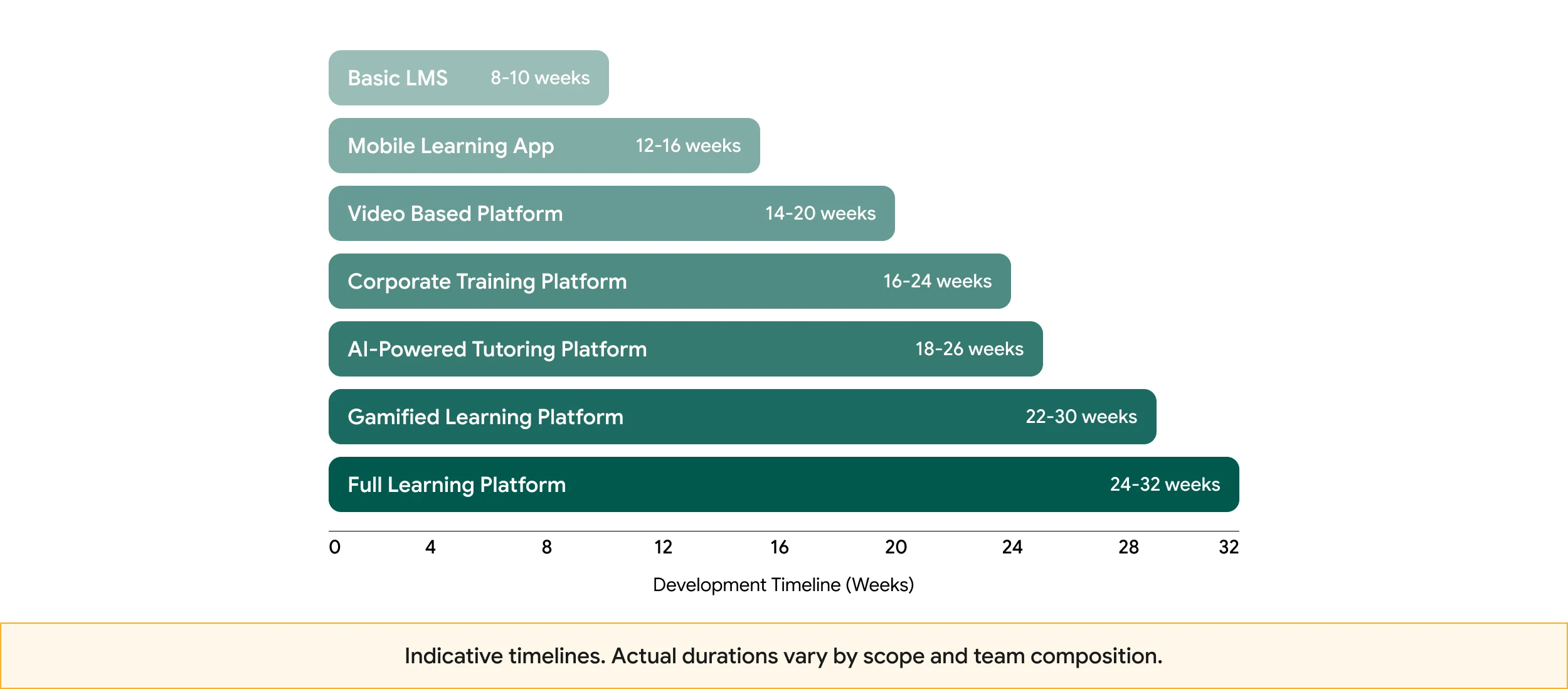
Timelines range from 12 weeks for a basic LMS to 32 weeks or more for a full learning experience platform, depending on complexity, integrations, and compliance requirements.
The table below draws on publicly available research from Cleveroad and Square Root Solutions' own project data. It assumes a team of two to five developers working at mid-market rates.
Platform type | Development timeline | MVP timeline |
Basic LMS | 12 to 16 weeks | 3 to 4 months |
Mid-complexity LMS (multi-role, reporting, one MIS integration) | 16 to 22 weeks | 4 to 5 months |
Assessment platform | 16 to 20 weeks | 3 to 4 months |
Corporate training and L&D (Learning and Development, the function within organisations responsible for employee training and growth) | 14 to 18 weeks | 3 to 4 months |
AI-powered tutoring | 20 to 30 weeks | 5 to 7 months |
Full LXP (Learning Experience Platform, a more advanced system that personalises learning paths and integrates multiple content sources) | 22 to 32 weeks | 5 to 8 months |
Student information system | 20 to 28 weeks | 5 to 7 months |
These ranges cover active development only. Add two to four weeks for the discovery phase that precedes it, and expect the timeline to shift based on integration depth, compliance requirements, and team availability.
The label matters more than founders expect. A platform described as "an LMS" covers everything from a course player with a login page to a multi-tenant enterprise system with SCORM (Sharable Content Object Reference Model, an interoperability standard for e-learning content) compliance and real-time analytics. For a clearer picture of what each category actually means, see LMS, School Management, or Learning App? How to Know What You Are Actually Building.
What does each phase of development actually involve?
Every EdTech build moves through five overlapping phases: discovery, design, core development, integration and compliance, and QA and launch preparation. The phases overlap because running them in strict sequence stretches the timeline unnecessarily.
Phase | Duration | What happens |
Discovery and scoping | 2 to 4 weeks | Define the learning model, map integrations, identify compliance requirements, set the MVP boundary |
UI/UX design | 3 to 6 weeks | Wireframes, user flows, design system, accessibility compliance, user testing with teachers or learners |
Core development | 8 to 20 weeks | Build the platform's primary features: content management, user roles, assessment engine, dashboards |
Integration and compliance | 3 to 8 weeks | Connect to MIS systems, SSO (Single Sign-On, letting users log in with one set of credentials), payment gateways, video tools; implement GDPR (General Data Protection Regulation, the EU's data privacy law) and accessibility architecture |
QA, security, and launch preparation | 2 to 4 weeks | Functional testing, security audit, accessibility testing, staging environment, pilot setup |
The overlap works because later phases do not depend on full completion of earlier ones. Design sprint two can run alongside early development. Integration work can begin once the core architecture is stable, typically around week ten. QA starts as soon as testable features exist. This parallel structure is what compresses a 30-week sequential timeline into a 20-week overlapping one.
What causes EdTech projects to run over?
Integration surprises are the most consistent cause of delays, followed by undefined scope boundaries and late accessibility work.
Undefined scope. Each feature that enters the brief after development starts adds one to three weeks. The cost of adding a feature in week fourteen is three to four times higher than scoping it in week two, because late additions interact with architecture decisions already made. This is why the discovery phase exists: it is cheaper to spend three weeks defining the brief than to spend eight weeks rebuilding around a brief that keeps moving.
Integration surprises. MIS systems, authentication providers, and learning standards like SCORM, xAPI (Experience API, a newer standard that tracks learning activities across platforms and devices), and LTI (Learning Tools Interoperability, a standard that lets learning tools plug into platforms seamlessly) all carry undocumented behaviours, rate limits, and edge cases that surface during development. A single MIS integration can absorb three to six weeks when data mapping is complex. Discovering this at week fourteen rather than week two is where projects stall.
Late accessibility work. Retrofitting WCAG 2.1 (Web Content Accessibility Guidelines, the standard for making websites accessible to people with disabilities) AA compliance after the build adds four to eight weeks. Building it in from the start adds modest time per sprint but avoids the retrofit entirely.
Stakeholder review delays. Each review round without clear decision authority stalls the project by one to two weeks. The fix is naming a single decision-maker for product and design questions before development begins.
For comparison, Cleveroad's research on enterprise LMS builds with deep integrations reports timelines of 9 to 14 months, significantly above the 22 to 32 week range for simpler enterprise platforms. The difference is almost entirely driven by integration complexity.
How does building for Irish and UK schools change the timeline?
Building for Irish and UK schools adds two to eight weeks to the baseline, driven by MIS integration, compliance architecture, and the school calendar's narrow deployment window.
MIS integration. Irish primary schools run on Aladdin. Post-primary schools use VSware. UK schools use Wonde or SIMS. There is no aggregation layer in Ireland equivalent to Wonde in the UK, so each integration is built individually. A single MIS integration, whether Aladdin or VSware, takes three to six weeks depending on data depth. Simple roster sync sits at the short end; bi-directional attendance, grades, and timetabling sit at the long end. Supporting both Irish systems adds two to four weeks.
Compliance architecture. GDPR compliance for platforms handling children's data must be built from the start, not added later. Building to the Irish Data Protection Commission (DPC, Ireland's data protection authority) standard first, then extending for the UK, takes two to three weeks when designed into the architecture from day one. Retrofitting the same compliance after the build takes six to ten weeks, because data flows, retention policies, and audit logging must be reworked across the entire system.
The European Accessibility Act (EAA, requiring digital products to be accessible to people with disabilities), enforceable in Ireland since June 2025, means WCAG 2.1 AA is the minimum standard. For platforms with adaptive learning or AI features, the EU AI Act may classify these as high-risk education AI, with compliance obligations applying from December 2027.
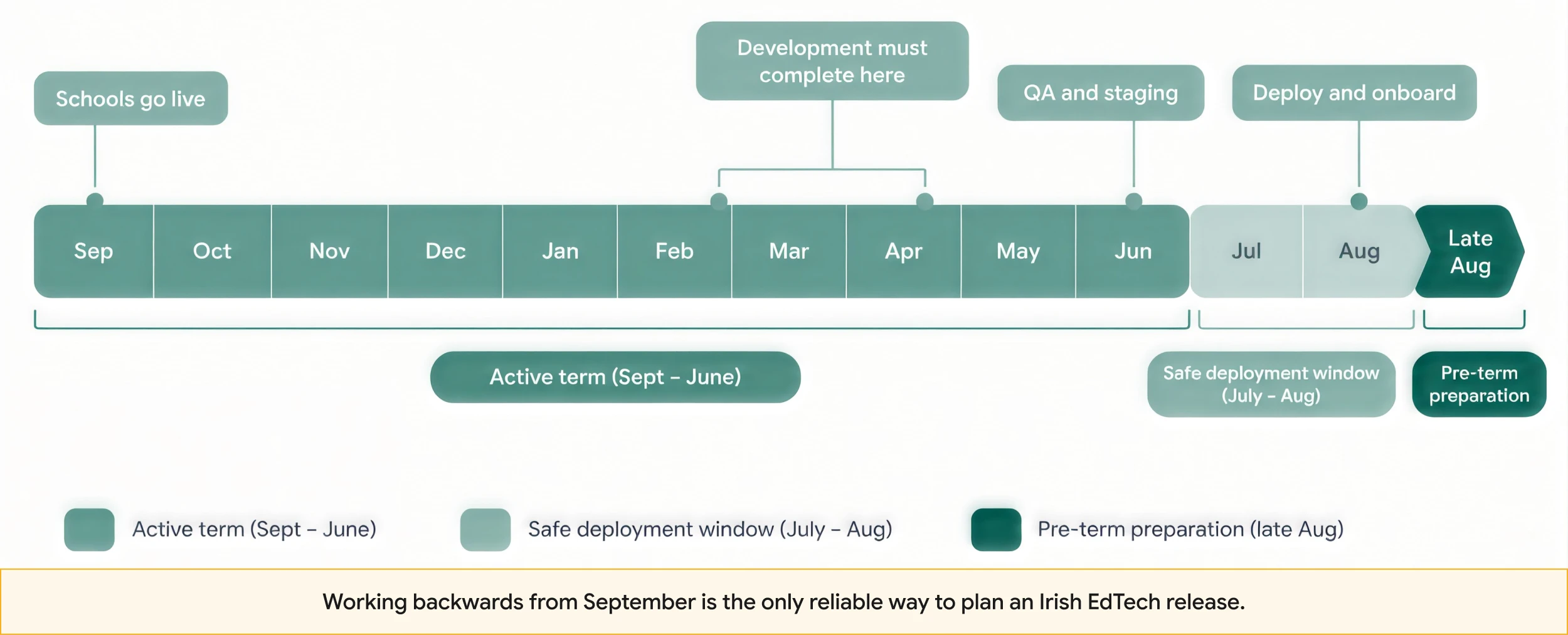
The school calendar. Irish and UK schools adopt new platforms during the summer break, which means the safe deployment window is July and August. A build that finishes in October faces a wait of approximately six months before schools will pilot it. Plan backwards from the deployment window: a January start with a 20-week build finishes in late May, leaving six weeks of margin before September. A March start finishes in July, with no margin for delays.
How can you compress the timeline without cutting quality?
Five practices reliably compress an EdTech build by 20 to 30 per cent: scoped discovery, a thin first release, parallel design and development, a separate integration workstream, and off-the-shelf components for commodity features.
Run a proper discovery phase. Two to four weeks of structured scoping before development starts prevents the scope changes that cause the biggest delays. This is the single highest-return investment in a build's timeline.
Build the thinnest viable slice first. One workflow, one user role, one school. Not three workflows, four roles, and a reporting dashboard. The EduSmart Planner, built by Square Root Solutions for CJ Fallon, put the AI lesson planning feature into the first version, not the third. That focus is why 250+ Irish schools and 4,500+ teachers adopted the platform: the feature that mattered was the feature they shipped first.
Run design and development in parallel. Overlapping design sprint two with early development compresses the total timeline by 20 to 30 per cent. This works because development can begin on features whose design is finalised while later features are still being designed.
Separate the integration workstream. Dedicated integration work starting around week ten, with a specialist joining the team for weeks ten to sixteen, prevents MIS and SSO integration from blocking core development.
Use off-the-shelf for commodity features. Video conferencing, payment processing, push notifications, and email delivery are solved problems. Building video from scratch takes 200 to 400 hours. Integrating it takes a fraction of that. Reserve custom development for the features that differentiate the platform.
Does adding AI features make the build longer?
Yes, AI integration typically adds four to ten weeks to the development timeline, depending on the sophistication of the feature.
Basic AI features, such as search, summarisation, or content tagging, sit at the shorter end. Adaptive tutoring with real-time personalisation, learning path optimisation, and governance controls sits at the longer end. The Department of Education and Youth has published guidance on AI in schools, and platforms operating in this space should build with that guidance in mind from the start.
The more important question is whether AI belongs in the first release. Many EdTech products do not need AI in version one. If the core value proposition works without it, shipping the platform first and adding AI features in a later iteration is often the faster path to market. The four to ten weeks is better spent on the features that determine whether schools adopt the product at all.
What does a realistic project roadmap look like?
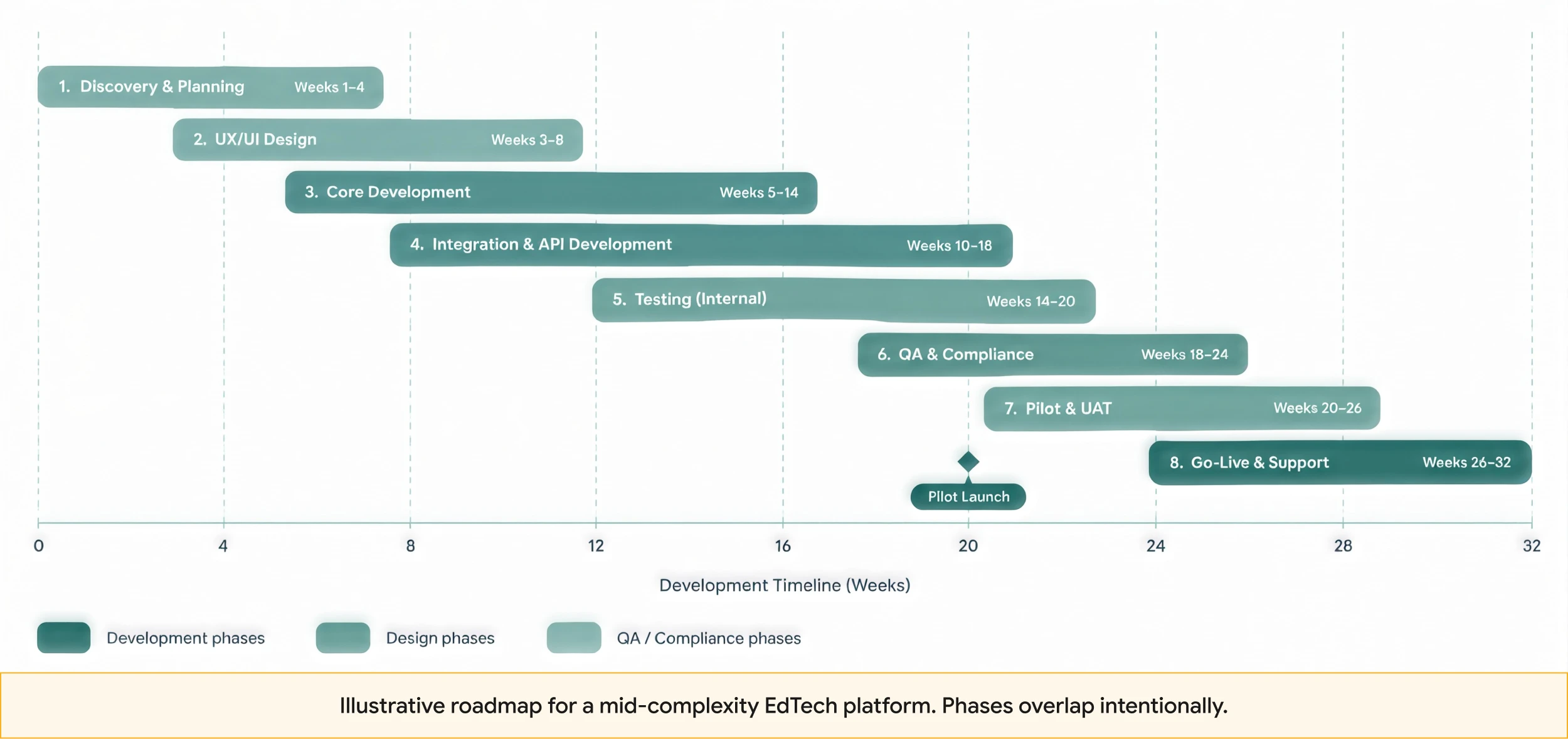
A mid-complexity Irish LMS with a team of four to six people reaches pilot launch in approximately 20 weeks, including a three-week discovery phase.
The team for this build typically includes two developers, one UI/UX (User Interface and User Experience, the visual design and interaction design that shape how people use the product) designer, one QA (Quality Assurance, the person who tests the product for bugs and usability issues before it reaches users) and security engineer, one project lead, and one integration specialist joining from weeks ten to sixteen.
Weeks | Phase |
1 to 3 | Discovery Sprint: define the learning model, map integrations, set compliance requirements, agree the MVP (Minimum Viable Product, the smallest version of your product that solves the core problem) boundary |
4 to 6 | UI/UX design sprint 1: wireframes, core user flows, design system |
5 to 8 | UI/UX design sprint 2 and development setup: detailed screens, component library, development environment and architecture |
7 to 14 | Core development: build the primary features across iterative sprints |
10 to 16 | Integration and compliance: MIS connections, SSO, GDPR architecture, accessibility |
15 to 18 | QA, security, and accessibility testing |
17 to 19 | Staging and pilot preparation |
20 | Pilot launch |
The phases overlap deliberately. Design sprint two runs alongside early development. Integration begins once the core architecture is stable. QA starts as soon as testable features exist. This overlap is what compresses a sequential timeline into a 20-week delivery.
For a January start targeting Irish schools, this roadmap delivers a pilot-ready platform by late May, with six weeks of margin before the September school year. A build that starts after March risks missing the summer deployment window entirely.
Your timeline depends on your learning model.
The ranges in this guide cover the spectrum, but your platform is not generic. Its timeline depends on your specific integrations, compliance obligations, and what the first release needs to do. A Discovery Sprint maps all three in two to four weeks, turning a 12-to-32-week range into a week-by-week plan you can hold your team to.
What should you lock down before the clock starts?
Three things determine whether your project finishes on time: a defined scope, a mapped integration landscape, and a clear compliance position.
Define the scope as five features, not fifty. Write down the five things the platform must do on day one. Not the twenty things it could eventually do. Five. That list is worth more than any feature specification document for getting a realistic timeline, because it forces the hard trade-offs before development begins rather than during it. For guidance on what that scoping and evaluation process looks like, see How to Choose an EdTech Software Development Company.
Map every integration before you start building. List every external system the platform must connect to: MIS, authentication, payment, video, content standards. For each one, confirm the API documentation exists, the authentication method is clear, and a test environment is available. The integrations you discover during development are the ones that cause delays.
Settle your compliance position. If the platform handles children's data, GDPR architecture must be designed in from day one. If it must be accessible, WCAG 2.1 AA is the standard. If it uses AI features, check the EU AI Act classification. Each of these is easier and cheaper to build in than to retrofit.
For Irish founders, Enterprise Ireland supports early-stage product development through several funding mechanisms, including Innovation Vouchers worth €5,000 and Innovation Partnership feasibility studies of up to €9,000. These can offset the cost of the discovery and scoping phase that precedes development.
For a detailed breakdown of what each of these elements costs, see How Much Does EdTech Software Development Cost?. For the full build-versus-buy decision, including a seven-factor scoring matrix, see Custom LMS vs Off-the-Shelf LMS.
Frequently asked questions
How long does it take to build an EdTech MVP?
A narrow MVP with a single workflow, basic authentication, and limited integrations takes 12 to 16 weeks of active development. A mid-complexity MVP with multi-role support, basic reporting, and one MIS integration takes 16 to 22 weeks. Both figures exclude the two-to-four-week discovery phase that precedes development. For a broader look at the phased build approach from first idea to first users, see How to Build an Online Learning Platform.
What is the fastest way to build an EdTech platform?
Run a proper discovery phase, build the thinnest viable slice first (one workflow, one role, one school), run design and development in parallel, use off-the-shelf components for commodity features, and build custom only for the differentiator. This approach compresses the timeline by 20 to 30 per cent without cutting quality.
How long does it take to integrate with Irish school management systems?
A single MIS integration, whether Aladdin or VSware, takes three to six weeks depending on data depth. Simple roster sync sits at the short end; bi-directional attendance, grades, and timetabling sit at the long end. Supporting both Irish systems adds two to four weeks. UK integrations through Wonde or SIMS follow similar timelines.
Does AI integration make an EdTech build take longer?
Yes, AI features typically add four to ten weeks to the development timeline. Basic AI such as search or summarisation sits at the short end. Adaptive tutoring with real-time personalisation and governance controls sits at the long end. Many products do not need AI in the first release, so consider whether it belongs in version one or version two.
What is the biggest cause of delays in EdTech projects?
Integration surprises, particularly with MIS systems, authentication providers, and learning standards like SCORM, xAPI, and LTI, are the most consistent cause. Discovering an undocumented API behaviour in week fourteen costs three to four times more than identifying it in week two. The second most common cause is undefined scope boundaries, where features enter the brief after development has started.
Square Root Solutions builds EdTech platforms for founders and training organisations across Ireland and the UK. If the timelines in this guide have given you a range but not answered your specific question, a Discovery Sprint is the starting point: two weeks to map your platform's requirements before you commit the build.
Read next: How Much Does EdTech Software Development Cost? The Numbers That Actually Matter for Your Budget