


The global LMS (Learning Management System, software for delivering, tracking, and managing training or education) market reached approximately $31.6 billion in 2026, according to Fortune Business Insights. That figure is growing at roughly 16% annually. Behind it sits a question that every EdTech founder and corporate L&D (Learning and Development, the function responsible for employee training and skills growth) leader faces eventually: should we build a custom LMS, or buy an existing one?
The honest answer is neither option is universally right. A custom LMS gives you control over the learning experience, full ownership of data and IP (Intellectual Property), and the ability to differentiate on pedagogy. An off-the-shelf platform gives you speed, a proven feature set, and someone else's engineering team maintaining the infrastructure. The wrong choice in either direction is expensive: building custom when a configured SaaS (Software as a Service, cloud-hosted software sold by subscription) product would suffice wastes capital, while buying off-the-shelf when the learning model is your core differentiator surrenders the one thing that makes your product valuable.
This guide compares the two approaches across cost, time, control, compliance, and long-term ownership, with specific reference to the Irish and UK education and training markets.
Key takeaways
Build custom when the learning experience is your product. If your revenue model depends on a proprietary pedagogical approach, adaptive learning engine, or differentiated assessment method, the LMS is your intellectual property and should be built to match.
Buy off-the-shelf when your needs are standard. Course delivery, enrolment, grading, and compliance reporting are solved problems. An off-the-shelf LMS handles them faster and cheaper than a custom build.
The three-year TCO comparison often favours custom. An off-the-shelf LMS costing €30 per user per year reaches €150,000 at 1,000 users over five years. A custom platform costing €140,000 to build may be cheaper to own over the same period, depending on usage patterns.
Compliance and data sovereignty can force the decision. Platforms handling children's data under GDPR (General Data Protection Regulation, the EU's data privacy law) and Irish DPC (Data Protection Commission) guidelines may need data residency and audit controls that standard SaaS platforms do not offer.
The middle ground is often the right answer. Configuring an existing platform, extending it with custom modules, or integrating multiple tools around a custom core avoids the extremes of both approaches.
What is the real difference between custom and off-the-shelf?
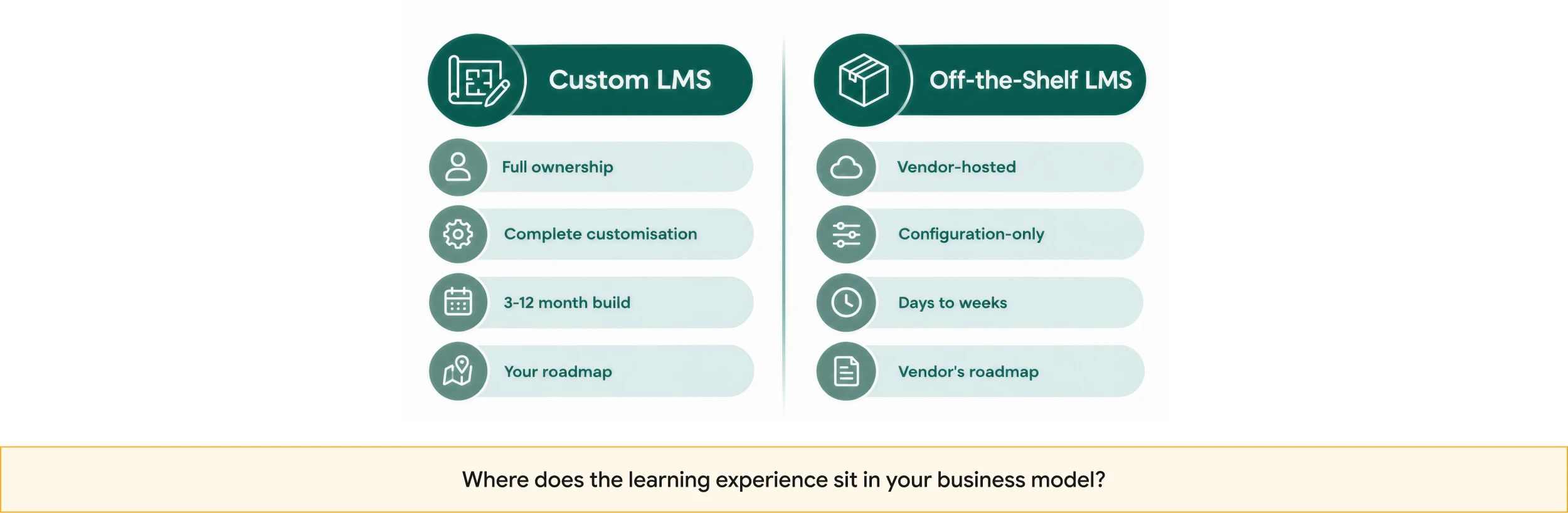
A custom LMS is software built specifically for your organisation's learning model, users, and workflows. You own the code, the architecture, and the data. An off-the-shelf LMS is a commercial product built for a broad market, configured to your needs within the boundaries the vendor allows.
Factor | Custom LMS | Off-the-shelf LMS |
|---|---|---|
Time to launch | 3 to 12 months | Days to weeks |
Upfront cost | €60,000 to €300,000+ | €0 to €35,000 (setup and configuration) |
Ongoing cost | Hosting, maintenance, feature development | Per-user subscription (€10 to €100/user/year) |
Customisation | Complete | Limited to vendor's configuration options |
Data ownership | Full: you own the database and infrastructure | Vendor-hosted: data sits in the vendor's infrastructure |
Integration depth | Unlimited: you control the API layer | Limited to vendor's supported integrations |
Scalability ceiling | Your architecture, your decisions | Vendor's roadmap, vendor's decisions |
IP ownership | Yours (with the right contract) | Vendor's |
The distinction that matters most is not technical. It is strategic. An off-the-shelf LMS puts you on someone else's product roadmap. A custom LMS puts you on your own. Whether that freedom is worth the investment depends on whether the learning experience is your competitive advantage or a supporting function.
How do the costs compare over three years?
Upfront cost favours off-the-shelf. Total cost of ownership over three to five years often does not.
Consider two scenarios for a platform serving 500 users in year one, growing to 1,000 by year three.
Cost category | Custom LMS | Off-the-shelf LMS (mid-tier SaaS) |
|---|---|---|
Year 1: Build or setup | €140,000 | €15,000 (configuration and onboarding) |
Year 1: Hosting and infrastructure | €4,800 | Included in subscription |
Year 1: Per-user subscription | N/A | €15,000 (500 users at €30/user) |
Year 2: Maintenance and features | €24,000 | N/A |
Year 2: Subscription | N/A | €22,500 (750 users at €30/user) |
Year 3: Maintenance and features | €30,000 | N/A |
Year 3: Subscription | N/A | €30,000 (1,000 users at €30/user) |
Hosting (Years 2-3) | €13,500 | Included |
Three-year total | ~€212,300 | ~€82,500 |
Five-year total (projected) | ~€290,000 | ~€157,500 |
At €30 per user per year, the off-the-shelf option remains cheaper even at five years. But this comparison changes dramatically at higher per-user rates. Enterprise SaaS platforms charging €60 to €100 per user per year reach €300,000 to €500,000 at 1,000 users over five years, which exceeds the custom build TCO (Total Cost of Ownership, the full financial commitment including build, hosting, maintenance, and ongoing development).
The crossover point depends on three variables: the per-user price of the SaaS alternative, the rate of user growth, and the cost of customisation work on top of the SaaS platform. Cleveroad's analysis suggests the breakeven typically falls around 1,000 users on a mid-tier SaaS plan, though the exact point varies by vendor and scope.
Pro tip. When comparing costs, include the customisation work you will inevitably do on top of the off-the-shelf platform. Most organisations spend 20% to 40% of the subscription cost on configuration, custom reports, and integration middleware. That rarely appears in the vendor's pricing page.
When should you build a custom LMS?
Build custom when the learning experience is inseparable from your business model.
The learning model is your IP. Acuru (formerly Examfly), built by Square Root Solutions, delivers adaptive technical learning for professional services firms including PwC, Grant Thornton, and BDO. The custom adaptive algorithms that personalise exam preparation for each learner are the core product. No off-the-shelf LMS could deliver this, because the pedagogical engine is proprietary. The platform achieved a 10% increase in exam pass rates and 40% reduction in time to mastery, outcomes that depend on the custom-built algorithm, not on standard course delivery features.
You need deep integration with institutional systems. Irish and UK education platforms often need to connect with Aladdin, VSware, Wonde, or SIMS through standards like LTI (Learning Tools Interoperability), OneRoster, SCORM (Sharable Content Object Reference Model), or xAPI (Experience API). Off-the-shelf platforms offer pre-built connectors for common systems, but these connectors rarely handle the specific data mapping, sync timing, and error recovery that institutional deployment demands.
Data sovereignty is non-negotiable. Platforms handling children's data under GDPR and Irish Data Protection Commission guidelines may require data residency within the EU, full audit logging, and the ability to execute Data Subject Access Requests (DSARs) programmatically. A custom platform gives you architectural control over where data lives and how it moves. A SaaS vendor gives you their data processing agreement, which may or may not align with your compliance obligations.
You plan to sell the platform itself. If the LMS is a commercial product, not an internal tool, you need ownership of every component. Licensing terms on off-the-shelf platforms typically restrict resale, white-labelling, or redistribution. Building custom is the only path to a platform you can sell, license, or raise investment against.
When does an off-the-shelf LMS make more sense?
Buy when the platform is infrastructure, not product.
Your training needs are standard. Onboarding, compliance training, professional development, and certification management are well-served by established platforms. Moodle, Canvas, and Brightspace have each spent years refining these workflows. Rebuilding them from scratch is an unnecessary capital drain.
Speed to market matters more than differentiation. A corporate L&D team rolling out a new compliance programme next quarter does not need a six-month custom build. An off-the-shelf platform configured in weeks delivers the capability when it is needed, even if the fit is imperfect.
You lack the budget or team to maintain custom software. A custom LMS is not 'build and forget.' It requires ongoing hosting, security patching, accessibility updates, and feature development. If your organisation cannot fund or manage that ongoing commitment, an off-the-shelf platform transfers that burden to the vendor.
The user count is low and stable. At 100 to 300 users with minimal growth, the per-user economics of SaaS are difficult to beat with custom development. The breakeven only shifts in your favour at higher user counts or higher per-user SaaS prices.
Pro tip. If you are considering an off-the-shelf LMS, run a three-year cost model before signing. Include the subscription, the implementation cost, the customisation work, and the cost of any integrations the platform does not support natively. That number is what you are comparing against a custom build, not the annual licence alone.
What about the middle ground: configure, extend, or integrate?
Most organisations do not need a fully custom LMS or a fully standard one. Three hybrid approaches sit between the extremes.
Configure an existing platform. Take an open-source platform like Moodle or an enterprise SaaS like Canvas and customise it within the vendor's configuration framework. You keep the vendor's security updates and roadmap while adapting the experience to your needs. The limit is the vendor's configuration boundary: anything beyond it requires custom development, which may void support agreements.
Extend with custom modules. Build proprietary features as modules that plug into an existing platform. An adaptive assessment engine, a custom analytics dashboard, or a specialised content authoring tool can sit alongside standard LMS features. This approach concentrates custom development spend on the components that differentiate your product while relying on proven infrastructure for everything else.
Integrate multiple tools around a custom core. Build the unique learning experience as a standalone application and connect it to standard tools for course delivery, payments, video conferencing, and communication. This is the approach Square Root Solutions took with several education platforms: the custom core handles the proprietary learning model, while established tools handle commodity functions. The Druid Learning content intelligence platform, for example, combines custom NLP (Natural Language Processing, AI that analyses and extracts meaning from text) and transformer models with standard cloud infrastructure for storage and delivery.
How does compliance affect the decision?
Significantly, especially in the Irish and UK education markets.
GDPR and the DPC. Any platform processing student or learner data must comply with GDPR. The Irish Data Protection Commission has specific guidance on children's data and educational records. A custom platform gives you full control over data processing, retention, and deletion. An off-the-shelf platform relies on the vendor's Data Processing Agreement, which may not cover edge cases specific to your learners or institution.
The European Accessibility Act. Since June 2025, the EAA has been enforceable in Ireland. WCAG (Web Content Accessibility Guidelines) 2.1 AA is the minimum standard. A custom platform can be built to AA compliance from the start. An off-the-shelf platform's accessibility depends on the vendor's own compliance, which varies considerably. Check the vendor's VPAT (Voluntary Product Accessibility Template) or accessibility statement before committing.
The EU AI Act. If the LMS includes adaptive learning, automated assessment, or AI-driven content recommendation, the EU AI Act may classify these as high-risk education AI, with compliance obligations applying from December 2027. A custom platform allows you to architect governance, audit trails, and human oversight controls from the start. An off-the-shelf platform's AI features are governed by the vendor's compliance posture, which may or may not align with your obligations.
What does a decision matrix look like?
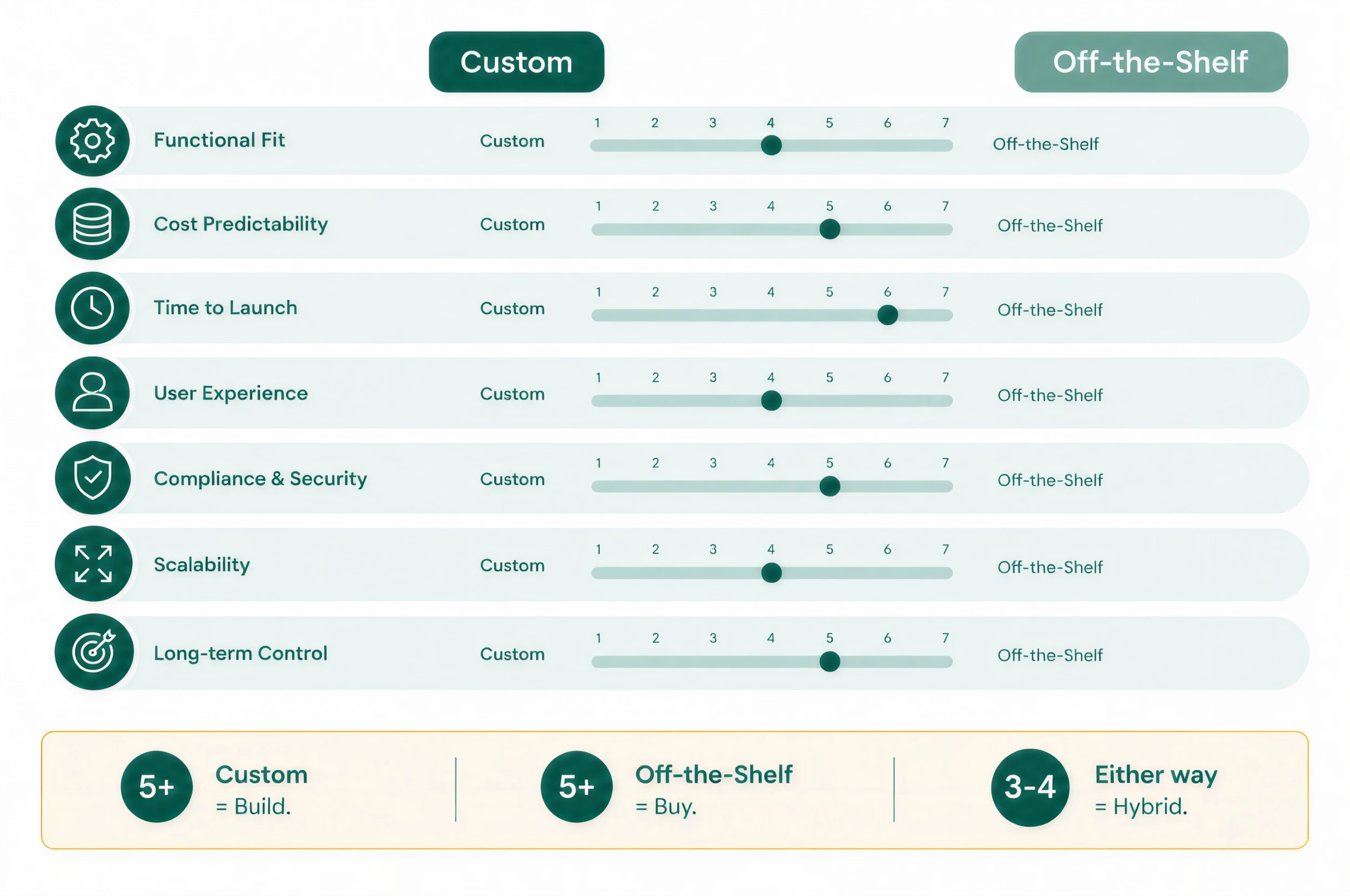
Use these seven questions to determine which approach fits your situation.
Decision factor | Points to custom | Points to off-the-shelf |
|---|---|---|
Is the learning model your IP? | The pedagogical approach is proprietary | Training needs are standard |
Will you sell the platform? | The LMS is a commercial product | The LMS is an internal tool |
What is your user trajectory? | Growing beyond 1,000 users | Stable at under 500 users |
How deep are your integrations? | Multiple institutional systems (MIS, SIS, HR) | Standard LTI/SCORM connectors suffice |
What are your data sovereignty needs? | EU data residency required, full audit control | Vendor's DPA meets your needs |
What is your budget horizon? | Three-to-five-year investment capacity | Need capability within one quarter |
Do you have ongoing technical capacity? | In-house team or retained development partner | No internal or retained technical resource |
Score each factor. If five or more point to custom, build. If five or more point to off-the-shelf, buy. Three to four in either direction suggests a hybrid approach: configure, extend, or integrate.
Still weighing the options?
A Discovery Sprint maps your specific learning model, integration requirements, and compliance landscape to determine whether custom, off-the-shelf, or hybrid is the right path. It turns a strategic guess into a structured decision.
What should you do before committing?
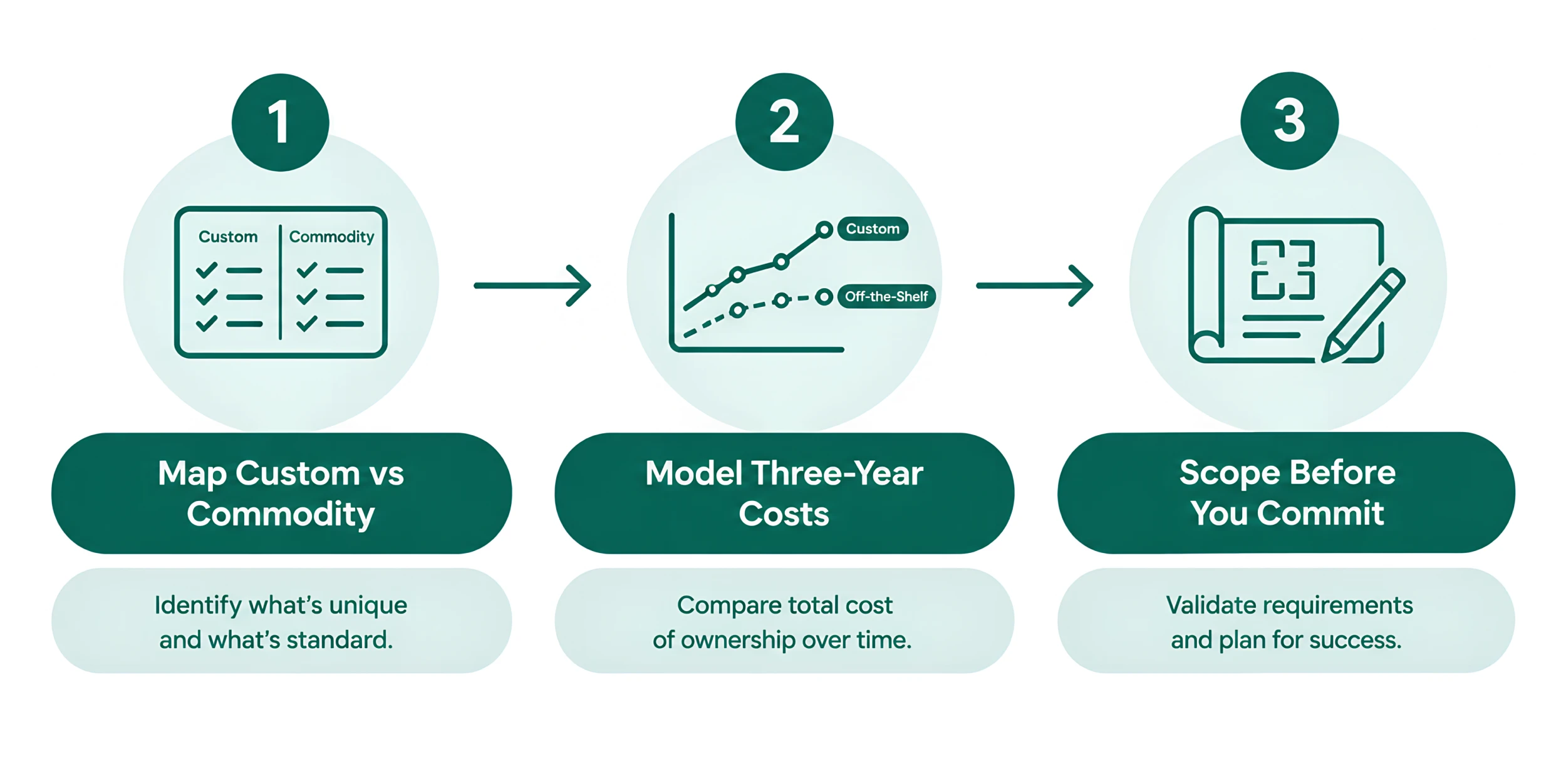
Three steps reduce the risk of an expensive wrong turn.
Map what is genuinely custom and what is commodity. List every feature in your LMS brief. Mark each one as either 'differentiator' (this is why learners choose us) or 'infrastructure' (every LMS has this). Build custom only for differentiators. Use proven tools for everything else. When Square Root Solutions built the Leaving Cert Plus platform, the differentiating features were the curriculum-mapped content model and per-subject entitlements. Standard infrastructure (adaptive video streaming, payment processing via Stripe, push notifications) was handled by established tools, concentrating custom development spend where it mattered.
Run a three-year cost model for both paths. Include build or setup cost, ongoing subscription or maintenance, hosting, customisation work, integration effort, and support. Compare the totals, not the first-year figures. The option with the lower year-one cost is not always the lower three-year cost.
Get a structured scope before you commit. Whether you are leaning toward custom or off-the-shelf, a two-to-four-week Discovery Sprint produces the clarity you need to make the decision with confidence. It maps your learning model against available solutions, identifies the integration requirements, surfaces the compliance obligations, and gives you a realistic budget for each path.
Frequently asked questions
How much does a custom LMS cost to build?
In the Irish market, a narrow LMS MVP typically costs €25,000 to €60,000. A pilot-ready LMS with multi-role support, reporting, and standard compliance runs €60,000 to €140,000. A commercial-grade platform with production scalability and deep integrations sits between €140,000 and €300,000. These figures are from the companion guide, How Much Does EdTech Software Development Cost?, and are indicative estimates based on 2026 Irish market data.
How long does it take to build a custom LMS?
Timelines depend on complexity. A basic LMS MVP takes 12 to 16 weeks. A mid-complexity platform with assessment, reporting, and multiple user roles takes 16 to 22 weeks. A full learning experience platform with adaptive features and deep integrations takes 22 to 32 weeks. These timelines assume a completed discovery phase.
What are the hidden costs of an off-the-shelf LMS?
The most commonly underestimated costs are configuration and onboarding (€3,000 to €35,000), custom report development, integration middleware for systems the platform does not natively support, and the cumulative subscription cost as user numbers grow. Per-user pricing that looks affordable at 200 users can become the largest line item in a training budget at 2,000.
Can you start with off-the-shelf and migrate to custom later?
Yes, but the migration carries its own costs: data extraction and mapping, user re-onboarding, content reformatting, and integration rebuilding. Plan the migration as a project in its own right, not as a background task. Some organisations use the off-the-shelf period to validate their learning model before investing in a custom build, which is a sensible strategy if the migration cost is budgeted from the start.
What is the best LMS for corporate training in Ireland?
There is no single best. For standard compliance and professional development training at scale, established platforms like Moodle, Canvas, or Brightspace offer proven capability. For proprietary training models where the learning experience is the product, a custom LMS built by a development partner with education sector experience is typically the better path. The right answer depends on whether the LMS is infrastructure or product.
Square Root Solutions builds custom learning platforms for EdTech founders and training organisations across Ireland and the UK. Whether you are weighing custom against off-the-shelf, or trying to find the right hybrid, a Discovery Sprint is the starting point: two weeks to map the decision before you commit the budget.