



Most corporate training problems get solved with a platform purchase. A company signs up for a learning management system (LMS, the software used to deliver and track employee training), runs a rollout, celebrates the completion rates, and discovers six months later that nothing much has changed. The knowledge did not transfer. The behaviour did not shift. The investment sits in the system logs as a percentage-complete figure that nobody believes.
The companies that notice this problem early enough to do something about it usually land on the same conclusion: the generic platform was never going to solve a specific problem. Building something custom was always going to be necessary. What they discover next is that building something custom is a different set of decisions from buying something generic, and most of them have never made those decisions before.
This piece is about those decisions. What corporate L&D founders and learning leads get wrong when they build a custom training platform for the first time, why the mistakes cluster in predictable places, and what the builds that actually work have in common.
Key takeaways
The LMS is not the problem. The embedding stage is. Completion rates measure delivery. They do not measure whether the learning changed anything. The gap between those two numbers is where most corporate training investment disappears.
Generic platforms solve generic problems. A platform built for any industry cannot be optimised for the specific knowledge, terminology, and assessment needs of one sector. Vertical specificity is not a feature. It is the product.
Scoping is the build. The most expensive mistakes in custom L&D platform development are made in the first two weeks, not the last two. A rushed brief produces a platform that solves the wrong problem at the correct specification.
Adoption is a product decision, not a change management decision. If a platform requires a change management programme to be used, the platform has a product problem. The Acuru platform achieved 92% learner engagement among Big 4 accounting professionals because the design removed friction rather than requiring staff to overcome it.
The handoff from build to behaviour change is a product surface, not a project milestone. The platform needs to be designed for the Monday after training, not the Friday before it.
Irish L&D leaders are building custom platforms at a different rate than their UK counterparts. The market is smaller, the budgets are tighter, and the sector-specific compliance requirements (particularly in financial services, healthcare, and regulated professions) make off-the-shelf solutions less viable.
Why generic LMS platforms keep failing corporate L&D teams
A generic LMS (Learning Management System) is built to serve every industry equally, which means it serves no industry particularly well. The interface is designed for the broadest possible learner, the content architecture assumes a standard course structure, and the reporting tells you what was clicked, not what was understood.
This is not a criticism of the platforms. It is a description of what they were designed to do. A platform that can serve a pharmaceutical company and a retail chain and a law firm simultaneously is a platform that has optimised for configurability rather than outcome. The price of that configurability is depth.
The problem shows up differently depending on the sector. In professional services, where Ciara McCarthy of Amplify Infrastructure has spent most of her career, the gap appears in the embedding stage. Amplify was founded specifically because McCarthy identified that organisations invest heavily in training delivery and leave the embedding stage unplanned: the period after the learning event where knowledge either transfers into daily practice or slowly disappears. A generic LMS has no surface for that stage. It ends when the course ends.
In financial services and regulated professions, the gap shows up in assessment design. John Kilroy, co-founder of the Digital Learning Institute (DLI, an Irish EdTech company serving clients including NHS, Diageo, and Manchester Metropolitan University), has built programmes where learners need to demonstrate applied judgement, not just recall. A multiple-choice quiz at the end of a module is not assessment. It is a completion mechanism. A platform built for applied understanding requires a different assessment architecture than a generic LMS can typically provide.
The pattern that connects both gaps: a generic platform is optimised for the learning event. A custom platform can be optimised for what the learning event is supposed to change.
The embedding problem nobody budgets for
Training completion rates are the wrong metric. A learner who completes a module has demonstrated that they can navigate a user interface and answer questions in a quiz environment. Whether they can apply what they were taught on a real client project three weeks later is a different question, and most platforms have no way to answer it.
Ciara McCarthy describes this as the core problem her work addresses: organisations invest heavily in change and leave the embedding stage unplanned. The training happens. The follow-up does not. By the time anyone notices that the behaviour has not changed, the training budget has already been spent and the calendar has moved on.
A custom L&D platform that takes embedding seriously looks different from one that does not. It has surfaces for spaced repetition, returning learners to key concepts at intervals after the initial learning event rather than treating the course completion as the endpoint. It has tools for managers to observe and verify application in practice, not just in assessment. It has feedback mechanisms that catch learners who are struggling in the weeks after training, not in the minutes before a quiz.
None of those features are complex to build. They are complex to specify, because they require an L&D team to articulate what they actually want to change in their organisation, not just what they want to teach.
Pro tip. Before writing a brief for a custom L&D platform, write a description of what a learner is doing differently six months after completing the programme. If that description does not change whether the platform is built with scenario-based assessment or multiple choice, the brief is not detailed enough yet.
What vertical means in practice and why it changes everything
A vertical learning platform is one built for a specific industry. The terminology, the scenarios, the assessment questions, the compliance frameworks, and the role-based learning paths are all specific to one sector. A platform built for infrastructure and asset management is not a repurposed generic LMS. It is a different product.
The business case for vertical specificity is straightforward. Generic content produces generic results because learners do not recognise their own context in the materials. A scenario about managing a client relationship reads differently to an accountant than it does to a nurse, even if the underlying skill being developed is the same. A platform that can be configured to serve both is a platform that will be partially relevant to each.
Amplify Infrastructure built in the infrastructure and asset-management sector because McCarthy identified that the knowledge required to work in that sector, the terminology, the regulatory environment, the specific failure modes that matter, not being developed by the generic L&D platforms serving it. The sector-specific gap was not an absence of content. It was an absence of content that practitioners would recognise as reflecting their actual work.
The same dynamic drove the Acuru build. Acuru (formerly Examfly, built by Square Root Solutions) is a learning platform for accounting, tax, and regulatory environments. It serves Big 4 accounting firms (PwC, Grant Thornton, BDO, Andersen, Vialto, and UHY) with short scenario-based exercises built around the specific standards and legislation those professionals work with daily. The adaptive engine detects a struggling concept and reinforces it until mastery is demonstrated, rather than progressing a learner through a standard course regardless of whether the previous material landed.
The outcome of vertical specificity at that level: a 10% improvement in exam pass rates, a 40% reduction in time to mastery, and 92% learner engagement among time-pressed Big 4 professionals. Those numbers do not come from motivation or change management. They come from the design of the product fitting the specific context of the learner.
The four decisions that determine whether a custom build succeeds
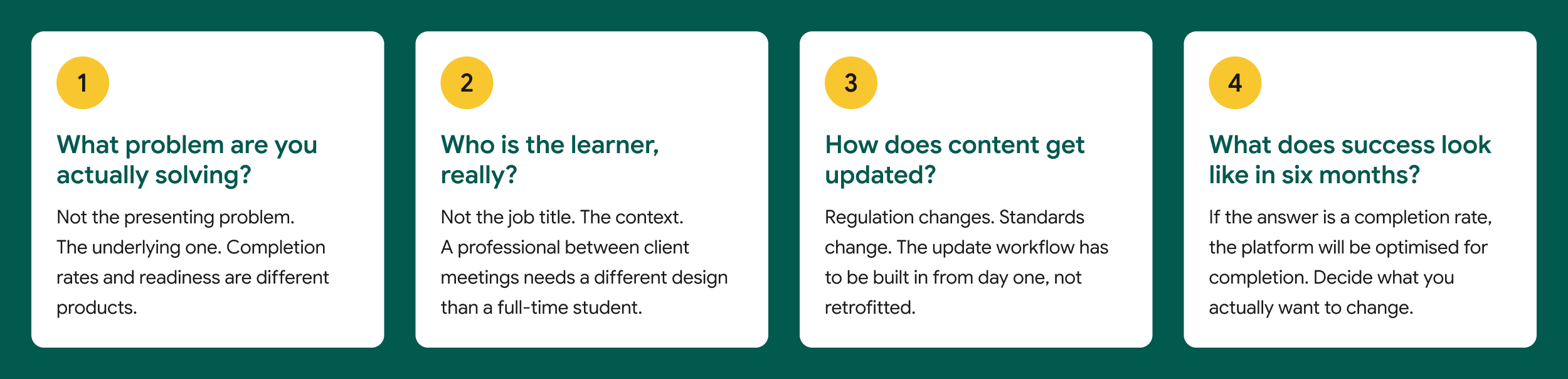
The most expensive mistakes in custom L&D platform development cluster in four decision points. None of them are technical decisions. All of them are made before the first line of code is written.
Decision 1: What problem the platform is actually solving. Not the presenting problem ("our LMS completion rates are low") but the underlying one ("our new joiners are not client-ready in the first six months"). These often require different platforms. A completion problem usually needs better content design. A readiness problem usually needs a different assessment architecture. Conflating the two produces a platform that solves neither.
Decision 2: Who the learner actually is. Not the job title, but the context. A working professional studying between client meetings needs a different interaction design than a full-time learner with a block of time. Deirdre Lyons, founder of Acuru, experienced this directly: studying for a professional qualification while working full time meant every learning session was short, interrupted, and in competition with a cognitive load already spent on real work. That learner context shaped every product decision Acuru makes: short scenarios, no long passive modules, instant feedback, no ten-minute videos that need to be watched in sequence.
Decision 3: What the content model is. How content will be created, maintained, and updated over time is a product architecture question as much as a content question. A platform serving regulated professions needs to update content when regulations change. That update process has to be designed into the platform from day one. Acuru can push centralised content updates to entire client cohorts at once, because regulatory changes need to reach a Big 4 firm's staff simultaneously, not at the rate at which individual learners happen to return to the platform.
Decision 4: What success looks like six months after launch. This is the decision most custom builds skip. If the answer is a completion rate, the platform will be optimised for completion. If the answer is a demonstrated change in client-readiness or exam performance or error rates, the platform needs to be able to measure those things, which changes what gets built at the data layer long before the first user interaction is designed.
If your platform brief doesn’t yet answer all four, a Discovery Sprint with Square Root Solutions will produce them.
It is a two-week scoping engagement that maps the specific problem, the learner context, the content model, and the success metrics before any development begins.
What the scoping process should actually produce
A scoping process for a custom L&D platform should produce four outputs before development starts. If a development partner cannot produce all four, the brief is not finished.
A learner context map. A description of who will use the platform, when, in what environment, on what devices, with what level of cognitive bandwidth available, and what they are trying to achieve. This is not a persona document. It is a design constraint document. The learner context map is what makes a 3-minute scenario the right format and a 45-minute course the wrong one, or vice versa.
A content architecture diagram. How content is structured, how it will be created, who maintains it, and what happens when it needs to change. This is the decision that most custom builds defer until late in development and then spend twice as much time on as planned, because content architecture decisions have downstream effects on the entire database design.
A measurement framework. The specific metrics that will indicate whether the platform is working, mapped to where in the product those signals can be captured. Completion rates are always available. Applied understanding, readiness indicators, and behavioural change require deliberate design to capture.
A build-versus-configure decision for each major feature. For every significant feature in scope, a clear decision about whether it will be built from scratch, configured from a framework, or integrated from a third-party service. This decision has cost, timeline, and maintenance implications that compound significantly when left ambiguous.
The scoping process for a platform of meaningful complexity takes two to four weeks when done properly. Compressing it does not save those weeks. It spends them later, at a higher cost per day and a lower quality of outcome.
What the builds that work have in common
Across the custom L&D platforms that have achieved real adoption (not just deployment, but actual sustained use) a pattern appears that is consistent enough to be instructive.
The learner experience was designed for the learner's actual context, not for the ideal learner. Acuru was designed for a professional trying to study between client calls, not for someone with a clear block of study time. That constraint produced the short-scenario format, the adaptive engine, the instant feedback, and the mobile-first delivery. Every one of those decisions came from taking the learner's actual context seriously rather than assuming the learner would adapt to the platform.
The content model was treated as a product decision, not a content decision. Every platform that has scaled successfully treats content creation, management, and maintenance as a product problem. The Acuru admin dashboard allows the Acuru team and firm L&D leads to push centralised updates when accounting standards or tax rules change, deploying new content across departments, offices, and jurisdictions simultaneously. That feature exists because content currency was identified as a critical need before the product was built, not discovered as a problem after launch.
The assessment design reflected the performance that mattered. The platforms that achieve meaningful outcome improvements (measurable changes in exam pass rates, client readiness, or error rates) use assessment that reflects the actual performance required. Acuru's continuous assessment of applied understanding (not course completion) is what produces the 10% exam pass rate improvement. The assessment design and the outcome improvement are the same decision.
The embedding stage was designed into the product, not left to a change management workstream. The platforms that sustain usage beyond the initial rollout have designed the embedding stage as a product surface. Spaced repetition, manager visibility, progress tracking across cohorts, and capability gap identification are all features that serve the period after the learning event. They are not afterthoughts. They are the point.
What to do before the first sprint
If a custom L&D platform is in scope for the next twelve months, four things should happen before the first development sprint begins.
Write the six-month success description. In concrete terms, not metrics. What does a learner do differently? What does a manager see differently? What does a client experience differently? That description will shape every subsequent decision about the platform.
Map the learner context. Spend time with actual learners in their actual environment. Not in a focus group. In the moment when they would use the platform, with the distractions they would have, on the device they would use. What a learner says they want in a focus group and what they need in a 90-second window between client calls are different things.
Separate the content problem from the platform problem. A platform that does not have good content will not work regardless of how well it is built. A content library that is not served by a well-designed platform will not be used regardless of how good the content is. Both need to be solved. Neither solves the other.
Run a scoping engagement before committing to a build. The decisions described in this piece are not decisions a development partner can make on your behalf. They require the knowledge that sits inside your organisation: your learners,, your content, your compliance environment, and your performance goals. A scoping engagement is how that knowledge gets surfaced and turned into a build that solves the right problem.
Frequently asked questions
When does it make sense to build a custom L&D platform rather than buying an existing one?
When the specific requirements of your learners, content, or sector cannot be met by a configurable generic platform without compromising on the things that matter. The decision usually becomes clear when you map what you actually need against what the generic platform actually provides and find that the gap is in the core product, not in the configuration layer. For highly regulated sectors, sector-specific terminology, or assessment requirements that need to reflect genuine applied understanding rather than course completion, custom is almost always the right answer.
How long does a custom L&D platform take to build?
A meaningful platform with a proper scoping process, a clear content model, and a considered assessment architecture takes four to nine months from the first sprint to a stable production release. Platforms that skip the scoping phase tend to take longer and cost more, because the decisions that were deferred come back as build problems rather than design decisions.
What is the right size of organisation to justify a custom build?
The question is not about size but about the cost of the learning gap the platform is intended to close. A 200-person firm in a regulated profession where employees who are not up to standard create client risk or regulatory exposure can justify a custom build at a lower headcount than a 2,000-person organisation in a sector where the cost of the learning gap is lower. The calculation is: what does the learning gap cost us, and how much does closing it change that figure?
How should we think about content creation for a custom platform?
Content architecture and content creation should be scoped as part of the platform build, not after it. The platform's content model (how content is structured, versioned, and updated) determines what is possible at the content layer. Platforms that defer content architecture until after the technical build is complete almost always discover that the technical build made assumptions that constrain the content in ways that matter.
What separates a custom L&D platform that gets adopted from one that does not?
Learner context. Platforms that were designed for the learner's actual environment (the time available, the device, the cognitive bandwidth, the competing demands) achieve adoption. Platforms that were designed for the ideal learner and then deployed to actual learners frequently do not. The Acuru platform achieves 92% learner engagement among Big 4 accounting professionals because it was designed for someone studying in short windows between client work, not for someone with a clear study day.
What compliance considerations apply to corporate L&D platforms in Ireland?
The primary compliance considerations are data protection (GDPR, the EU General Data Protection Regulation) and, for regulated sectors, sector-specific requirements. An L&D platform processing employee learning records holds personal data that requires a lawful basis, a data protection impact assessment (DPIA, a formal assessment of privacy risks required before processing high-risk data), and clear data retention and deletion procedures. For financial services, healthcare, and regulated professions, the compliance layer is more extensive and should be scoped from day one rather than added at the end of the build.
If the decision between generic and custom is still open, the scoping conversation usually settles it. The cost of the learning gap, the specificity of the sector, and the requirements of the embedding stage together produce a clear answer in most cases.
Or, if you are working through the four decisions described in this piece and want a mapped view of what the right build looks like for your specific context, a complimentary Discovery Sprint with Square Root Solutions produces that in two weeks. Book a Discovery Sprint