



A student sits a reading test on paper. She underlines a word twice, crosses out an answer, writes a small note in the margin explaining why she changed her mind. None of that gets scored. All of it tells the assessor something the final mark alone does not. Digitise the same test badly and the underlining, the crossing out and the margin note disappear along with the paper. What is left is a cleaner number and a thinner picture of the student who produced it.
For most schools that is an inconvenience. For a student applying for an exam access arrangement, extra time, a reader, a scribe, because a learning difficulty makes the standard format unfair, it can be the difference between a request that is granted and one that is not. A paper process captured that evidence almost by accident. A digital one has to capture it on purpose, or it quietly stops existing.
Every EdTech founder building an assessment, screening or evaluation product eventually has to answer the same design question: what did the paper version do that the digital version now has to do deliberately. This piece is about what actually gets lost in that move, who has already solved it well, and what to check before a paper process gets ported onto a screen.
Key takeaways
A paper assessment carries signal a digital form does not automatically keep. Workings, margin notes, timing flexibility and the assessor's holistic read of context all have to be designed back in. None of them survive a straight port from paper to screen.
Education Elephant's SWIFT platform is a working example of holding onto that evidence. Built by two educational psychologists and launched in December 2024, it was designed specifically to keep the evidence a school needs for an exam access arrangement, not just produce a faster score.
Not everything paper captured is worth keeping. Illegible handwriting, physical storage risk and marking delay are administrative noise. Working shown, accommodation evidence and holistic context are judgement signal. Confusing the two is the most common design mistake.
CJ Fallon's EduSmart Planner shows the same discipline applied beyond scoring. It replaced paper-based curriculum planning for 4,500+ Irish teachers across 250+ schools without changing the exact format inspectors and principals expect, and cut administration time by 75%.
The fix is architectural, not cosmetic. A judgement-preserving digital design needs a structured capture field for reasoning, an accommodation flag set at the point of testing rather than requested later, and an audit trail a reviewer can actually read back.
What actually disappears when a paper assessment moves onto a screen
Four things routinely go missing. The visible trail of a student's thinking goes first: crossings-out, workings in the margin, a half-answer that shows understanding even though the final response is wrong. The assessor's holistic read of context goes next: a bad day, a known difficulty, a pattern the assessor has seen in this student before that a single score cannot carry. Paper's built-in flexibility goes third: extra time on paper is just more time, a scribe just writes, nothing in the format itself has to know an accommodation happened. And the informal evidence base that an access-arrangement application will need later goes fourth, because nobody wrote it down at the point it was true.
A digital form, built without thinking about any of this, captures the final answer and nothing else. Paper, almost by accident, captured the process that produced it.
Which of it is safe to lose, and which of it decides an outcome
Not all of it matters equally, and treating everything as sacred is as big a mistake as treating nothing as sacred. Illegible handwriting, the risk of a physical paper going missing, and the delay before a stack of scripts gets marked are administrative noise. Digitising those away is a genuine improvement with no real cost. Working shown, accommodation evidence and holistic context are judgement signal. Digitising those away without a deliberate replacement changes the outcome for the student on the other end of the process.
Signal | Paper assessment | Naive digital port | Judgement-preserving digital design |
|---|---|---|---|
Working shown | Visible in the margin | Rarely captured | A structured working field, tagged to the question |
Accommodation evidence | Written at the point of testing | Requested later, from memory | Captured in the same session as a flag with a short reason field |
Timing flexibility | Just more time | A fixed timer built into the form | A configurable timer per learner profile |
Holistic context | In the assessor's head, sometimes on the page | Lost entirely | A free-text note visible only to the moderator |
Defensibility | The paper itself is the record | A score with no reasoning | A logged decision trail a reviewer can read back |
Pro tip. An access-arrangement form only needs one field a paper process never explicitly had: a short free-text reason the assessor writes at the point of testing, not weeks later during an appeal. Design that field into the capture flow and the evidence base gets stronger than paper ever made it. Leave it out and the evidence quietly gets thinner than paper made it, and nobody notices until an appeal is refused.
How Education Elephant designed SWIFT to keep the evidence, not just the score
Education Elephant built SWIFT to preserve exam access-arrangement evidence through digitisation, not just to speed up marking. Education Elephant was co-founded by Rebecca Good and Dr Kate James, sisters who are both educational psychologists and who spent years running paper-based standardised assessments for schools before building the software. That background shows up directly in the product brief.
SWIFT launched in December 2024 for students aged 11 to just under 15, with a second release in early 2025 extending it to ages 16 to 18. It is built to standards set by JCQ (the Joint Council for Qualifications, the group of UK examination boards that governs the process for exam access arrangements), so a school running SWIFT can still produce the same category of evidence a paper-based reading, spelling or processing-speed test would have produced for a Form 8 application, a scribe, extra time or a reader.
The company's earlier product, SPaRCS (Spelling, Processing Speed, and Reading Comprehension Speed, Education Elephant's original pen-and-paper screening test), was already accepted as access-arrangement evidence in the UK's JCQ process and Ireland's RACE scheme (Reasonable Accommodations at the Certificate Examinations, run by the State Examinations Commission, the Irish body that administers the Junior Cycle and Leaving Certificate exams). SWIFT's brief was not to replace that evidence with a faster number. It was to keep producing the same category of evidence digitally, at a scale paper could not reach.
Education Elephant now supports 1,500 schools worldwide and is forecasting more than 50% growth in 2026 on the back of SWIFT's launch, according to thinkbusiness.ie. That is a founder-led product decision paying off commercially, not just a compliance box being ticked.
What breaks when a digitisation project treats an assessment as a data-entry problem
This is the failure list, the part most vendor content skips because it is uncomfortable to publish.
A single rigid input format erases partial-credit reasoning. If the form only has a box for the final answer, the working that would have earned partial marks on paper simply never gets captured.
There is no field to capture context at the point of testing. The assessor's justification for an accommodation gets written weeks later during an appeal, from memory, instead of at the moment it was true, and the evidence is measurably weaker for it.
Auto-scoring gets presented as more precise than it is. A human assessor would have flagged genuine ambiguity in a borderline answer. An automated score often just picks a number and moves on, and nobody downstream knows the ambiguity existed.
There is no audit trail a reviewer can actually use. If a parent or a school appeals a decision, the platform needs to show why the decision was made, not just what the decision was. A score with no reasoning behind it is not defensible in the way a paper script, however messy, always was.
Accommodation handling gets bolted onto a generic form as an afterthought instead of being designed into the capture flow from the start. This is the single most common mistake, and it is almost always a sequencing problem rather than a technical one: accommodation logic gets added in a later sprint, after the core assessment flow is already locked in.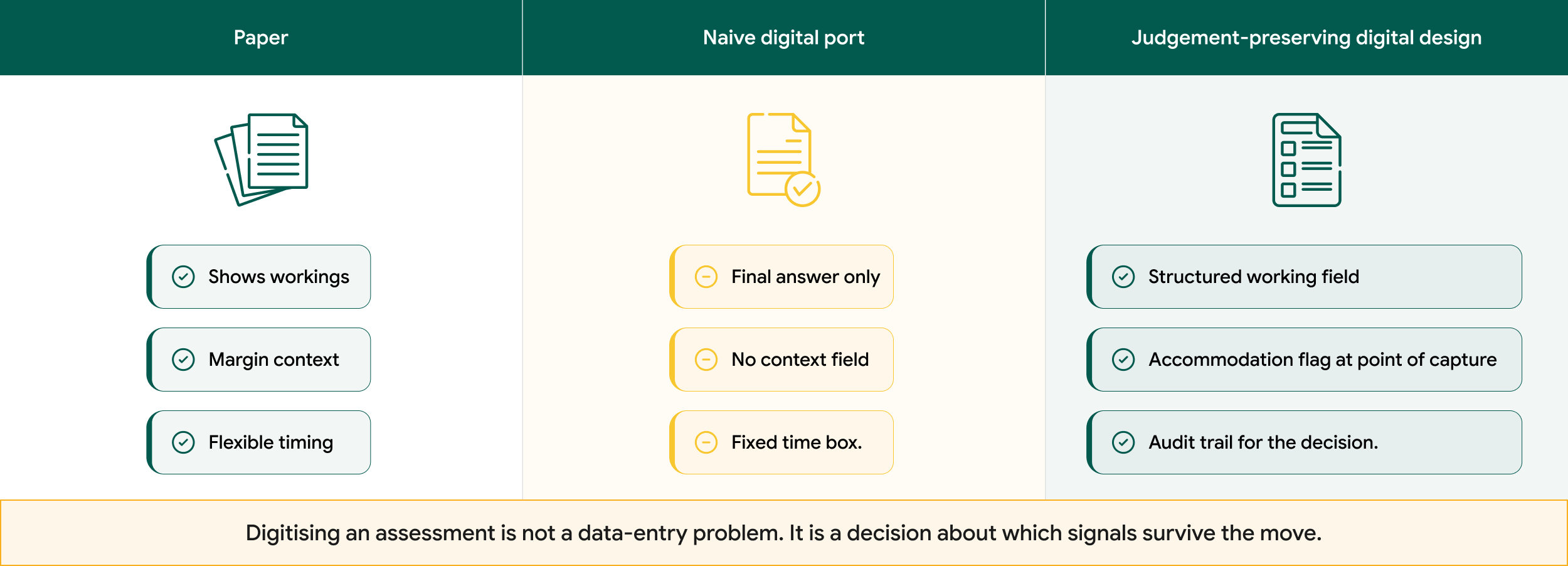
If your assessment platform can't show its working, neither can the school.
A Discovery Sprint maps where a paper process's judgement signal needs to survive digitisation, before the data model gets built around a final score alone.
What a paper-based process looks like once it is redesigned properly for a screen
The same design discipline applies to any paper-based judgement record a school keeps, not only to exam scripts.
CJ Fallon, one of Ireland's most prominent educational publishers, commissioned EduSmart Planner to replace paper-based curriculum planning across its partner schools. The brief was not to invent a generic digital planning template. It was to reproduce the exact monthly format Irish primary schools are required to complete, Cuntais Mhiosúla (the monthly planning record every Irish primary school must submit against the national curriculum), inside a system a teacher could use every week rather than once a term.
The platform now runs across 250+ schools and 4,500+ teachers, and schools using it report 75% less time spent on curriculum and plan management. Aine Leacy, Digital Product Manager at CJ Fallon, has described the platform as earning "overwhelmingly positive educator feedback." That result did not come from making planning faster in the abstract. It came from keeping the specific format a principal and an inspector already expect to see, and building the AI assistance around that format rather than around a generic template a founder assumed schools would accept.
Where the human judgement layer actually has to sit in the architecture
This is not a UI decision. It is an architecture decision, and it has to be made before the data model is fixed.
OnWard Education, a Dublin-headquartered MedEdTech (medical education technology) company, faced a version of the same problem in clinical training. Medical students record patient encounters as bullet points, full sentences, or a recorded audio note, because that is how the work actually happens on a ward. The platform resolves any of those formats into one standardised report, using AI to compare what the student actually asked against an admin-defined question set for that diagnosis. The AI does not replace the clinical supervisor. It surfaces the gap between what was asked and what should have been asked, and gives the student a structured prompt before the next encounter.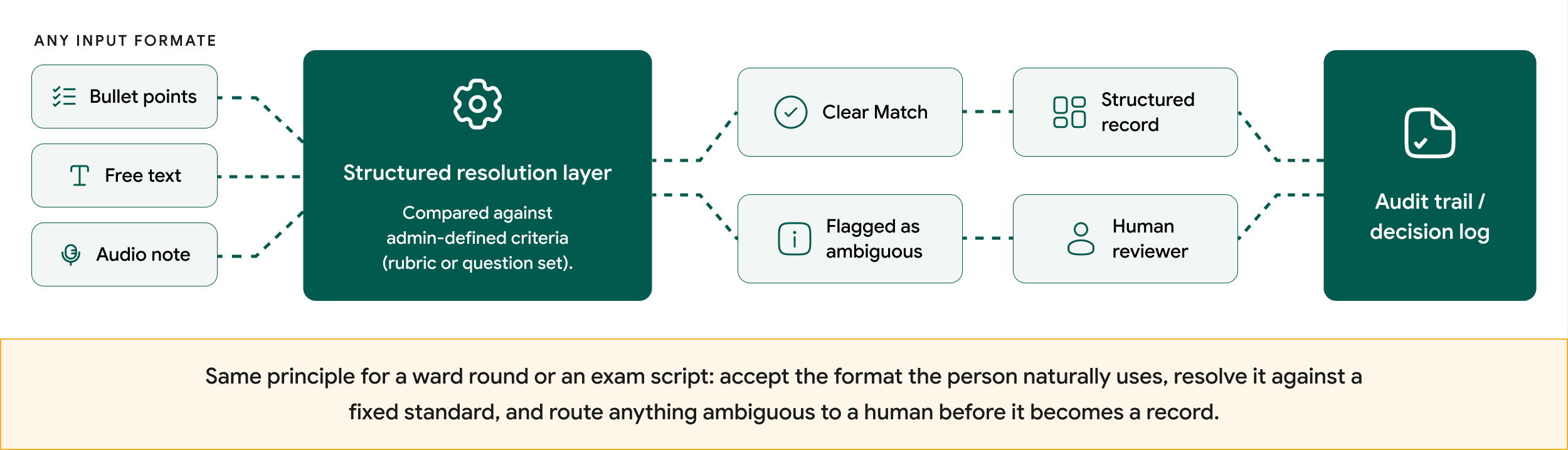
The design principle transfers directly to school assessment: accept whatever input format the person providing evidence would naturally use, resolve it into one structured, comparable record on the backend, and keep a human reviewer in the loop for anything the system flags as ambiguous rather than letting a score stand in for a judgement nobody actually made. That only works if the admin-defined comparison criteria (the rubric, the question set, the marking scheme) are built as a first-class, editable part of the system, not hardcoded into the scoring logic where nobody can inspect them later.
What to check before you digitise a paper-based assessment or planning process
Catalogue what the paper version currently captures beyond the final score or the final entry. Workings, margin notes, timing adjustments and verbal context all count, even if nobody has ever written them down as a formal requirement.
Separate administrative noise from judgement signal using the distinction above. Anything that is genuinely just friction (illegible handwriting, physical storage, marking delay) is safe to remove. Anything that carries a decision is not.
Design the capture format for the judgement signal specifically, not just for the final answer. A working field, an accommodation flag set at the point of testing, and a moderator-only context note are three concrete fields, not abstract principles.
Build a moderation or audit layer with a named human role attached to it, before launch, not as a fix once a complaint arrives.
Test the redesigned process with the practitioners who ran the paper version, before it replaces paper entirely. They will notice what the brief missed faster than any amount of internal QA (quality assurance) will.
The Ireland-specific rule that a UK-built assessment tool usually misses
An assessment platform built around JCQ's access-arrangement process will not automatically satisfy an Irish school. Ireland runs its own scheme, RACE, administered by the SEC (State Examinations Commission, the state body responsible for the Junior Cycle and Leaving Certificate exams), and RACE has its own eligibility criteria, its own evidence requirements, and its own review timeline separate from JCQ's.
The scale of this is not small. Roughly 26% of candidates sitting the Irish state examinations in 2025 had an accommodation granted under the RACE scheme, and in 2026 the Department of Education introduced an interim measure granting around 30,000 candidates an additional ten minutes per written paper, according to a Department of Education press release. An assessment product that only maps its evidence fields to JCQ's Form 8 requirements will produce evidence an Irish school cannot use to support a RACE application, no matter how good the underlying test is.
The same split runs through data protection. An Irish school's data goes through the DPC (Data Protection Commission, Ireland's GDPR regulator), not the UK's ICO (Information Commissioner's Office). A platform's DPIA (Data Protection Impact Assessment, the formal review of privacy risk required before processing high-risk personal data) has to be written for the regulator the school actually answers to. Building for the UK market first and assuming Ireland is close enough is one of the most common and most avoidable mistakes an EdTech founder makes when expanding across the Irish Sea.
Frequently asked questions
What is digital assessment in schools, and how is it different from an online form?
A digital assessment platform administers, scores and reports on a standardised test through software rather than on paper. It is different from a plain online form because a properly designed one captures the same judgement-relevant evidence a paper process captured, workings, context and accommodation evidence, rather than just the final score. A form that only records the final answer has automated the test without preserving what the test was actually for.
Why does digitising an assessment risk losing evidence for exam access arrangements?
Paper assessments capture accommodation-relevant evidence almost incidentally, in an assessor's margin notes or in the physical fact that extra time was simply given. A digital form only captures what it was explicitly designed to capture. If nobody builds a field for accommodation evidence at the point of testing, that evidence is not delayed, it never exists, and a later access-arrangement application has to rely on memory instead of a contemporaneous record.
What is Education Elephant's SWIFT platform and how does it protect that evidence digitally?
SWIFT is a digital assessment platform built by Education Elephant, launched in December 2024 for students aged 11 to just under 15 with a further release in early 2025 extending it to 16 to 18 year olds. It is designed to standards set by JCQ so that a school running assessments through SWIFT can still produce evidence suitable for an access-arrangement application, rather than losing that evidence in the move from paper to screen.
Should an EdTech founder replace a paper process outright, or run the digital version alongside paper first?
Running both in parallel for at least one assessment cycle is the safer route for any process where the paper version was carrying judgement signal, such as exam access arrangements or curriculum planning records an inspector will review. It lets the practitioners who ran the paper version flag anything the new design missed before the paper safety net disappears completely.
What is the difference between the UK's JCQ access arrangements and Ireland's RACE scheme, and why does it matter for an assessment product?
JCQ (the Joint Council for Qualifications) governs the UK's access-arrangement process for GCSEs and A-levels. RACE (Reasonable Accommodations at the Certificate Examinations) is Ireland's separate scheme, run by the SEC, with its own eligibility criteria and evidence requirements for the Junior Cycle and Leaving Certificate. An assessment product built only around JCQ's evidence format will not automatically produce evidence an Irish school can use for a RACE application, which matters directly for any UK-built platform expanding into the Irish market.
Square Root Solutions builds custom assessment, planning and screening platforms for EdTech founders and the schools they serve, designed around what the practitioners administering them actually need to keep. Read how that discipline played out for CJ Fallon in the EduSmart Planner case study.
Read next: EduSmart Planner case study: replacing paper-based curriculum planning for 4,500+ Irish teachers
Or, if a paper-based process in your own product still needs a digital design that keeps its judgement intact: