


What experienced teachers understand about technology adoption that EdTech companies often learn too late
In the 2005/06 school year, Department of Education inspectors sat at the back of Irish primary classrooms and counted how often computers were actually used. The answer, published in the Inspectorate's 2008 evaluation of ICT (Information and Communication Technology) in schools, was 22% of the lessons they observed. At post-primary level, the same report put effective integration at roughly 11% of lessons. The equipment was arriving. The practice was not keeping up.
A teacher who stood in front of one of those classes has since lived through interactive whiteboards, cloud platforms, a pandemic that moved every lesson online overnight, and now generative AI (artificial intelligence that produces text, images or plans on request). Each arrived with a promise. Each met the same timetable, the same thirty children and the same Wi-Fi.
So when an EdTech (educational technology) founder pitches the next tool, that teacher is not hearing it for the first time. They are hearing a version of a story they already know the ending to. This piece asks whether that experience makes them better judges of technology, what the Irish evidence actually shows, and what founders, product teams and investors should take from it.
Key takeaways
The same gap keeps reappearing. Irish schools have repeatedly had more technology than they used well, from the 2005/06 Inspectorate fieldwork to the 2025 evaluation of the Schools Excellence Fund.
Documented Irish teacher criticism is mostly about conditions, not change. When the Department of Education asked teachers in 2021, they named broadband, time, devices and support, not a dislike of technology.
Experience is not the same as better technology judgement. Newer teachers report more digital confidence. Experienced teachers bring context. A product team needs both.
Generative AI repeats the old pattern with one new problem. The adoption gap is familiar. The threat to coursework authenticity is not, and it is where Irish teacher concern is concentrated.
Classroom-product fit is a separate test from winning the buyer. A product can pass procurement and still fail on Monday morning if it ignores timetables, support, reliability and evaluation.
What have Irish teachers actually lived through since the late 1990s?
Irish teachers have lived through at least five distinct waves of school technology in under thirty years, and each one was funded, promoted and then absorbed into ordinary practice at a slower pace than promised.
The early investment was large. According to the Inspectorate's 2008 report, the Schools IT 2000 programme (1998) and the Blueprint for the Future of ICT in Irish Education (2001) put tens of millions of euro into equipment and connectivity, followed by a national schools broadband programme in 2005. The same report found that interactive whiteboards were in about 2% of primary schools and 5% of post-primary schools at the time, and that the lack of technical support and maintenance was a significant impediment.
Then came the Department's Digital Strategy for Schools 2015 to 2020 and its Digital Learning Framework, which asked schools to evaluate how technology affected learning rather than count devices. From 2018, the Schools Excellence Fund Digital and STEM programme (STEM meaning science, technology, engineering and maths) funded clusters of schools to try new approaches together.
In spring 2020, every Irish classroom went remote at once. That was not a product test. It was an emergency, and teachers learned a great deal about which tools held up under pressure and which did not.
The current wave is shaped by the Digital Strategy for Schools to 2027, published in April 2022, and by the Guidance on Artificial Intelligence in Schools the Department of Education and Youth published on 21 October 2025.
Whiteboards are the clearest example of a full cycle. Rare in 2005, they are now so ordinary that nobody thinks of them as EdTech at all. What changed is that the technology stopped being the point.
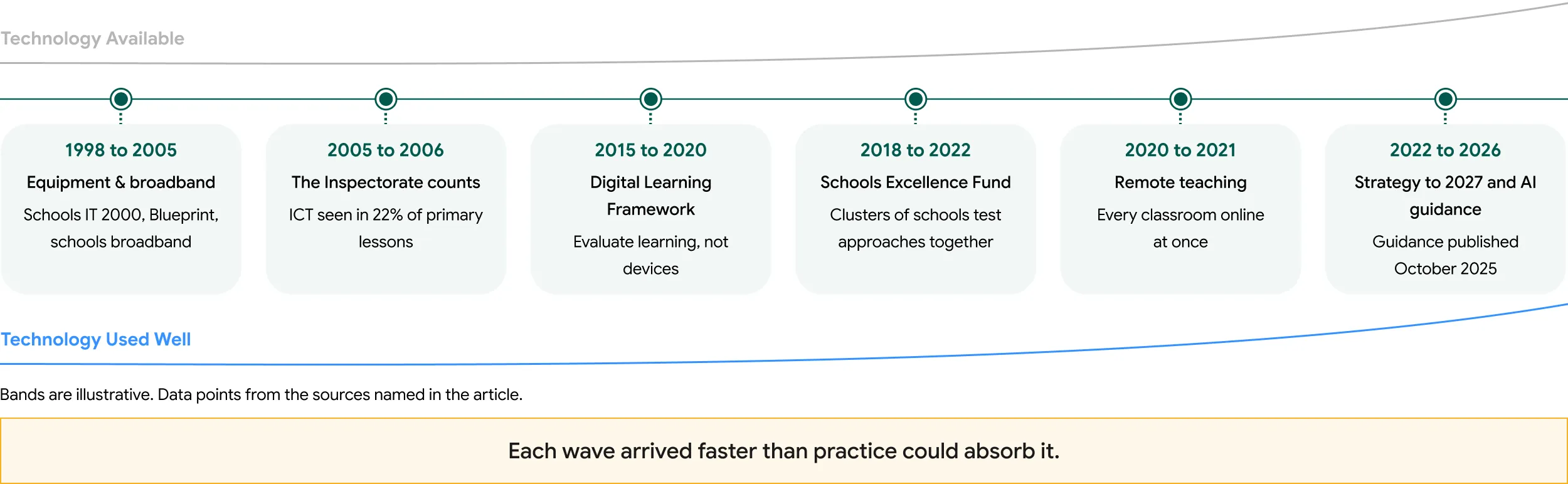
Each wave arrived faster than practice could absorb it.
Why does the gap between having technology and using it keep coming back?
The gap keeps coming back because most waves were measured by what arrived in schools, not by what changed in lessons, and the conditions that decide use (time, support, reliability, a clear purpose) rarely arrived with the equipment.
The Irish record makes this unusually visible. The 2008 Inspectorate report measured it directly in classrooms. Nearly two decades later, the September 2025 final evaluation of the Schools Excellence Fund Digital and STEM programme, published by the Department of Education and Youth, found that only 11% of participating clusters referred to evaluating their work. The evaluation also found that sustained use depended on consistent staffing, clear goals, continued funding and ongoing support.
None of those four things appears in a product specification. All four decide whether the product is still in use in year two.
The OECD (Organisation for Economic Co-operation and Development) reached a similar conclusion in its 2025 report on digital technologies and learning in Ireland, commissioned by the Department. The Department's summary of that report puts it plainly: moderate, purposeful use of digital tools can improve learning, and the benefit depends on strong teaching and careful planning around the tool.
Read those findings together and the pattern is hard to miss. The technology is rarely the failure point. The missing piece is almost always the work around it.
What is teacher scepticism usually objecting to?
Documented Irish teacher scepticism mostly objects to the conditions around technology (connectivity, time, devices, support and data protection), not to technology itself.
The clearest evidence comes from the teacher questionnaire run for the consultation on the current strategy, published on the Digital Strategy for Schools to 2027 page. Around 658 teachers took part. They named broadband, lack of time, access to devices, resources for SEN (special educational needs) and GDPR (the General Data Protection Regulation, the EU data protection law) as barriers. What they asked for was dedicated technical support, training time inside the school day and advice on buying the right products.
The sample was self-selected, so it is not a census of Irish teacher opinion. But the requests are specific, practical and very familiar to anyone who has tried to run a lesson on a laptop trolley.
Education researchers have a useful name for this. Peggy Ertmer's widely cited 1999 paper in Educational Technology Research and Development separates first-order barriers (external things like equipment, time, training and support) from second-order barriers (internal things like beliefs about teaching and confidence). A later review of 48 studies by Khe Foon Hew and Thomas Brush found resources, knowledge and skills, and attitudes and beliefs to be the most commonly cited barriers.
Most of what Irish teachers told the Department sits firmly in the first-order column. That matters for founders. A first-order objection is a product and service problem. It can be designed for.
Pro tip. When a teacher says 'this won't work here', ask one follow-up question: 'What would have to be true for it to work?' The answer is usually a first-order condition you can design for, such as a login flow, an offline mode or twenty minutes of training inside the timetable.
What do experienced teachers see that a product demo cannot show?
Experienced teachers see the conditions a demo removes: the full class, the timetable, the unreliable connection, the student who finds the one distracting feature, and the evening admin the product quietly adds.
It is worth being careful here. No study has shown that living through several technology cycles makes teachers better judges of technology. That is a hypothesis, not a finding. What the evidence does support is that teachers hold a specific kind of knowledge that product teams usually lack.
Classroom knowledge. A teacher knows what happens when thirty students, a forty-minute period and a login screen meet. A demo shows one user on a fast connection.
Implementation knowledge. They know that the first week of a new platform is not the same as the sixth. The Schools Excellence Fund evaluation found that some participants questioned training delivered by the vendors of the technology being trained on, and preferred peer-led and in-school models. That is a view held by a subset of respondents, not a majority finding, but it is a signal worth hearing.
Workload awareness. They can tell whether a tool saves time or moves it. A product that shortens a lesson task but adds twenty minutes of setup at home has not saved anything.
Student awareness. They know how students actually behave with a device, which is rarely how a product designer imagines it.
Memory. They remember what the last three platforms promised, and what happened to the work stored in the one that stopped trading.
This is where Ciarán Stone's position is useful to describe plainly. Ciarán has taught at a DEIS (Delivering Equality of Opportunity in Schools, the Irish government programme for schools in disadvantaged areas) school in Dublin 12 for over a decade, and also leads Square Root Solutions, which builds EdTech platforms. He is not a neutral observer. But he sees both sides of the conversation this piece is about: the pitch, and the Monday morning it has to survive.
Sean Glynn, Chief Learning Officer at Wriggle Learning, put the same idea in one line that has been reported by educationawards.ie among others: 'Technology doesn't transform education, teachers do.'
When is teacher scepticism wrong?
Teacher scepticism is wrong when it rests on untested beliefs about what a technology can do, rather than on evidence about fit, support and outcomes.
This section matters, because an argument that treats every teacher objection as correct is as lazy as one that treats every objection as resistance.
Ertmer's second-order barriers are real. Beliefs about how teaching should work are harder to see and harder to change than a missing charger, and some researchers argue they matter most. A product that genuinely helps can still be rejected because it does not match how someone thinks a lesson should feel.
Experience also cuts both ways. The same 2008 Inspectorate report found that recently qualified teachers rated their own ICT skills higher than experienced colleagues did, and were more likely to use ICT for lesson planning. Those are self-perceptions, and confidence is not the same as effective use. But it is a reminder that experience and digital fluency are different assets. Newer teachers bring tool fluency. Experienced teachers bring context. The strongest product feedback comes from both.
There is also a clean counterexample from England. In a randomised trial published by the Education Endowment Foundation (EEF) in December 2024, 259 science teachers across 68 secondary schools planned Year 7 and 8 lessons. Those given ChatGPT and a guide cut weekly planning time from 81.5 minutes to 56.2 minutes, a saving of about 25 minutes, and reviewers found no noticeable difference in quality, though the researchers cautioned that the quality sample was small.
A sceptic who said 'this will not save me any time' was wrong for that task. A sceptic who said 'I would need support to use it properly' was right: the teachers had a guide to work from before the trial began.
The useful question, then, is not whether a teacher is sceptical. It is which kind of barrier sits behind the scepticism.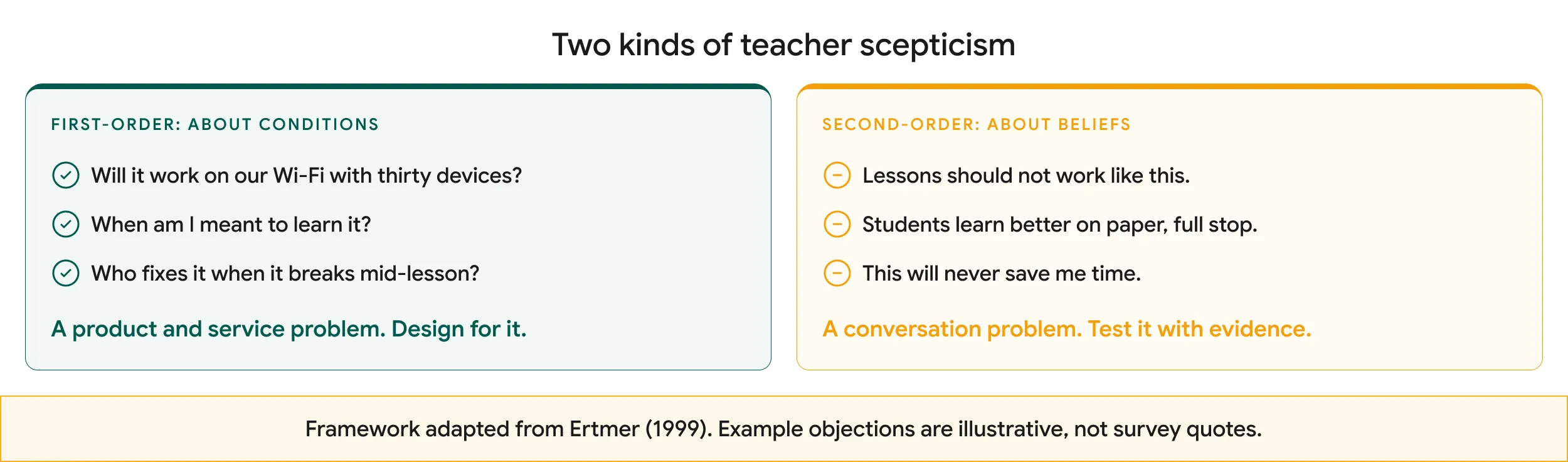
Most documented Irish objections sit on the left. That is good news for product teams.
Is generative AI a new cycle or the same one again?
Generative AI is the same cycle in one important way and a genuinely new one in another: the gap between access and good use is familiar, but the direct threat to assessment is not.
Irish policy has moved quickly. The Department's Guidance on Artificial Intelligence in Schools describes itself as a living document and places the teacher as the final checkpoint on anything AI produces. Its practice questions ask how a teacher would evaluate whether AI actually improved learning, which is exactly the question an experienced sceptic would ask. On 7 April 2026, the Department announced an AI in Schools External Advisory Taskforce with assessment, including state-certified assessment, as its first priority. According to Mary Immaculate College, it held its first meeting on 14 May 2026.
That focus follows teacher concern. In a February 2026 survey of 1,591 members of the ASTI (Association of Secondary Teachers, Ireland), carried out by the research company RED C, an overwhelming majority of teachers said they expect difficulty confirming that coursework was completed solely by the student. In business, 95% disagreed that they would have no difficulty. The concern is sharp because Leaving Certificate students in redeveloped subjects now complete an AAC (Additional Assessment Component, a coursework element marked outside the final exam) that carries a large share of the final grade.
| What feels familiar | What is genuinely new |
Adoption | Access is ahead of confident, purposeful use | The tool is general-purpose and already in students' pockets |
Evidence | Strongest for teacher time on bounded tasks (EEF trial) | Little independent evidence yet for AI tutoring, marking or personalisation |
Risk | Training and support gaps, unequal access | Coursework authenticity, hallucination, bias, deepfake bullying |
Regulation | Guidance arrives after the tools do | EU rules for high-risk education AI now apply from 2 December 2027 |
That last row matters for anyone building AI features for schools. The Department's October 2025 guidance cites August 2027 as the date the EU AI Act applies in full. Since then, Regulation (EU) 2026/1744, in force from 27 July 2026, moved the deadline for stand-alone high-risk systems, which include AI used to evaluate learning outcomes in education, to 2 December 2027. The guidance predates the change, so a product team reading it today needs to read it alongside the amended regulation.
What an experienced teacher brings to AI is not a verdict. It is a set of questions. What problem does this solve? Who checks the output? Where does the student data go? How will we know if learning improved? They are the Department's own questions, and they are the right ones for a product team to answer before launch.
What does classroom-product fit mean for founders, CTOs and investors?
Classroom-product fit means a product survives daily use by a real teacher and a real class under real constraints, which is a different test from convincing a principal, a board of management or a procurement officer to buy it.
It is our term, not an academic one. We did not find a research source that defines the distinction. It rests on the evidence above: the Schools Excellence Fund finding that sustained use depended on staffing, goals, funding and support, and the OECD's point that benefit depends on purpose and planning. A product can pass every buyer test and fail all four.
Test | Winning the buyer | Classroom-product fit |
Who decides | Principal, board, procurement officer | Teacher and students, every day |
What is judged | Features, price, compliance, curriculum match | Setup time, reliability, workload, learning |
When it is proven | At signature | In the sixth week, and in year two |
What failure looks like | A lost deal | Quiet abandonment after the licence is paid |
Each audience reading this has a version of the same question to ask:
Founders: what would a teacher have to stop doing for this product to fit their day?
CTOs (chief technology officers): how does it fit the logins, devices and MIS (management information system, the school's core database) the school already runs? In Irish primary schools that usually means Aladdin, and at post-primary it usually means VSware or Compass.
Investors: what is the evidence of learning, not just usage?
Implementation and referral partners: who supports the school after go-live, and what happens to the data if the vendor stops trading? The Schools Excellence Fund evaluation records a learning platform ceasing to trade during a funded project.
This is the argument behind how EduSmart Planner was built for CJ Fallon. The platform produces Cuntais Mhiosúla (the monthly planning record required by the Irish primary curriculum) in the format principals expect, rather than a generic lesson plan, and it is now used by more than 4,500 teachers in over 250 schools, with schools reporting 75% less time on curriculum and plan administration, according to the EduSmart Planner case study. Nothing about that is clever engineering. It is a decision, made early, to design around the document a teacher already has to produce.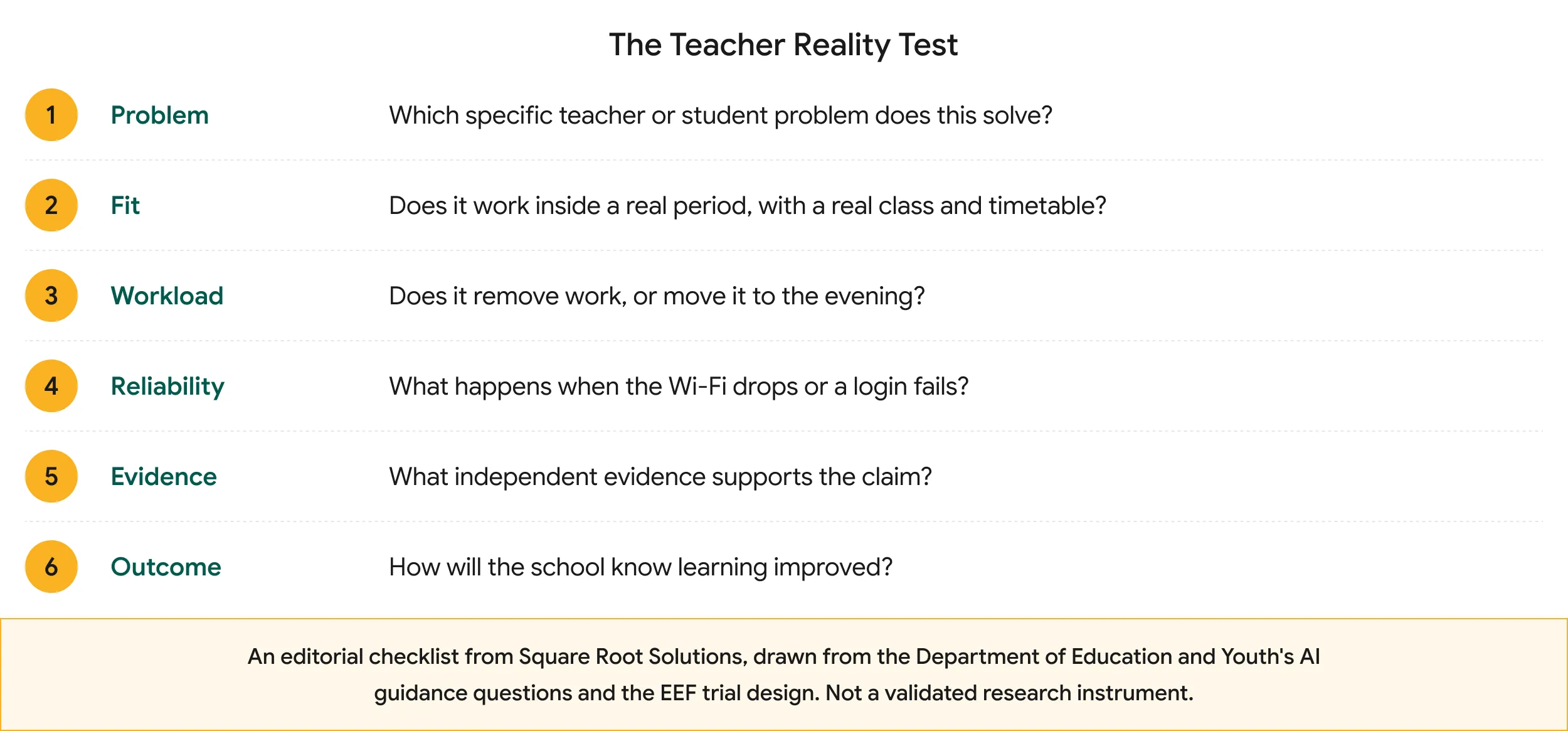
Six questions an experienced teacher is already asking, whether or not anyone hands them a checklist.
If your roadmap was written without a teacher in the room, test it now.
A Discovery Sprint with Square Root Solutions takes your product brief through these six questions with the practitioners who will use it, and turns the answers into architecture, integration and workflow decisions before any code is written.
What should an EdTech team do before the next build?
Before the next build, an EdTech team should involve experienced teachers at the brief stage, design for the conditions teachers name, and decide how it will prove learning, in that order.
Bring teachers in before wireframes, not at beta. Late-stage pilots find usability problems. Early conversations find the wrong product. The evidence for formal co-design is modest, so treat it as good practice, not a guarantee.
Read feedback as workflow signals. 'It takes too long' usually means a specific step, at a specific point in the day. Find the step.
Ship the support, not just the software. Irish teachers asked for technical support and training time inside the school day. Budget for both, and consider teacher champions over vendor-led sessions.
Design for verification. If your product uses AI, make the output easy to check and correct. The teacher is the final checkpoint under Irish guidance, so build for that role.
Build evaluation in from day one. Only 11% of Schools Excellence Fund clusters referred to evaluation. A product that measures its own effect on learning is rare, and schools notice.
Plan for your own exit. Data portability and a clear handover path answer the question experienced teachers ask quietly: what happens to our work if you disappear?
Push back where the evidence says to. When feedback is a preference for the old way rather than a problem with the new one, test it. Challenge feedback with evidence, not with enthusiasm.
Pro tip. Before a pilot, ask the school which technology it stopped using in the last three years, and why. The answer tells you more about your adoption risk than any feature request.
None of this treats teachers as an obstacle to get past. It treats them as the people who will decide, one lesson at a time, whether the product becomes ordinary infrastructure like the whiteboard or another login nobody remembers.
Frequently asked questions
Why do experienced teachers criticise EdTech products?
In Ireland, the documented criticism is mostly about conditions: connectivity, time, devices, support and data protection. A 2021 Department of Education consultation with around 658 teachers found them asking for technical support, training time inside the school day and procurement advice. That is criticism of implementation, not of technology itself.
Are teachers who have seen several EdTech trends better judges of new technology?
There is no study proving it. Experienced teachers hold detailed knowledge of classroom constraints and implementation, while the 2008 Inspectorate report found recently qualified teachers rated their own ICT skills higher. The most useful product feedback comes from combining both kinds of knowledge rather than ranking one above the other.
What is classroom-product fit in EdTech?
Classroom-product fit is Square Root Solutions' term for whether a product survives daily use by a real teacher and class, as distinct from winning over the buyer. It depends on setup time, reliability, workload and evidence of learning. The September 2025 Schools Excellence Fund evaluation found that sustained use in Irish schools depended on staffing, clear goals, funding and support.
How are Irish teachers responding to AI in schools?
Irish teacher concern about AI is concentrated on assessment. A February 2026 ASTI and RED C survey of 1,591 teachers found an overwhelming majority expect difficulty confirming that coursework is solely the student's own work. The Department of Education and Youth's AI in Schools External Advisory Taskforce, announced in April 2026, lists assessment as its first priority.
Does AI actually save teachers time?
For bounded tasks with support, the best evidence says yes. A December 2024 Education Endowment Foundation trial in England found science teachers using ChatGPT with a guide saved about 25 minutes a week on Year 7 and 8 lesson planning, with no noticeable quality difference. The trial measured teacher time, not student attainment.
When do EU AI Act rules apply to AI in education products?
Regulation (EU) 2026/1744, in force from 27 July 2026, moved obligations for stand-alone high-risk AI systems, which include some uses in education, to 2 December 2027. The Department of Education and Youth's October 2025 guidance predates that change and cites an earlier date. Founders should check the current text of the regulation and take legal advice for their specific product.
The teachers who have watched every wave arrive are not waiting for technology to fail. Most of them are waiting for it to arrive with the conditions that make it work. Products built with those conditions in mind tend to become ordinary, and in schools, ordinary is what success looks like.
Square Root Solutions builds custom education platforms for EdTech founders in Ireland and the UK, led by a CEO who still teaches every week. Our forthcoming whitepaper looks at what actually happens when AI meets a real teacher.
Or, if you would rather test your own product against classroom reality now:
A product that wins the buyer can still lose the classroom.
A Discovery Sprint with Square Root Solutions maps where your brief meets real teacher conditions in two weeks, before any code is written.