



An IT director on a sales call asks one plain question: does this replace our MIS, or sit beside it. A founder who has not named their product's category cannot answer that cleanly, and the call rarely recovers from the pause that follows.
An LMS (Learning Management System, the platform teachers and students use to deliver and consume lessons and coursework), a School Management System, and a Learning App each answer to a different buyer, sit in a different relationship to the school's MIS (Management Information System, the school's core system of record for students, timetables, attendance and reports), and carry a different compliance load. Get the category wrong at the start and the mistake gets built into the pricing model, the integration scope and the data protection review before anyone notices.
This is a category guide, not a build guide, for a founder who needs to name what they are actually building before the roadmap gets written.
Key takeaways
The three categories answer different questions, not different versions of the same question. An LMS answers "did the learner master the material." A School Management System answers "is this administrative process accurate and defensible." A Learning App answers "did this one skill improve."
The category decides what you must connect to on day one. A School Management System usually has no choice but to talk to the MIS. An LMS can often sit beside it for a while. A Learning App frequently never needs to touch it.
Almost no successful Irish or UK EdTech product is a pure category. Most borrow a feature or two from another. The founders who move fastest name which category is primary before they borrow anything.
What is an LMS, a School Management System, and a Learning App?
An LMS answers one question for an enrolled group of learners: did they master the material. It owns the coursework loop, content, enrolment, grading and progress tracking, for people enrolled by someone else, a school, a firm, a training provider. Acuru, built for accountants and other professional services staff, runs scenario-based exercises across accounting standards and tax legislation and reports capability firm-wide by grade, office and service line; firms using it report a 10% improvement in exam pass rates and a 40% cut in time to mastery.
A School Management System answers whether one administrative process, admissions, attendance, timetabling, billing, is accurate and defensible, not whether anyone learned anything. Because that process usually produces data the school already keeps elsewhere, the product typically has no choice but to integrate tightly with the MIS or become a module of it. NameDown runs the entire admissions cycle for Irish schools, application forms, selection criteria, a digital lottery for oversubscribed places, waiting lists and offers, and exports the finished record to POD (the Primary Online Database, the Department of Education's central record of primary pupils), PPOD (its post-primary equivalent) and the school's MIS. It never delivers a lesson.
A Learning App answers whether one specific skill improved, taught or drilled directly to a learner, usually outside the school relationship entirely. Leaving Cert Plus sells bite-sized video lessons, notes, flashcards and exam questions directly to secondary school students on a subscription. It serves over 25,000 students without ever integrating with a single school's MIS, because the student holds the account, not the school.
LMS vs School Management System vs Learning App, side by side
Learning Management System | School Management System | Learning App | |
|---|---|---|---|
Question it answers | Did the learner master the material | Is this process accurate and defensible | Did this one skill improve |
Typical buyer | The institution or firm running the programme | The institution's admin team or leadership | The learner or a parent |
MIS integration | Often useful, rarely mandatory on day one | Usually mandatory, sometimes becomes part of the MIS | Rarely needed |
Sales cycle | Weeks to months, institutional procurement | Months, tied to a compliance or admissions window | Days to weeks, consumer-style |
Pro tip. If a feature only exists to make a spreadsheet or a filing cabinet disappear, it is a School Management System feature, whatever the roadmap calls it. Sort every request this way before it reaches the backlog.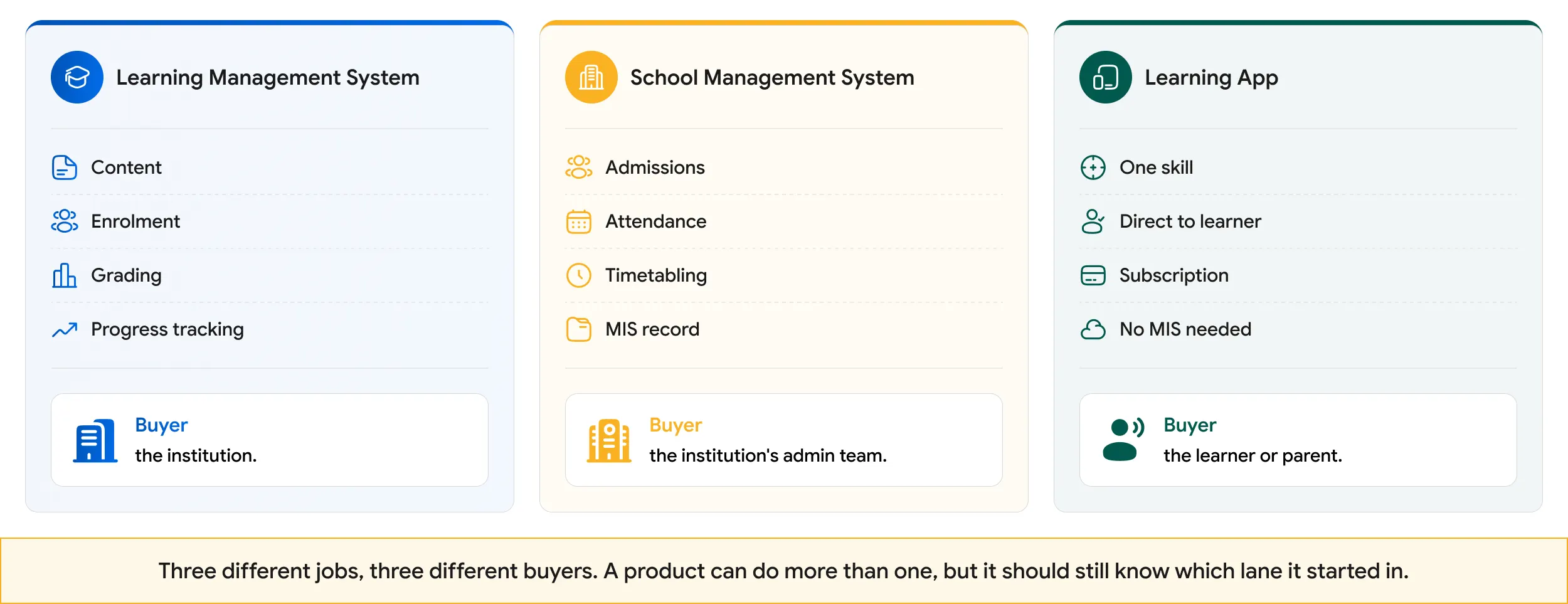
The three-test check for naming your category
Run a product idea through three tests, in order, before the roadmap gets written.
The buyer test. Who signs the contract, and are they the person who uses the product day to day? A parent or learner paying directly pulls toward a Learning App. A school's admin team or leadership pulls toward a School Management System or an LMS.
The loop test. What does the product do, every day, for the account holder? Delivering and grading content is an LMS loop. Recording and reporting on one administrative process is a School Management System loop. Teaching or drilling one skill is a Learning App loop, regardless of who is paying.
The system-of-record test. Does the product need to become the definitive record for data the MIS already holds, or does it only need to read from that data occasionally, or not at all? Becoming the definitive record is a School Management System commitment. Reading occasionally is an LMS pattern. Needing nothing from the MIS is the clearest Learning App signal there is.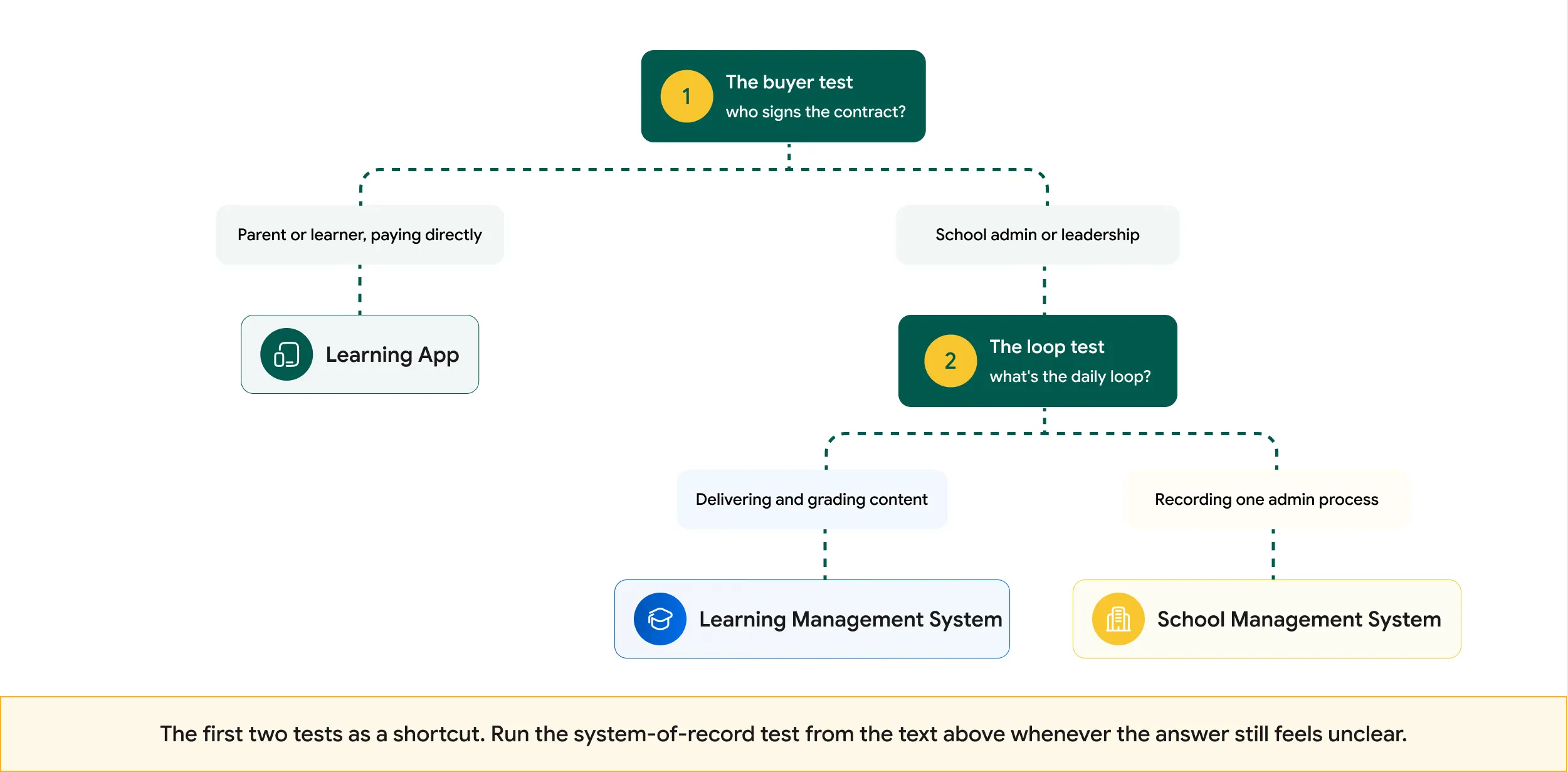
What breaks when a product refuses to pick one
The daily loop gets diluted. A product trying to deliver coursework, run admissions and drill exam skills at once rarely does any of the three as well as a founder who picked one and built it properly.
The compliance load becomes the union of all three, not the sum of the easiest parts. Holding coursework data, a core administrative student record and payment data at once means clearing the highest bar each category sets, simultaneously, from the first release.
The buyer gets confused, and confused buyers do not sign. An IT lead evaluating MIS integration, a Head of Teaching and Learning evaluating coursework tools, and a parent evaluating a subscription app are three different conversations. One pitch trying to land all three usually lands none of them.
It does not have to end there. MLI International Schools runs admin, scheduling, grading and mobile apps across eight or more language-teaching centres in Ireland and the UK, and on paper looks like exactly this trap. It avoids it because the build named a primary system of record first, centralised course, level and centre management, and layered scheduling and grading on top of that one record, rather than building three competing systems and gluing them together afterwards.
Why the pick matters most in Ireland
The category decision has an immediate, practical consequence in Ireland: whether Aladdin, the MIS Aladdin's own site reports is used daily in 90% of Irish primary schools, sits on your integration roadmap for launch or for year two.
A School Management System selling into Irish primary schools has to plan for Aladdin from the first release, because it is either replacing or feeding data a principal already expects to see there. An LMS can often stay MIS-agnostic for longer. A Learning App, in most cases, never needs to touch it.
The same pick drives the DPC (Data Protection Commission, Ireland's GDPR regulator) conversation. The closer a product sits to School Management System territory, holding a child's core administrative record, the more likely it is to need a full DPIA (Data Protection Impact Assessment, the formal review of privacy risk required before processing high-risk personal data) before a school will sign. A Learning App holding a student's name, email and payment details carries a materially lighter version of that same conversation.
Frequently asked questions
What is the difference between an LMS and a School Management System?
An LMS answers whether a learner mastered the material, through content, assignments, grading and progress tracking. A School Management System answers whether one administrative process, such as admissions or attendance, is accurate and defensible, and usually has to integrate with or become part of the school's MIS.
Can one product be both an LMS and a School Management System?
Yes, but it works best when one is built as the primary system of record and the other as a layer on top of it. MLI International Schools does this: a School Management System core with LMS-style scheduling and grading layered on it, reading from one underlying record.
Does a Learning App need to integrate with a school's MIS?
Usually not. A Learning App is typically bought directly by a learner or a parent, so it rarely needs to read from or write to the school's administrative record at all.
How do I know which category my EdTech product idea actually falls into?
Run it through the buyer test, the loop test and the system-of-record test. Who signs the contract, what the product does every day for the account holder, and whether it must become the definitive record for data the school's MIS already holds. The three answers almost always point to one primary category.
Square Root Solutions has built Learning Management Systems, School Management Systems and Learning Apps across Ireland and the UK, and naming which category comes first is usually the first real decision in scoping any of them. Read how that decision played out for MLI International Schools in the MLI International Schools case study.