



Every assessment platform founder has had the same conversation in the past two years. A school, a university, or a professional body asks: "Can your platform detect AI-generated work?" The question sounds reasonable. The answer almost every founder gives is: "We are working on it."
This post argues that working on it is the wrong decision, and that building AI detection into your assessment platform will not protect the schools using it, will not satisfy the regulators governing it, and will damage the credibility of your product with the buyers who understand this space best.
That is a strong claim. Here is the evidence behind it.
Key takeaways
The regulatory position in both Ireland and the UK is that AI detection tools are unreliable and should not be the primary response to AI in assessments. QQI's NAIN (National Academic Integrity Network) and the UK's JCQ (Joint Council for Qualifications) both say this explicitly.
AI detection tools produce false positives at a rate that creates real legal exposure. A student wrongly flagged as having submitted AI-generated work has grounds for a formal complaint that most EdTech platforms are not equipped to defend.
The institutional buyers who understand this space have already stopped asking for detection. Universities that have engaged seriously with the problem have moved to assessment redesign, not detection tooling.
Building AI detection into your platform is a feature that dates badly, costs continuously, and generates liability. The detection arms race moves faster than any EdTech vendor's update cycle.
What actually works is assessment design that makes AI submission irrelevant. Platforms that support this design are where the defensible product opportunity sits.
What the regulators actually say about AI detection
The most important thing to understand about the regulatory position in Ireland and the UK is that neither regulator has endorsed AI detection tools as a solution to AI in assessments. Both have instead focused on assessment design and human judgement.
In Ireland, QQI's National Academic Integrity Network developed guidelines for educators on responsible AI use in teaching, assessment, and research in 2023, and published a strategy running to 2028 that focuses on policy, practical supports, and awareness rather than technical detection. The NAIN guidelines, which apply to every publicly funded higher education institution in Ireland, do not recommend deploying AI detection tools. They recommend assessment redesign.
In the UK, the JCQ's guidance on AI use in assessments is the authoritative document for every school and college in England, Wales and Northern Ireland running GCSEs, A-levels and vocational qualifications. The JCQ guidance states that AI detection tools can be instructed to employ different languages and levels of proficiency when generating content, and that some AI tools can produce quotations and references, making automated detection unreliable. The JCQ guidance has been updated and will continue to be updated as developments in AI tools and detection tools evolve, which signals that the regulator is watching the space closely rather than committing to any particular technical approach.
Neither regulator has told schools to buy an AI detection tool. Both have told schools to rethink how they design assessments.
What this means for your platform: if the regulators your customers are accountable to do not endorse AI detection as the right response, building it into your product does not make your product more compliant. It adds a feature your buyers will eventually have to answer for.
Why AI detection tools fail in the classroom
The technical case against AI detection is straightforward and well-documented.
AI detectors work by identifying statistical patterns in text that correlate with machine-generated output. The problem is that those patterns overlap significantly with the writing of students who are not native English speakers, students with dyslexia and other processing differences, and students who write in a plain, direct style. A student writing in their second or third language is consistently flagged at higher rates than a native speaker writing the same AI-generated content with minor edits.
Stanford University's Human-Centered AI group published research in 2023 showing that GPTZero, one of the most widely used detectors at the time, incorrectly classified 61% of essays written by non-native English speakers as AI-generated. That number has improved in successive versions of detection tools, but the underlying problem has not gone away, because the statistical signature of clear, simply structured writing looks the same whether it comes from a machine or from a student who has learned to write plainly.
The detection accuracy problem is compounded by how quickly AI models are updated. A detection tool trained on GPT-4 output is partially obsolete the week GPT-4o is released. No EdTech vendor has an update cycle that keeps pace with the major AI labs. The arms race is not winnable from the platform side.
Pro tip. Ask any AI detection vendor for their false positive rate on non-native English speaker text. If they cannot give you a number, the tool has not been tested properly. If they can, calculate what that rate means across a cohort of 500 students and ask how many wrongful accusations you are comfortable processing in a term.
The legal and liability problem nobody mentions
Building AI detection into an assessment platform transfers a significant portion of the malpractice investigation burden from the institution to the platform vendor, and most platform vendors have not thought through what that means.
When a detection tool flags a student's work, the institution has to act on it. That action, whether a formal investigation, a grade penalty, or a failed submission, creates a paper trail that points back to the tool that generated the flag. If the student appeals, which they are entitled to do under the formal malpractice procedures of every major awarding body in Ireland and the UK, the institution needs to defend the original flagging decision. That defence requires evidence that the detection tool is reliable, independently validated, and applied consistently.
No currently available AI detection tool meets all three of those criteria simultaneously. Which means the institution is defending an action based on a tool it cannot fully vouch for, and the platform that provided the tool is in the conversation.
In the UK, Ofqual published a policy paper in April 2024 outlining their approach to AI, and the formal malpractice procedures that govern every JCQ-affiliated institution require documented evidence of misconduct before sanctions can be applied. An AI detector flag is not documented evidence. It is a probability score from a model. The two are not the same thing, and the institutions that have tested this distinction in appeal proceedings have found it matters.
In Ireland, QQI's framework for academic misconduct investigation requires that the institution can demonstrate the student had a fair process. A detection tool that flags non-native speakers at higher rates than native speakers does not support a fair process.
For EdTech founders: this is not a theoretical risk. It is the reason several UK universities quietly removed AI detection integrations from their VLE (Virtual Learning Environment) plugins in 2024 after early deployments generated appeal caseloads they were not staffed to manage.
What the institutional buyers have already figured out
The conversation in higher education has moved. The schools and universities that engaged most seriously with AI in assessment in 2023 and 2024 are not asking for better detection tools in 2025. They are asking for assessment designs that make detection unnecessary.
The shift happened because the evidence accumulated. Detection does not work reliably. It generates appeals. It disproportionately affects certain student groups. And it does not address the actual problem, which is that assessments designed around a take-home essay submitted once, with no process trail, were already vulnerable to contract cheating before AI existed. AI just lowered the cost and raised the volume.
The institutions that have moved forward are doing three things instead of building detection: designing assessments with process components that are hard to fake (intermediate submissions, in-session verification, oral components), asking students to submit AI interaction logs alongside their work where AI use is permitted, and using existing academic integrity frameworks more rigorously for the subset of cases that genuinely need investigation.
In the UK, Universities UK published a framework in 2023 that explicitly positions assessment redesign as the primary institutional response to AI, with detection as a secondary and unreliable supporting tool at best.
The professional body market, which is a significant segment for assessment platforms in Ireland, has moved in the same direction. Bodies setting assessments for accounting, law, medicine and engineering have largely concluded that closed-book, supervised, time-limited assessments are the most defensible format under current AI conditions, and that the value of their qualification is better protected by making AI irrelevant to the assessment than by trying to detect its use after the fact.
What a school or professional body buyer actually wants from your platform in 2025 and 2026 is not detection. It is tools that make their assessment design more defensible without detection.
What to build instead: integrity by design
The platform opportunity is not detection. It is the infrastructure that makes assessment integrity demonstrable without a detector.
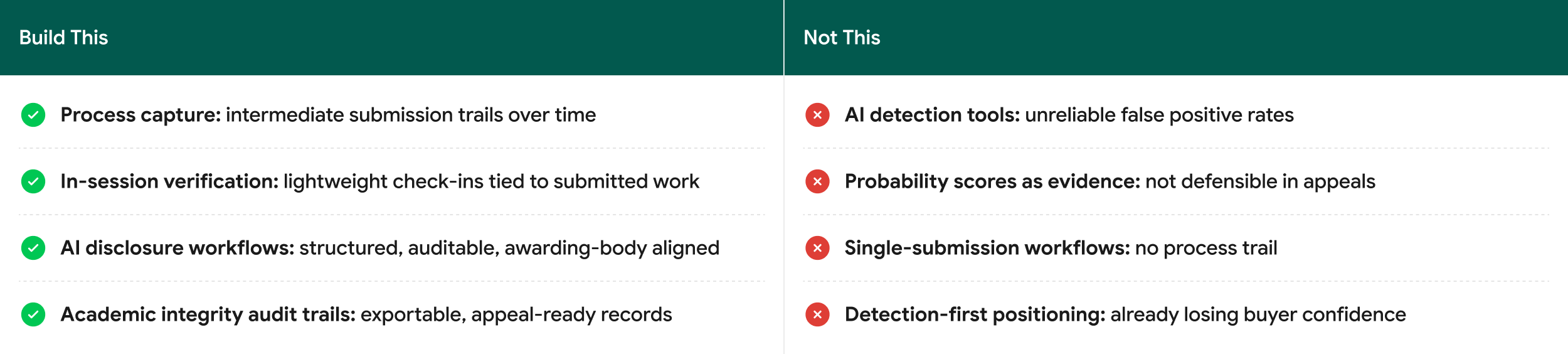
Four features address the actual problem:
Process capture. The ability to record intermediate stages of student work over time, not just the final submission. A student working on a coursework project over six weeks leaves a different kind of evidence trail than one who submits in the final twenty-four hours. Platforms that surface that trail give assessors real evidence rather than a probability score.
In-session verification. Short, synchronous check-ins where a student demonstrates understanding of their submitted work. This is already used in viva voce examinations at postgraduate level. Bringing a lightweight version of it into coursework assessment is both feasible and increasingly expected by awarding bodies.
AI use disclosure workflows. In many assessments, limited AI use is now explicitly permitted. A platform that makes disclosure easy, structured, and auditable serves the institution better than one that tries to detect undisclosed use. The JCQ guidance already acknowledges that students may legitimately use AI tools if they reference the use appropriately. Building that referencing into the submission workflow is a product feature, not a policy document.
Academic integrity audit trails. The ability to produce a clear, exportable record of everything that happened during an assessment, for any submission, at any time, without needing to trigger a formal investigation. This is what appeals require, and it is what most platforms cannot currently produce without significant manual effort.
EduSmart Planner, the AI curriculum planning tool we built for CJ Fallon, was scoped specifically around the question of what AI should do in an Irish classroom context. The brief was not "detect AI use." It was "remove a specific administrative burden from a teacher's day without asking them to change their behaviour." The result is a tool that 100+ Irish schools use because it solves a problem they actually have, not a problem vendors assumed they had.
Working out where AI detection sits on your platform roadmap and what to build instead?
We offer a complimentary Discovery Sprint assessment: a mapped view of what your assessment platform's integrity features should include, what the Irish and UK regulatory position actually requires, and what your buyers will ask for in the next procurement conversation.
What this means for your assessment platform roadmap
The practical implication of everything above is a straightforward product decision.
Remove AI detection from your roadmap if it is there. Not because it is technically impossible, but because it is a feature that will generate more liability, more false positives, more appeals, and more buyer scrutiny than it will generate value. The market has not rewarded it. The regulators have not endorsed it. The institutional buyers who understand the space are not asking for it.
Replace it with the four features described above: process capture, in-session verification, AI disclosure workflows, and academic integrity audit trails. These features are harder to build, less easy to demo, and more defensible in every conversation with every buyer in every market you are selling into.
Frequently asked questions
Do Irish schools and universities need AI detection tools?
The regulatory guidance from QQI's National Academic Integrity Network does not recommend AI detection tools as the primary institutional response to AI in assessments. The guidance focuses on assessment redesign and the application of existing academic integrity frameworks. Schools and universities that have deployed detection tools in the absence of redesigned assessments have generally found the tools generate more problems than they solve.
What does the JCQ say about AI detection for UK schools?
The JCQ's guidance on AI use in assessments, updated in April 2025, acknowledges that AI detection tools exist but does not endorse them as reliable mechanisms for identifying AI misuse. The guidance focuses on what assessors should look for in student work and how centres should update their malpractice policies. A detection tool flag is not itself evidence of malpractice under JCQ procedures.
Can an AI detector flag a student who did not use AI?
Yes, and at a rate that is not negligible. Research from Stanford University's Human-Centered AI group found false positive rates of 61% or higher for non-native English speakers on widely used detection tools. The rates have improved on more recent tools but the underlying problem has not been solved, because plain, clearly structured writing produces similar statistical signatures regardless of whether it was written by a person or a machine.
What should an assessment platform do instead of AI detection?
The four features with the strongest regulatory alignment and buyer demand are: process capture (recording intermediate stages of student work over time), in-session verification (lightweight synchronous check-ins tied to submitted work), AI disclosure workflows (structured submission processes for assessments where AI use is permitted), and academic integrity audit trails (exportable records that can support an appeal investigation without manual reconstruction).
Does building AI detection into an assessment platform create legal risk?
It creates liability exposure that most EdTech platforms have not designed for. When a detection tool flags a student's work and the institution acts on that flag, any subsequent appeal traces back to the tool. If the tool cannot demonstrate it is reliable, independently validated, and applied consistently, the institution is in a difficult position and the platform that provided the tool is in the conversation. Several UK universities removed AI detection integrations from their VLE platforms in 2024 for this reason.
Is there a market for AI integrity features in Irish and UK EdTech?
Yes, but it is a market for assessment design infrastructure rather than detection tooling. The buyers who understand this space are asking for features that make their assessments more defensible: process trails, verification workflows, disclosure mechanisms, and audit-ready records. These are harder to build than a detection integration and harder to demo, but they are what the market will ask for in every serious procurement conversation in 2025 and 2026.
This argument is not about whether AI in education is a problem. It is about which part of the problem is yours to solve.
The assessment platform's job is not to catch students using AI. It is to give institutions the infrastructure to design assessments where catching is not required.
Get that right and detection becomes irrelevant. Get it wrong and you have built a feature that will generate appeals, cost you in maintenance, and date badly as the AI models it was trained on are superseded.
Read next: how the AI features that actually survive in Irish and UK classrooms are built, and what separates them from the ones that get ignored after week one. Sign up for early access to our whitepaper: AI in Irish and UK EdTech: What Actually Works When It Meets a Real Teacher
Or if you want a view of where your current assessment platform sits against what the Irish and UK regulatory frameworks actually require, we offer a complimentary Discovery Sprint assessment. Book a Discovery Sprint