



Beyond the bold founder story: what Irish EdTech evidence tells us about product, market, team, timing and execution
Every startup ecosystem has a favourite founder story. Someone leaves a safe job, bets the house, ignores the sceptics and wins. It makes a good keynote.
It is a poor guide to education technology (EdTech) in Ireland, where the buyer is often a principal with a fixed budget, the user is a teacher with forty minutes and a full timetable, and the contract may be decided by a public tender two years from now.
Look at who has actually built durable EdTech companies here and a different picture forms. Learnosity spent roughly eleven years essentially bootstrapped before taking outside investment. Deirdre Lyons had lectured for the Irish Tax Institute before founding Examfly. Dr Patricia Scanlon spent years in speech research at Bell Labs before SoapBox Labs. None of that fits the poster. All of it fits founders who knew a problem well and bought themselves time to solve it properly.
This piece does not argue that risk is bad. EdTech companies that never bet on anything do not survive long enough to be studied. It asks something narrower.
What if the founders who succeed are not the ones who take the biggest risks, but the ones who know which risks deserve to be taken?
Key takeaways
The hero story survives because failures are quiet. Rest of World reported that 645 EdTech companies launched worldwide in 2025, against almost 10,500 in 2020, and most of the companies that disappeared never told their story on a conference stage.
Experience predicts growth better than bravado. US Census research by Azoulay, Jones, Kim and Miranda found a mean founder age of 45 among the fastest-growing startups, and prior industry experience more than doubled the odds of top-tier growth.
EdTech needs two kinds of fit. The teacher who uses a product is rarely the principal, Education and Training Board or firm that pays for it.
Capability coverage matters more than founder count. SoapBox Labs and Examfly were both solo-founded and filled technical and commercial gaps through early hires.
Education moats reopen at every tender. In 2026, two Education and Training Boards moved post-primary schools from VSware to Tyro through public procurement.
AI changes the cost of building, not the fundamentals of adoption. Workflow fit, trust, evidence and distribution still decide who stays.
Why the hero founder story is so easy to tell
The hero founder story is easy to tell because it only needs the survivors. A founder who bet everything and won gets the podcast invitation. A founder who bet everything and lost gets, at most, a post about lessons learned. Researchers call this survivorship bias: judging a strategy by the people it worked for, while the people it failed have left the room.
EdTech has had an unusually large number of people leave the room. Global EdTech venture capital (VC) fell from $20.8 billion in 2021 to roughly $2.3 billion to $2.6 billion a year in 2024 and 2025, according to HolonIQ figures, a fall of close to 88% from the peak. HolonIQ data reported by 36Kr puts the first half of 2026 at about $1 billion, down 26% on the same period a year earlier. Rest of World reported that only 645 EdTech companies launched worldwide in 2025, against almost 10,500 in 2020.
Those numbers do not prove that bold founders failed. They show that a cohort built for the 2021 market met a very different one, and that most of what happened to those companies is missing from the stories we repeat.
There is a second trap inside the first. Even when we study winners, we tend to confuse what successful founders did with what caused their success. A founder who worked eighty-hour weeks and succeeded also drank a lot of coffee. The useful question is which behaviours separate winners from founders who did the same things and failed. That needs evidence from both groups, which is exactly what founder mythology does not collect.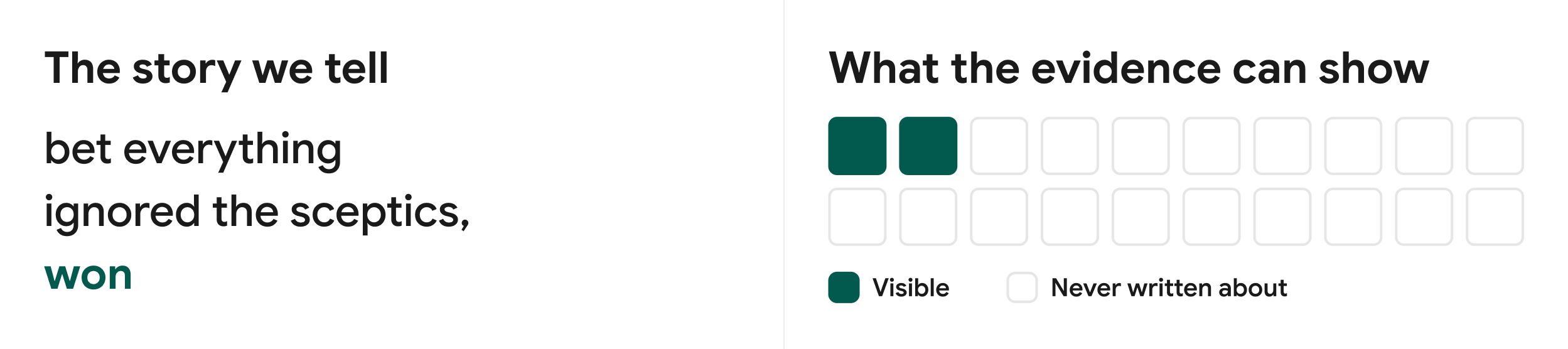
Is risk-taking the same as risk management?
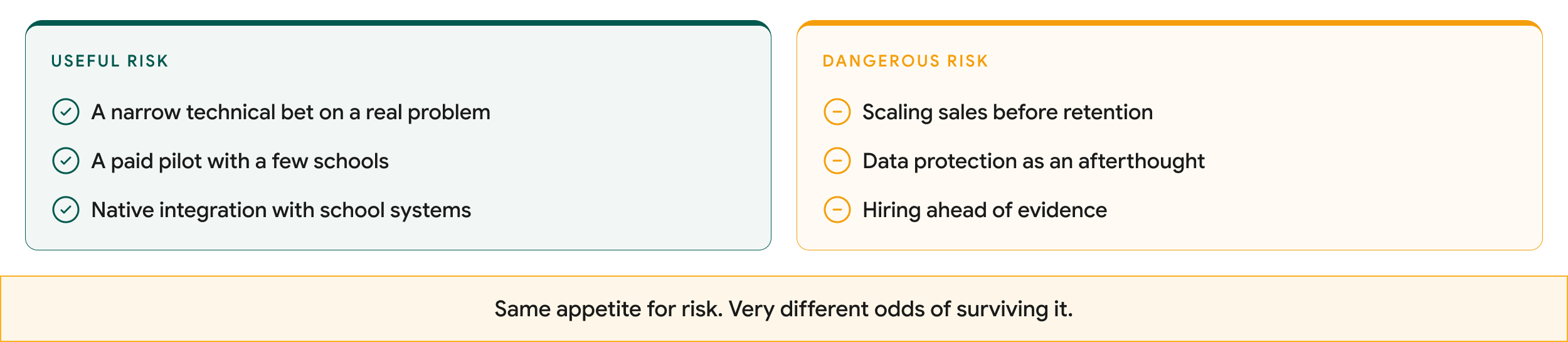
Risk-taking and risk management are different skills, and EdTech rewards the second far more reliably than the first. Every founder takes risks. The useful question is not “Are you willing to take risks?” It is “Do you know which risks you are taking?”
Picture two founders. The first spends six months building a full adaptive maths platform before any school has seen it. The second spends six weeks running a small paid pilot to see whether anyone renews. Both are taking risks. The first is expensive and only resolves at the end. The second is cheap, fast, and teaches you something whichever way it goes.
The Right Risk Test (Original framework developed from the research. Not an established academic model.)
Before committing serious time or money, ask whether the risk is:
Testable: can we learn the answer before betting the company on it?
Survivable: if we are wrong, are we still trading next term?
Evidence-backed: what do we already know, and from whom?
Reversible: can we undo the decision if the evidence turns?
Worth the upside: if it works, does it change the company’s trajectory?
Type of risk | EdTech example | What to do |
Useful | Years of engineering on a problem few others can solve | Take it, and stage it |
Testable | Whether schools will pay for a feature teachers love | Test cheaply first |
Survivable | A new pricing model for one segment | Run it, measure, adjust |
Existential | Treating child data protection as a later problem; hiring a sales team before retention is proven | Retire it early |
SoapBox Labs shows what a useful risk looks like. Dr Patricia Scanlon spent years building proprietary speech recognition for children’s voices rather than wrapping someone else’s engine. That was a large, slow bet. It was also a bet on the thing she knew best, sold to other EdTech companies (more than 50 licensed the technology) rather than school by school. Curriculum Associates acquired SoapBox Labs in November 2023. The risk was real. It was also chosen with unusual precision.
Why EdTech has a different risk profile
EdTech carries a different risk profile from most software because the person who uses the product is rarely the person who pays for it, and both work inside rules the founder does not set. A consumer app can win with one delighted user. An EdTech product usually needs a willing teacher, a convinced principal or Board of Management, a satisfied data protection officer and, more and more often, a successful tender.
Each layer brings its own risk:
Procurement. Irish post-primary MIS (management information systems, the school’s core database for students, timetables and attendance) are increasingly bought through ETB (Education and Training Board, one of 16 regional bodies that run many post-primary schools and further education centres) tenders. Kilkenny and Carlow ETB awarded a framework worth up to €4 million in February 2026 after a competition with four bidders, according to notice 232458-2026 on Tenders Electronic Daily (TED, the EU’s public procurement journal).
Data protection. Pupil data falls under GDPR (the General Data Protection Regulation), enforced in Ireland by the Data Protection Commission (DPC). A compliance gap is not a bug to fix after launch. It can stop a sale.
AI regulation. Under the EU AI Act, some education uses (admissions, assessment and monitoring) are classed as high risk, which adds compliance cost for AI assessment vendors.
Policy. The Department of Education and Youth published Guidance on AI in Schools on 21 October 2025, with Oide Technology in Education, under the Digital Strategy for Schools to 2027. A revised edition is due in 2026.
Calendar. School budgets and buying decisions follow the academic year. Miss the window and the next one can be twelve months away.
Put together, a founder can build a technically excellent product and still stall, because the product was ready and the market’s calendar was not. A startup-closure database cited by Rest of World blamed high acquisition costs, long institutional sales cycles and weak retention for EdTech failures. None of those is solved by more courage.
What comes before the founder: problem, buyer and evidence
Before any question about the founder comes a question about the problem: is it painful enough, for someone with a budget, that they will pay to remove it and keep paying? That is ordinary product-market fit. In education it splits in two.
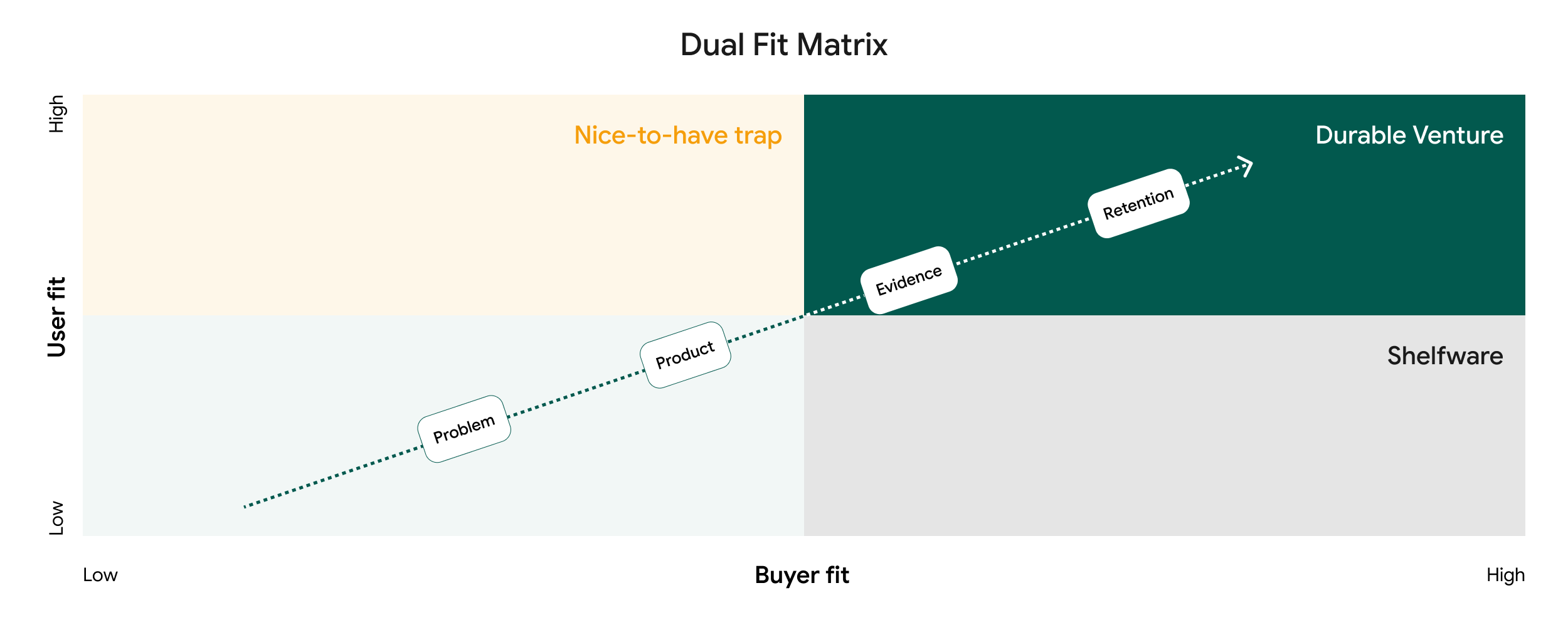
Classroom-product fit is whether teachers, pupils or trainees actually use the product, week after week. Institutional buyer fit is whether the principal, ETB, university or employer has a budget line for it and a reason to renew. A product with only the first is a much-loved free trial. A product with only the second is shelfware.
| Low buyer fit | High buyer fit |
High user fit | The nice-to-have trap: teachers love it, nobody pays | A durable venture: used daily, renewed annually |
Low user fit | No demand, no budget | Shelfware: bought from the top, abandoned by staff |
The Dual-Fit Matrix. Original framework developed from the research.
Three Irish companies sit in the top-right box, each for a different reason.
Aladdin, founded in 2009, says it serves more than 450,000 primary pupils (a company figure, not independently verified). Its product answers a buyer’s pain directly: the administrative load carried by principals and school secretaries. Whether teachers find it delightful matters less than whether the office can close the month.
Examfly, now Acuru, was founded by Deirdre Lyons to serve professional tax and accounting exams, and chose a buyer with a budget and a measurable pain from day one. Its first customer was Chartered Accountants Ireland, according to the Business Post, and its clients have included PwC UK, Deloitte and EY. For a firm, a trainee failing a professional exam costs money and time, so better pass rates are something a learning and development (L&D) budget can justify. (Disclosure: Square Root Solutions was the development partner behind the platform.)
Wriggle Learning, launched in 2012 as the education arm of IT firm Typetec according to Silicon Republic, reached the same insight from the hardware side. Schools were not really buying devices. They were buying devices that worked, with teacher training and support attached. Wriggle reports more than 150,000 devices under management.
The lesson across all three is less about who founded them and more about where they aimed. Each picked a problem that a paying buyer already recognised as a problem.
Does domain experience predict EdTech success?
The best available evidence says experience matters more than boldness, but not that experience is enough. Pierre Azoulay, Benjamin Jones, J. Daniel Kim and Javier Miranda analysed US Census Bureau data on new firms in their paper Age and High-Growth Entrepreneurship. The mean founder age among the fastest-growing 1 in 1,000 startups was 45.0. Prior experience in the same industry more than doubled a founder’s chance of building a top-tier growth company. It is not an EdTech study, and it is American. It is still a direct hit on the image of the young outsider who wins by not knowing the rules.
Irish EdTech fits the pattern closely. Patrick Barry co-founded VSware in 2013, starting in a bedroom in Kildare, and grew it to around a million students across Ireland and Norway. In 2023 he co-founded Tyro Schools with Niall O’Reilly, carrying a decade of post-primary MIS knowledge into a new product. Lyons had lectured for the Irish Tax Institute. Scanlon came from speech research at Bell Labs. These founders took real risks, but inside domains they already understood.
Domain knowledge has a blind spot too. A founder who has lived one version of a problem can mistake it for the whole market. A teacher in an urban DEIS (Delivering Equality of Opportunity in Schools, the Irish programme for schools in disadvantaged areas) primary school knows that world precisely. A rural Gaelscoil (an all-Irish primary school), a fee-paying secondary school or an ETB further education centre can work very differently. Knowing the problem deeply is valuable. Assuming your own experience speaks for everyone else is dangerous.
What about team shape? The familiar claim that complementary founding teams beat solo visionaries does not hold up well. Greenberg and Mollick’s “Sole Survivors” study of Kickstarter-funded ventures found solo-founded for-profit ventures were about 2.5 times more likely to survive than team-founded ones. That sample is crowdfunded consumer products, not EdTech, so it settles nothing alone. But two of the strongest Irish cases, SoapBox Labs and Examfly, were solo-founded, and both hired engineering and commercial talent around deep domain expertise.
The more defensible reading is this: what matters is whether a venture covers domain, technical and commercial capability early, through co-founders or first hires. Founder count is a proxy, and not a good one.
Why team, distribution and trust decide how far a product travels
Founder personality is one part of a larger system. Around the product sit three supporting layers, and any of them can carry it or sink it.
Team is what we have just described: domain, technical and commercial capability, however it is assembled.
Distribution is how a product reaches buyers at a cost the business can sustain. Several of Ireland’s biggest EdTech outcomes avoided selling to schools one at a time. Learnosity, founded in 2007 by Gavin Cooney and Mark Lynch, sells assessment technology to publishers and platforms through APIs (application programming interfaces, the connections other software uses to call a service). It was essentially bootstrapped until Battery Ventures took a stake of around 40% in 2018, bought Questionmark in 2021, and was acquired by Leeds Equity Partners in January 2025. Texthelp, co-founded in 1996 by Mark McCusker and Martin McKay, grew through integration with Google, Microsoft and Apple platforms and a buy-and-build acquisition strategy, passing £60 million in turnover before merging with n2y in March 2024 to form Everway.
Trust is the layer founders most often treat as paperwork. It covers data protection, reliability, evidence of impact and educational credibility. In schools it often decides the sale, because a principal who picks the wrong vendor lives with the consequences for years.
Distribution has a catch that the Irish market made very visible in 2026. Workflow embedding, where a product becomes part of how a school runs every day, is usually described as a moat. VSware held exactly that position. Yet in 2026, Dublin and Dún Laoghaire ETB and Kilkenny and Carlow ETB moved post-primary schools from VSware to Tyro through public tenders, with Castleknock Community College confirming its move in June 2026. The challenger was built by the person who built the incumbent.
The lesson is not that moats are fake. In education, embedding buys retention, not permanence. The tender is the moment of truth, and incumbents lose when a better-informed challenger arrives at renewal.
Pro tip. Treat every renewal as a sale you have not made yet. If you sell to ETBs, universities or other public bodies, check TED and the Office of Government Procurement (OGP) for notices in your category, not only your own contract dates. A competitor’s framework win is public before it becomes your lost account. 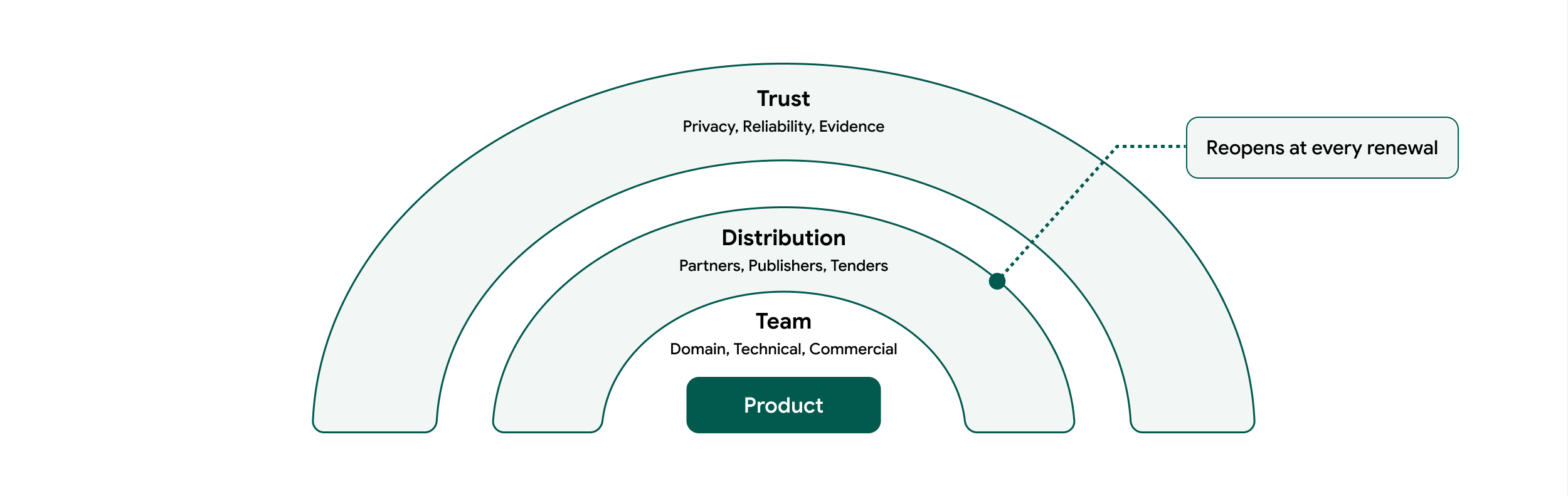
When should an EdTech founder change their mind?
A founder should change their mind when the evidence changes, and not before. Adaptability looks like a personality trait in hindsight. In practice it is a habit of updating the plan. Persistence is useful when the evidence is improving. It becomes dangerous when it simply means refusing to update.
The Irish record needs care here, because one of the most repeated pivot stories is not true. Examfly is sometimes described as a company that began with school students and pivoted to corporate training. It did not. It targeted professional exams from its first customer. Its adaptability was quieter: raising in stages tied to milestones, with a €600,000 pre-seed round from Enterprise Ireland and angel investors, then a €1.5 million seed round in 2024, rather than raising ahead of evidence.
Barry’s move from VSware to Tyro is a sharper example of updating on evidence. The person who built the incumbent concluded the market needed something different, including AI-assisted timetabling, and built it. Tyro raised €2.1 million from Folens and Enterprise Ireland, reached 55 schools by October 2024, and won the Kilkenny and Carlow framework in 2026. Whatever happens next, that is hard to call stubbornness.
Failure stories matter as much, though Irish EdTech rarely publishes them. Two patterns recur often enough in the research to describe. Both are composites, not any single named company:
The brilliant engine nobody could use. A university spinout builds a sophisticated adaptive maths tutor without checking school Wi-Fi limits, timetable constraints or whether teachers can override it. Grant funding covers the pilot. No school renews.
The sales team that arrived before the product. A corporate compliance-training startup scales outbound sales before usage or integration with the client’s learning management system (LMS) is proven. Acquisition costs climb, learners drift away, and the company shrinks.
In both cases the founders took risks. What they did not do was test the risk that could kill them before taking the ones that excited them.
Does AI change the founder equation?
AI (artificial intelligence) changes what it costs to build an EdTech product. It changes much less about what it takes to get one adopted.
Investors have already priced this in. Rest of World reported that investors now favour AI-enabled products, workforce learning and school operations tools that cut costs, while overall funding stays far below its peak. Enterprise Ireland reported that 99 of the 198 startups it backed in 2025 had AI central to their product.
What AI changes | What AI does not change |
A small team can build in months what once took years | Someone still has to know what good output looks like in an Irish classroom |
Generic features (a draft lesson plan, a quiz) become free inside tools schools already use | Trust, data protection and evidence still decide procurement, and the EU AI Act raises the bar for assessment |
Competitors can copy a feature quickly | Distribution and workflow fit still decide whether anyone opens the product twice |
This is where the “thin wrapper” pattern shows up (again a composite from the research, not a named company). An AI lesson-scaffolding tool that is little more than a front end on a third-party model gets a burst of sign-ups, then loses users as the same capability appears inside the Google and Microsoft tools teachers already have.
The alternative is AI placed inside a workflow a paying buyer already recognises. EduSmart Planner, built by Square Root Solutions for the publisher CJ Fallon, uses AI to generate lesson plans and quizzes, but its value comes from structuring them around Irish requirements such as Cuntais Mhiosúla (the monthly planning record required in Irish primary schools). CJ Fallon reports use in more than 250 schools by over 4,500 teachers, with schools reporting 75% less time on curriculum and plan administration. Those are client-reported figures, not an independent evaluation.
Sean Glynn, Chief Learning Officer at Wriggle Learning, put the underlying point in a line reported by RTÉ News, Silicon Republic and educationawards.ie: “Technology doesn’t transform education, teachers do.” AI makes that more true, not less. The founders with an edge are the ones who understand the teacher’s workflow well enough to know where AI removes friction and where it quietly adds a step.

What the Irish EdTech evidence suggests
Taken together, the Irish evidence points to factors that interact rather than a single founder trait that explains outcomes. The companies in this piece showed some mix of a clearly painful problem, a buyer with budget, early evidence of use, a distribution route that avoided costly school-by-school selling, capability across domain, technology and sales, and capital staged to milestones. That is correlation, not causation. The sample is small and tilted towards survivors, which is the very bias this piece set out to question. But the pattern is consistent enough to organise into a working model.
The EdTech Venture Success Stack (Original framework developed from the research. Read from the foundation up.)
Problem: a real, recurring pain in teaching, learning or administration
Customer: the user and the buyer identified separately
Product: built around the user’s actual workflow
Evidence: proof of use and, ideally, of learning gained or time saved
Distribution and renewal: a repeatable route to buyers, and a plan to win the next tender
Retention: customers renew without heroics
Economics: acquisition cost and contract value work on an academic calendar
Adaptability: the plan changes when the evidence does
Scale: growth funded by the layers below, not ahead of them
Skipping a layer to reach the top faster is where both composite failures above went wrong.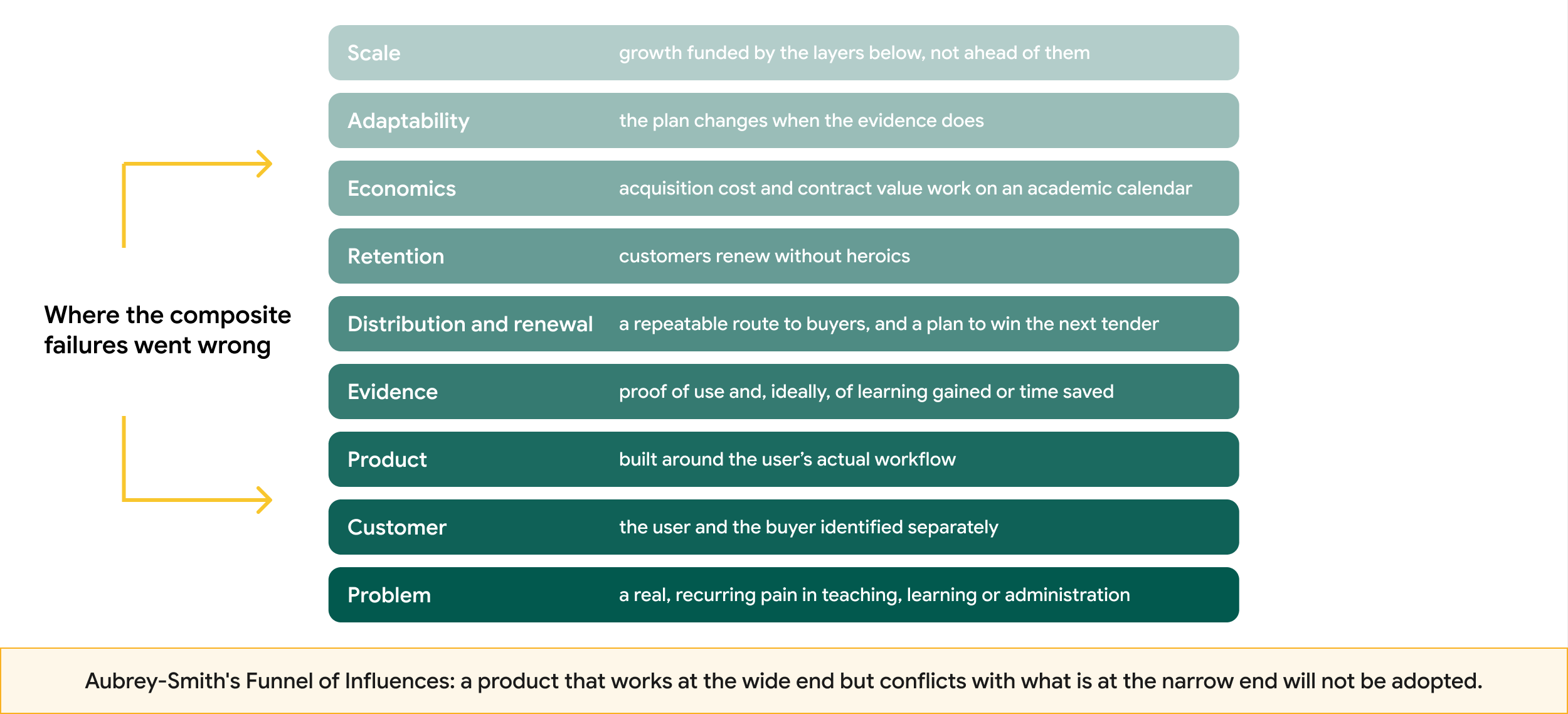
Capital discipline runs through every layer. Learnosity spent eleven years essentially bootstrapped. Examfly and Tyro used Enterprise Ireland staging alongside angel and strategic investors. That staging is cheaper than most VC, but it is not free money. Enterprise Ireland’s HPSU (High Potential Start-Up) funding is equity. The PSSF (Pre-Seed Start Fund) is a convertible loan note of €50,000 or €100,000 at 3% interest over five years, converting to equity at a 20% discount. Only grants, such as feasibility support and the Commercialisation Fund, are non-dilutive.
The scale of that support is significant for a small ecosystem. Enterprise Ireland invested €32.9 million in 198 startups in 2025 (90 HPSUs and 108 early-stage companies), up from €27.6 million across 157 in 2024. Learnovate, the Enterprise Ireland and IDA Ireland technology centre at Trinity College Dublin, secured €9.6 million in March 2024 and has around 75 member organisations. Money like this buys time to test risks properly. A funding round is still an input, not an outcome.
What founders, product leaders and investors should ask
The practical value of all this is a better set of questions. Founders, product leaders, CTOs (chief technology officers) and investors are each asking a version of the same thing: what do we actually know, and how do we know it?
Founders | Product leaders and CTOs | Investors and advisers |
What evidence do we actually have? | What problem are we solving, and for whom? | What evidence exists beyond the founder’s story? |
Which risk are we taking right now? | What does the user actually do, not say? | Is retention real, and who renews? |
Can we test it cheaply? | Are we measuring outcomes or activity? | Is distribution repeatable without the founder in the room? |
Who is the real buyer? | Does the technology remove friction or add a step? | When is the next tender or renewal? |
Why will customers stay? | Are data protection duties built into the architecture? | Which capability gaps remain, and what is the plan? |
What would make us change direction? | What happens when AI makes our core feature free? | Has the plan changed when the evidence did? |
If your product brief cannot answer these questions yet, start there.
A Discovery Sprint with Square Root Solutions is a complimentary two-week scoping engagement that tests the riskiest assumptions in your brief, from buyer fit to data protection and integration, before any code is written.
The myth, rewritten
None of this says great founders avoid risk. Scanlon spent years on a technical bet most investors would have called too slow. Barry started again against the company he had built. Lyons staked her career on the idea that professional exam preparation could be active rather than passive. Those are brave decisions.
What they share is not appetite for risk. It is judgement about it: knowing what to test before committing, what to protect at all costs, when to persist, when the evidence is thin, and when customers are saying something the plan does not want to hear.
Learnosity may be the clearest Irish illustration. For roughly eleven years it grew without outside investment, selling infrastructure to publishers rather than chasing schools one by one. When capital arrived in 2018, it arrived into a business that already worked. That is not a poster story. It is a business story.
The strongest founder story in Irish EdTech may not be about courage at all. It may be about judgement, and the patience to let evidence rather than ambition decide the next move.
Square Root Solutions builds custom platforms for EdTech founders across Ireland, the UK and Europe, and is led by Ciarán Stone, a classroom teacher at a DEIS school in Dublin 12. The questions above are the ones we work through with founders before a build begins.
Frequently asked questions
What makes an EdTech startup successful?
The Irish cases point to a painful problem, a buyer with budget, evidence of regular use, a sustainable route to market and capital staged to milestones. No single founder trait explains outcomes. The evidence is correlational, so treat these as signals rather than a formula.
Why do EdTech startups fail?
A startup-closure database cited by Rest of World blamed high acquisition costs, long institutional sales cycles and weak retention. In practice that often means a product teachers liked but no budget holder would renew, or a sales team hired before retention was proven.
Do EdTech startups need a co-founder?
Not necessarily. SoapBox Labs and Examfly were solo-founded, and Greenberg and Mollick’s “Sole Survivors” study found solo ventures survived more often in its crowdfunded sample. What matters is covering domain, technical and commercial capability early, through co-founders or first hires.
Is Enterprise Ireland funding non-dilutive?
Mostly not. High Potential Start-Up funding is equity, and the Pre-Seed Start Fund is a convertible loan note that converts to equity at a 20% discount. Grants such as feasibility support and the Commercialisation Fund are non-dilutive.
Does AI make it easier to start an EdTech company?
It makes building cheaper and faster, which also helps competitors. Adoption still depends on workflow fit, trust, data protection and distribution, and the EU AI Act classes some education uses, such as assessment, as high risk.
Read next: Acuru (formerly Examfly): adaptive learning built for professional services firms
Or, if you are about to commit budget to a build:
The riskiest assumption in a product brief is cheaper to test before development than after launch.
A Discovery Sprint with Square Root Solutions tests it in two weeks, before any code is written.