



Every school in Ireland and the UK rebuilds its year in the same fortnight. New class lists, new staff, new groups, new option blocks. If your product needs any of that data, you are asking hundreds of schools for it at the exact moment they have the least time to give it.
Get that fortnight wrong and you do not lose a week. You lose the school for the year, because nobody re-onboards a piece of software in November.
This is about the integration that decides how that fortnight goes.
Key takeaways
The problem is timing, not technology. Every school in Ireland and the UK rebuilds its year in the same fortnight, which is also the fortnight your integration is under most load.
Ireland needs two integrations, the UK needs forty. Aladdin and VSware cover most Irish schools between them. The UK is fragmented enough that direct integration is a permanent commitment.
For the UK, use an aggregator. Wonde, Clever, Ednition and Edlink each solve most of the problem. Building direct only makes sense for Ireland alone, or when the integration is the product.
Sync every few hours, not in real time. A record being edited mid-morning is not a source of truth.
Five things break in late August. Old data, duplicate students, departed staff, unfinished option blocks, and errors in the school's own records that your product is the first to surface.
Staff the last two weeks of August as a peak, not a normal fortnight. Almost every mistake in this space is a variation of not doing that.
What MIS integration actually means for an EdTech product
MIS (Management Information System, the core administrative database schools use to manage students, enrolments, classes, staff, and attendance) integration means pulling a school's live student, class and staff records straight from its management system, rather than asking a member of staff to export a spreadsheet and send it to you.
In Ireland and the UK, this is called an MIS. In the United States the same thing is usually called an SIS (Student Information System). Products serving both markets need to speak both words.
What it looks like in practice: Aladdin, the Irish primary school platform, holds attendance, test results, report cards and contact details for over 500,000 pupils. VSware does the equivalent job at post-primary, covering attendance, timetabling and parent communication. That is the data your product needs. Without an integration you are asking a school secretary to export it from one of those systems and email it to you, in the same week she is doing the same favour for four other suppliers.
For your product the difference is not technical elegance. It is whether a school is live in ten minutes or live in three weeks.
Which MIS systems you need to support in Ireland and the UK
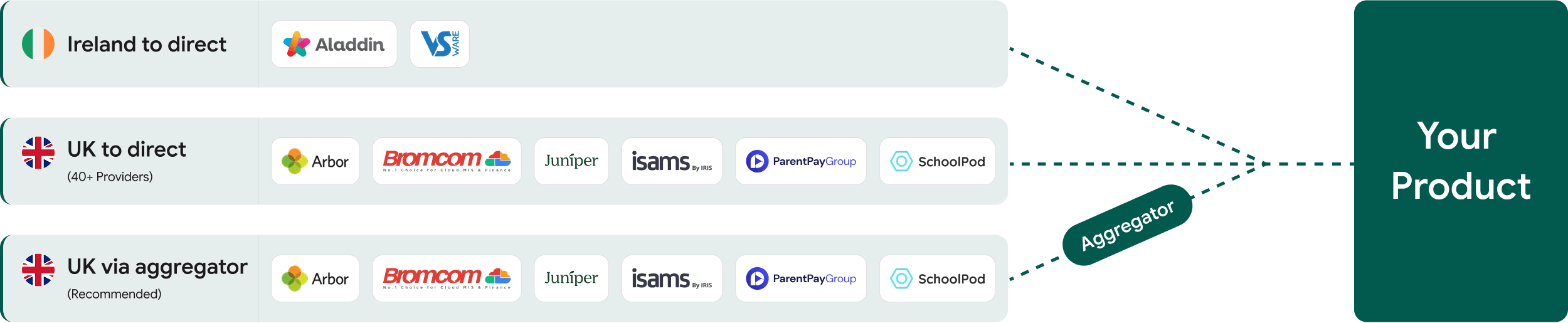
In Ireland the list is short. Aladdin and VSware cover most of the market, with Compass and Tyro behind them. In the UK it is long and fragmented, with SIMS, Arbor, Bromcom and iSAMS accounting for the bulk of schools and a substantial tail after that.
Aladdin has been serving Irish primary schools since 2009 and reports that 90% of them use it daily, across urban, rural, DEIS (Delivering Equality of Opportunity in Schools, a Department of Education programme targeting disadvantaged communities), special and model schools and Gaelscoileanna. VSware, founded in 2013, is the leading MIS at post-primary.
So the integration question in Ireland is not really "which MIS." It is "which segment am I selling to." A product for primary schools integrates with Aladdin. A product for post-primary integrates with VSware. Choosing both means two integrations and two very different sales conversations, and plenty of Irish EdTech products get eighteen months in before they realise they have quietly committed to one segment.
That is a completely different problem to the UK, where four integrations still leaves a long tail and every school that switches MIS provider adds maintenance you did not plan for.
Build direct integrations or use an aggregator
For the UK, use an aggregator. For Ireland alone, building direct is defensible. The deciding factor is not engineering effort. It is who has to negotiate data access with each individual school.
Every school is a separate data controller with its own board of management deciding what leaves the building. Ireland has roughly 3,000 primary and 700 post-primary schools, and each one makes that call for itself. Doing that conversation school by school is a slower and more expensive problem than writing the code.
The aggregators worth knowing:
Wonde is the default in the UK. You write one set of code to reach over 60 MIS platforms, and the permissions sit with the school through their own portal rather than with you. They are ISO 27001 certified and SOC2 compliant, and their school onboarding process is built to get a school live without manual data entry at the school's end.
Clever works the same way with a larger app ecosystem, partnering with over 1,050 education applications to build rostering and single sign-on integrations.
Ednition sells rostering as a service on flat per-student pricing, for companies that want the outcome without adopting a platform relationship.
Edlink sits in the same space with a developer-first posture, reporting over 60 EdTech companies integrated across more than 2,200 institutions.
When building direct is the right call. Some MIS providers actively want you to. WCBS, which serves UK independent schools, deliberately limits itself to MIS, admissions and income, and built the rest of its platform on a read and write API specifically so schools can keep using their preferred tools elsewhere. If your target MIS behaves like that, an aggregator is a layer you do not need.
We have built it both ways. For an Irish education publisher we integrated directly, because the addressable market was covered by a small number of systems and the platform now runs across more than 100 schools and 2,000 teachers. For a multi-centre school group operating across several sites, we built the data layer ourselves, because the product needed attendance, welfare and academic records in one place and no third party exposed that combination. Both routes are written up in our case studies, including what each cost to maintain afterwards.
Which route is right depends on your market, your roadmap, and how much of your team's attention you are willing to permanently allocate to integrations. It is the argument we have in the first few weeks of most projects, usually before anyone writes any code.
Working through the direct vs aggregator decision right now?
We have made this call for platforms in early years, publishing, higher education and professional training, and the answer has been different every time. A Discovery Sprint will map the right integration route for your specific market and roadmap before you commit to building it.
What breaks in late August, and why it all breaks at once
Five things go wrong in the same fortnight, and only one of them is your code.
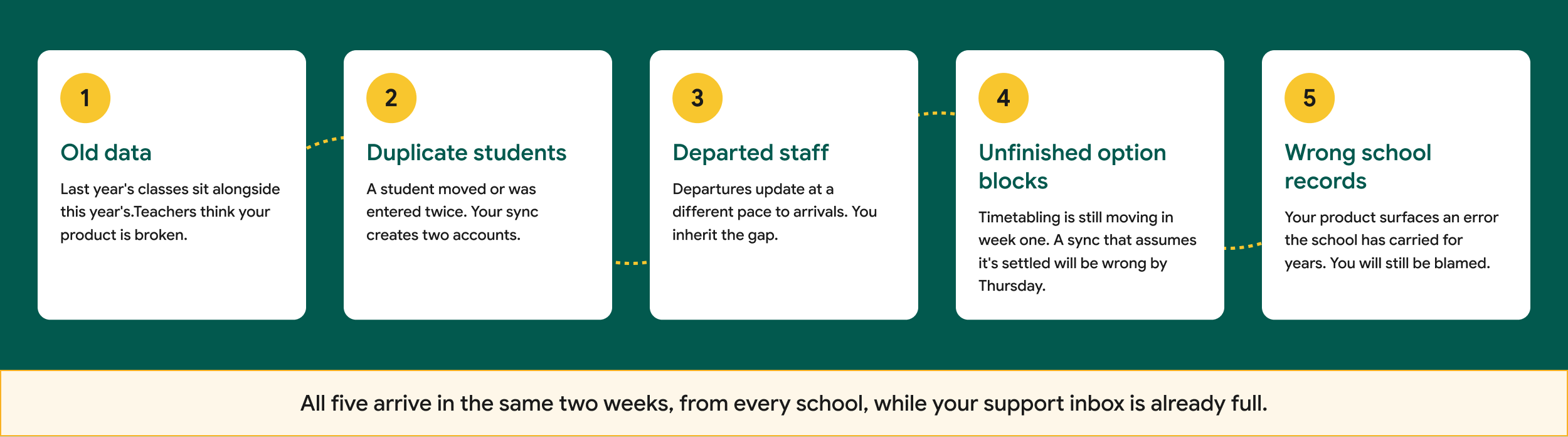
Old data is still there. Last year's classes sit alongside this year's. Your product shows both, and a teacher decides your product is broken.
Students appear twice. A student who moved school, changed name, or was entered manually somewhere along the line now exists under two identifiers. Your sync creates two accounts and nobody knows which one is real.
Staff who left are still provisioned. Departures get updated in the MIS at a different pace to arrivals. You inherit that gap.
Option blocks are not finished. Subject choices, class allocations and timetabling are frequently still moving in the first week of term. A sync that assumes the structure is settled will be wrong by Thursday.
The school's own records are wrong. This is the uncomfortable one. Your product is often the first system that surfaces an error a school has been carrying for years. You did not cause it, and you will still be blamed for it.
None of these are unusual. All of them arrive at once, from every school, in the same two weeks, while your support inbox is already full.
The only real defence is building for the peak rather than the average. We rebuilt a live platform that was serving several hundred early years settings simultaneously, replacing four separate interfaces without any setting going offline. The sequencing of that work mattered more than any single technical decision in the project. Read the full case study: How we rebuilt a live EdTech platform without taking schools offline
How often your integration should sync
Every few hours during term, and daily through the weeks either side of the year rollover.
Wonde syncs rostering data every four hours. That is a reasonable default.
Real-time sounds better and is usually worse. A record being edited mid-morning by an administrator is not a source of truth, and a product that reflects every keystroke in the MIS will show staff a moving target.
A working example: Pageticker runs a full MIS sync every Sunday night, with the option to sync sooner when something changes, sitting on top of Wonde's four-hourly rostering refresh. Weekly is plenty for what their product does, and it means a school starts every Monday on data that settled over the weekend rather than data captured mid-edit on a Friday afternoon.
The rule worth taking: pick a cadence that matches how often the underlying data actually changes, not how often you are technically able to poll it.
The thing nobody tells you about the Irish market
Ireland is different, and mostly in your favour. Two MIS systems cover most of the country, which makes integration a finite job. What is hard is distribution, because roughly 3,700 schools each decide for themselves through their own board of management. There is no national buyer to win.
That is the inverse of the UK, where integration is the hard part and multi-academy trusts give you a route to many schools at once.
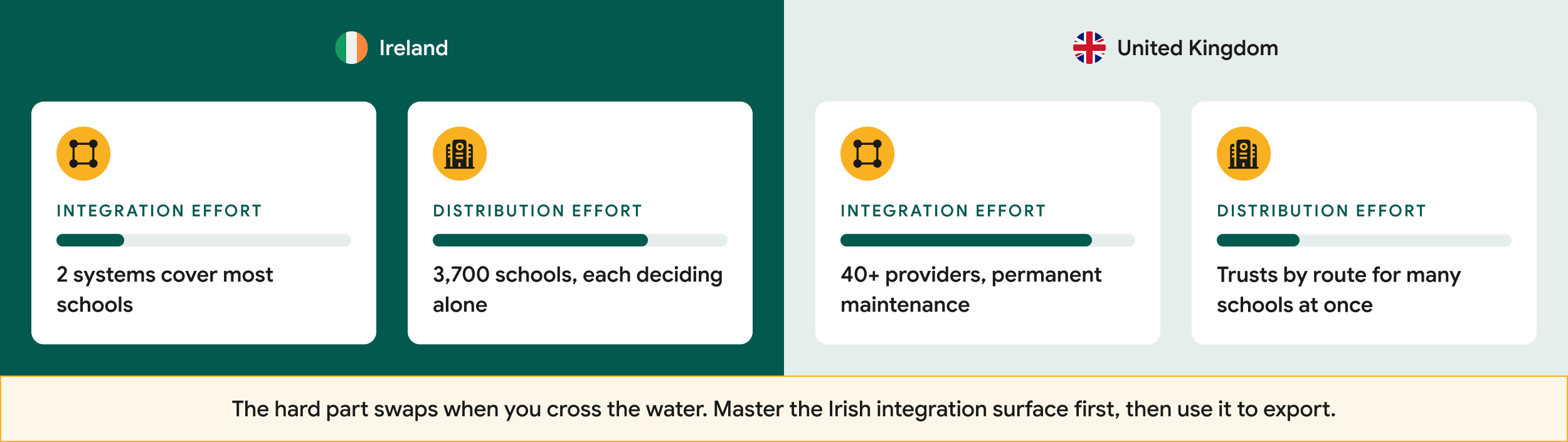
What that looks like when it works. Spellings for Me, co-founded by Paddy Grace, was built for Irish primary schools and now supports over 90,000 students across 25 countries. Small home market, deep integration into it, then export. That sequence is available to any Irish EdTech company precisely because the integration surface here is small enough to master.
The other route is a partner who already reaches the schools. CJ Fallon, one of Ireland's largest education publishers, distributes an AI curriculum planning platform we built across more than 100 schools and 2,000 teachers, and the schools arrived through the publisher's existing relationships rather than one at a time.
The shortcut worth knowing. There are 16 ETBs (Education and Training Boards, regional bodies each owning and running their own schools and further education colleges with a single budget and a single procurement process). One ETB decision can cover a dozen schools. For a product that has solved its integration problem, they are the shortest route out of selling one school at a time.
And one more party to keep in mind. Wriggle supports over 1,500 Irish schools and manages more than 50,000 devices, which in practice makes them the IT partner for a large slice of the market. On a managed school device, the school's device partner decides what gets installed. Your integration can be perfect and still never reach a pupil if you are not on that list.
What to do before this August
Four things, in this order.
Audit what your onboarding asks a school to do by hand. Write down every step where someone at the school has to produce, format or upload something. That list is your risk.
Pick your integration route and commit. Direct for Ireland only, aggregator for anything wider. Half-committing means maintaining both.
Test against real messy data, not sample data. Ask an existing customer for a genuine export, duplicates and departed staff included. Clean test data hides every failure mode listed above.
Move your support capacity into the last two weeks of August. Whatever your integration does, that fortnight will generate more tickets than any other period in the year. Staffing it as a normal week is the most common version of this mistake.
If the audit in step one turns up more manual steps than you expected, the useful time to deal with it is now rather than in September.
Frequently asked questions
What is MIS integration for EdTech?
It is the connection that pulls a school's live student, class and staff records straight from its management information system into your product, replacing the spreadsheet upload most onboarding still relies on. For an EdTech product it decides whether a school is live in ten minutes or three weeks.
Which MIS systems do I need to support in Ireland?
Aladdin at primary and VSware at post-primary cover most of the market between them. Compass and Tyro sit behind them. Which one you integrate with is decided by which segment you sell into, not by preference.
Should I build direct MIS integrations or use an aggregator like Wonde?
For the UK, use an aggregator. The market is fragmented across forty-plus providers and direct integration becomes a permanent maintenance commitment. For Ireland alone, building direct is defensible because two integrations cover most schools. The real deciding factor is who negotiates data access with each individual school, which is slower and more expensive than writing the code.
How often should an EdTech product sync with a school's MIS?
Every few hours during term, and daily through the weeks either side of the year rollover. Real-time syncing sounds better and is usually worse, because a record being edited mid-morning is not a source of truth. Wonde syncs rostering data every four hours as a reference point.
Why do MIS integrations break in late August?
Five things go wrong at once: last year's classes sit alongside this year's, students appear under duplicate identifiers, departed staff are still provisioned, option blocks are not yet finalised, and errors in the school's own records surface for the first time. All of it arrives together, from every school, in the same fortnight.
What is the difference between an MIS and an SIS?
Nothing meaningful. MIS is the term used in Ireland and the UK. SIS is the American term for the same category of software. Products serving both markets need to speak both words.
Whether your MIS integration is still running on CSV exports or you are mid-build and hitting the direct vs aggregator decision, map it against the four steps above before August arrives.
Read next: The hardest version of this problem is a platform that cannot go offline while you fix it. We rebuilt a live platform serving several hundred early years settings simultaneously, replacing the integration layer underneath an active user base without any setting going dark. How we did it and what the sequencing looked like
If August is closer than your integration plan, we offer a complimentary Discovery Sprint assessment: a mapped integration route for your specific market, a sync cadence recommendation, and an honest view of what your onboarding will look like in week one of term. Book a Discovery Sprint