



Roughly 31% of software projects are delivered on time and on budget, according to the Standish Group's CHAOS reports. In education technology, where compliance requirements, integration dependencies, and pedagogical complexity add layers that most software categories do not face, the odds are often worse. The platforms that succeed are the ones that get the sequence right: scope before you build, validate before you scale, and architect for the learning model, not around it.
This guide walks through each stage of building an online learning platform, from defining the problem through to launch and iteration. It draws on specific examples from the Irish and UK education markets and assumes you are building something with a meaningful degree of custom functionality, whether that is an LMS (Learning Management System, software for delivering, tracking, and managing training or education), an LXP (Learning Experience Platform, a learner-driven platform that curates and recommends content), an assessment engine, or a corporate training tool.
Key takeaways
Start with the learning model, not the feature list. The platform exists to deliver a specific educational or training outcome. Every technical decision, from architecture to integrations, should flow from that outcome.
Discovery is not optional. A two-to-four-week Discovery Sprint produces the scope, architecture, and budget clarity that prevents the 69% failure rate the Standish Group documents. It is the cheapest insurance available.
Build in phases. An MVP (Minimum Viable Product, the narrowest version that delivers the core learning experience) with real users generates more actionable insight than six months of planning without feedback.
Plan for compliance from day one. GDPR (General Data Protection Regulation, the EU's data privacy law), the European Accessibility Act, and the EU AI Act are not features to add later. Retrofitting compliance into an existing codebase costs significantly more than building it in from the start.
Budget for the full lifecycle. A platform costing €140,000 to build typically reaches €257,000 at three years and €385,000 at five when hosting, maintenance, and feature development are included.
What problem is the platform solving?
Every successful learning platform begins with a specific educational problem, not a technology brief.
The question is not "what features does the platform need?" but "what learning outcome does it enable that existing tools cannot?" The answer determines whether you are building an LMS, an LXP, an assessment tool, a content marketplace, or something that does not fit a standard category.
Some examples from the Irish and UK markets illustrate the range:
Clinical training that requires AI evaluation. OnWard Education needed a platform for medical students to practise clinical encounters and receive structured AI-assisted feedback. No off-the-shelf LMS could replicate this, because the core value is in the AI evaluation engine, not in course delivery. Square Root Solutions built three connected products: a student mobile app, an educator portal, and an admin interface, with OpenAI-powered evaluation at the centre.
Curriculum-mapped study content with per-subject monetisation. Leaving Cert Plus, built by Square Root Solutions, needed a platform where students could buy access to individual Leaving Certificate subjects, with content mapped to the Irish curriculum and delivery optimised for mobile. The commercial model (per-subject entitlements, free-to-paid conversion, Stripe and Klarna integration) shaped the architecture as much as the pedagogical requirements. The platform now serves 25,000+ students.
Early years documentation across multiple settings. Mosaic, built by Square Root Solutions, serves 85+ early years settings with three connected products: an educator tablet app, a family app, and an admin panel. The learning model centres on observation, documentation, and parent engagement, not course delivery, which required a completely different architecture from a traditional LMS.
The common thread: each founder defined the problem before the platform. The technology followed.
Pro tip. Write a one-paragraph problem statement before any technical discussion. If the statement reads like a feature list ("we need an LMS with video, quizzes, and a gradebook"), the thinking is not specific enough. If it reads like a learning outcome ("we need to reduce the time to competency in financial regulation exams by 30% while maintaining a 90%+ pass rate"), the architecture has something to aim at.
What does the discovery phase look like?
A structured Discovery Sprint produces the foundation for every decision that follows.
The discovery phase runs two to four weeks and delivers four outputs: a validated scope document, a technical architecture proposal, a realistic budget and timeline, and a prioritised feature backlog. Without these, you are estimating in the dark.
Scope. Discovery maps every user role, every core workflow, and every integration touchpoint. For a learning platform, this typically includes learner flows, educator or instructor flows, administrator functions, reporting requirements, and content management. It also identifies what is genuinely custom and what can be handled by proven tools.
Architecture. The architecture proposal specifies the technology stack, the infrastructure approach, the data model, and the integration strategy. For Irish and UK education platforms, this includes how the platform will connect to institutional systems such as Aladdin (the primary school management system used across Ireland), VSware (the post-primary equivalent), or UK systems like Wonde and SIMS (School Information Management System).
Budget and timeline. Discovery produces a cost estimate grounded in actual scope, not analogies. The companion guide, How Much Does EdTech Software Development Cost?, details how project complexity maps to budget: from €25,000 to €60,000 for a narrow MVP, to €140,000 to €300,000 for a commercial-grade platform.
Feature prioritisation. Not everything in the backlog belongs in the first release. Discovery separates must-have features (the minimum to deliver the learning outcome) from should-have (features that improve the experience but are not essential for launch) and could-have (features for future phases).

What are the core components of an online learning platform?
Every learning platform shares a common set of functional layers, regardless of the specific learning model.
Content delivery. How learning material reaches the learner: video (live, recorded, or adaptive streaming), text, interactive exercises, downloadable resources, or a combination. The delivery method shapes infrastructure cost significantly. Adaptive video streaming, the approach used in Leaving Cert Plus, requires CDN (Content Delivery Network) infrastructure that adds to hosting costs but dramatically improves the learner experience on variable connections.
User management and roles. Multi-role access control covering learners, instructors, administrators, and often parents or guardians. Irish and UK education platforms frequently need role structures that reflect institutional hierarchies: class groups, year levels, departments, and multi-school networks. MLI International Schools, built by Square Root Solutions, required four distinct interfaces for administration, directors of studies, staff, and students across eight centres.
Assessment and progress tracking. Quizzes, assignments, rubric-based grading, and progress dashboards. For platforms with adaptive learning, this layer includes the algorithms that adjust content difficulty or sequence based on learner performance. Acuru's custom adaptive algorithms, built by Square Root Solutions for professional services exam preparation, achieved a 40% reduction in time to mastery by dynamically adjusting the learning path for each user.
Reporting and analytics. Institutional and individual reporting that satisfies both pedagogical needs (how are learners progressing?) and compliance needs (can we demonstrate training completion?). Standards like xAPI (Experience API, a specification for tracking learning activities across platforms) and SCORM (Sharable Content Object Reference Model, the legacy standard for e-learning content interoperability) govern how learning data is structured and shared.
Integration layer. Connectors to external systems: institutional MIS (Management Information System), payment processors, communication tools, identity providers (SSO), and content repositories. The integration layer is where most learning platforms underestimate complexity and cost.
Communication. Notifications, messaging, video conferencing, and parent or guardian engagement. The communication model varies dramatically by platform type: a corporate LMS needs manager notifications, while an early years platform like Mosaic needs parent engagement through a dedicated family app.
How should you approach platform architecture?
Architecture decisions made in the first month shape costs and capabilities for years.
Monolith versus microservices. For most learning platforms at the MVP stage, a well-structured monolith is the right starting point. It is simpler to build, deploy, and debug than a microservices architecture, and it can be decomposed later as scale demands. The exception is when specific components have very different scaling profiles: a video processing pipeline, for example, benefits from independent scaling even at moderate user counts.
Native versus cross-platform mobile. Flutter and React Native deliver iOS and Android from a single codebase, reducing development time by 30% to 40% compared to native builds. Square Root Solutions has used Flutter for several education platforms, including the Leaving Cert Plus student app and the Acuru adaptive learning app, where the cross-platform approach delivered a consistent experience without doubling the mobile development budget.
Cloud infrastructure. AWS (Amazon Web Services), Google Cloud, and Microsoft Azure all support production learning platforms. The choice typically comes down to team familiarity, specific service requirements (Azure's cognitive services for AI features, AWS's media services for video), and data residency. For Irish and UK platforms handling children's data, the EU region availability of your chosen provider is a compliance consideration, not just a performance one.
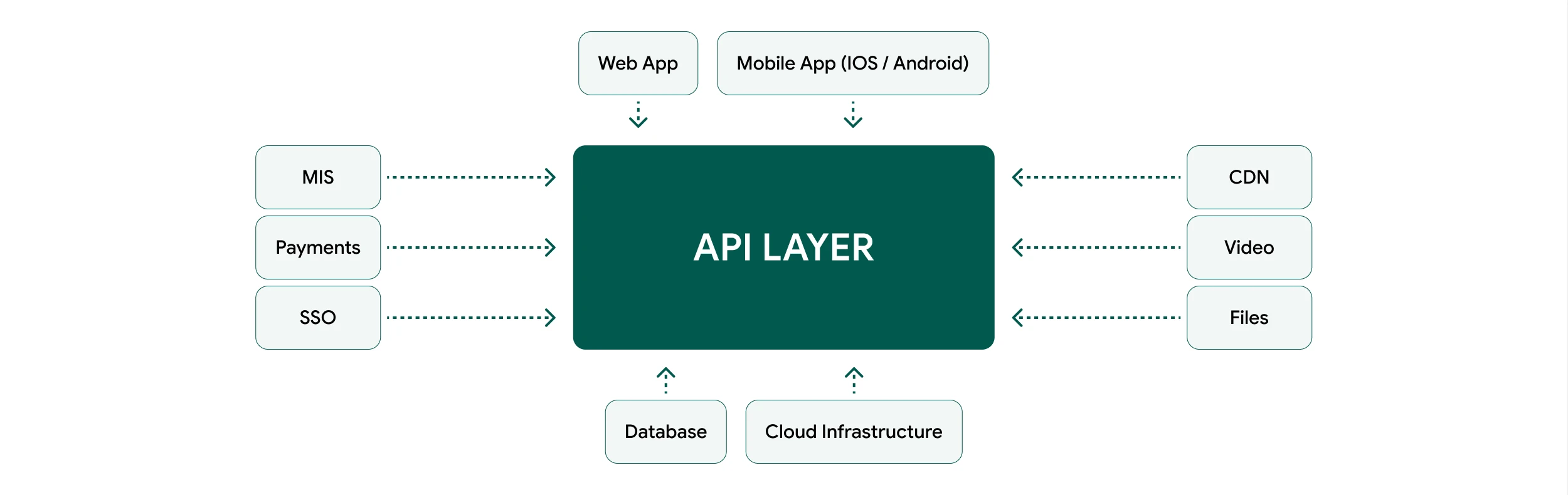
API-first design. Build the platform's core functionality as an API (Application Programming Interface) layer first, then build the web and mobile interfaces on top of it. This approach makes future integrations, third-party access, and mobile app development dramatically simpler. It also supports the standards-based interoperability (LTI, OneRoster, xAPI) that institutional buyers expect.
Architecture is not just about the platform.
A Discovery Sprint maps your learning model to the right technical architecture before a line of code is written. It identifies the integration requirements, the compliance constraints, and the infrastructure decisions that shape cost and capability for the lifetime of the product.
What does the development timeline look like?
Timelines depend on complexity. The table below uses ranges from the companion guides and Square Root Solutions project data.
Platform type | Timeline (after discovery) | Typical scope |
|---|---|---|
Basic LMS | 12 to 16 weeks | Course delivery, user management, basic reporting, single role type |
Mid-complexity LMS | 16 to 22 weeks | Multi-role access, assessment engine, institutional reporting, MIS integration |
Assessment or exam platform | 16 to 20 weeks | Timed exams, question banks, rubric grading, anti-cheating measures, results analytics |
Corporate training platform | 14 to 18 weeks | Compliance tracking, team management, certificate generation, HR system integration |
AI-powered tutoring or adaptive learning | 20 to 30 weeks | Adaptive algorithms, personalised learning paths, AI content generation, advanced analytics |
Full LXP | 22 to 32 weeks | Content curation, social learning, skills mapping, multi-source content aggregation, recommendations engine |
These timelines assume a completed discovery phase. Without discovery, add four to eight weeks of scope clarification that will happen during development, typically at higher cost and with more rework.
Pro tip. The timeline compression that matters most is not faster coding. It is faster feedback. An MVP launched at 12 weeks with 50 users generates more useful insight than a feature-complete platform launched at 30 weeks. Build the narrowest version that delivers the core learning experience, get it in front of real learners, and iterate based on what they actually do.
How do compliance and accessibility shape the build?
In the Irish and UK education markets, compliance is not a phase at the end of the project. It is a set of constraints that shape the architecture from day one.
GDPR and the DPC (Data Protection Commission, Ireland's data privacy regulator). Platforms processing student data must implement data minimisation, purpose limitation, retention policies, and the ability to fulfil Data Subject Access Requests (DSARs). For platforms serving children under 16, the Irish Digital Age of Consent applies, and parental verification is required. Build these capabilities into the data model and user management layer, not as an afterthought.
The European Accessibility Act. Since June 2025, the EAA has been enforceable in Ireland. WCAG (Web Content Accessibility Guidelines) 2.1 AA is the minimum standard for learning platforms. This means keyboard navigation, screen reader compatibility, sufficient colour contrast, alternative text for images, captions for video, and accessible forms. Retrofitting accessibility into an existing codebase typically costs two to three times more than building it in from the start.
The EU AI Act. If the platform includes adaptive learning, automated assessment, or AI-driven content recommendation, these may be classified as high-risk education AI under the EU AI Act, with compliance obligations applying from December 2027. Build governance structures, audit trails, and human oversight mechanisms into any AI feature from the beginning.
Standards compliance. Institutional buyers in Ireland and the UK expect support for LTI (Learning Tools Interoperability, a standard for connecting learning tools to platforms), OneRoster (a data standard for exchanging class rosters and grades), and either SCORM or xAPI for content interoperability. These are not optional features for platforms selling into schools and universities.
What does a realistic budget look like?
Budget depends on platform complexity, but the full lifecycle cost is always higher than the initial build.
Cost component | Range | Notes |
|---|---|---|
Discovery Sprint | €8,000 to €15,000 | 2 to 4 weeks. Produces scope, architecture, budget, and feature backlog |
MVP development | €25,000 to €60,000 | Core learning experience, single platform (web or mobile), basic reporting |
Mid-scope platform | €60,000 to €140,000 | Multi-role, multi-platform, assessment engine, institutional reporting, integrations |
Commercial-grade platform | €140,000 to €300,000 | Full production scalability, deep integrations, advanced features, accessibility and compliance |
Annual maintenance | 15% to 20% of build cost | Security patches, infrastructure, monitoring, dependency updates |
Annual feature development | Variable | New features, integrations, and improvements driven by user feedback |
Hosting and infrastructure | €4,000 to €15,000/year | Cloud infrastructure, CDN, monitoring, backups |
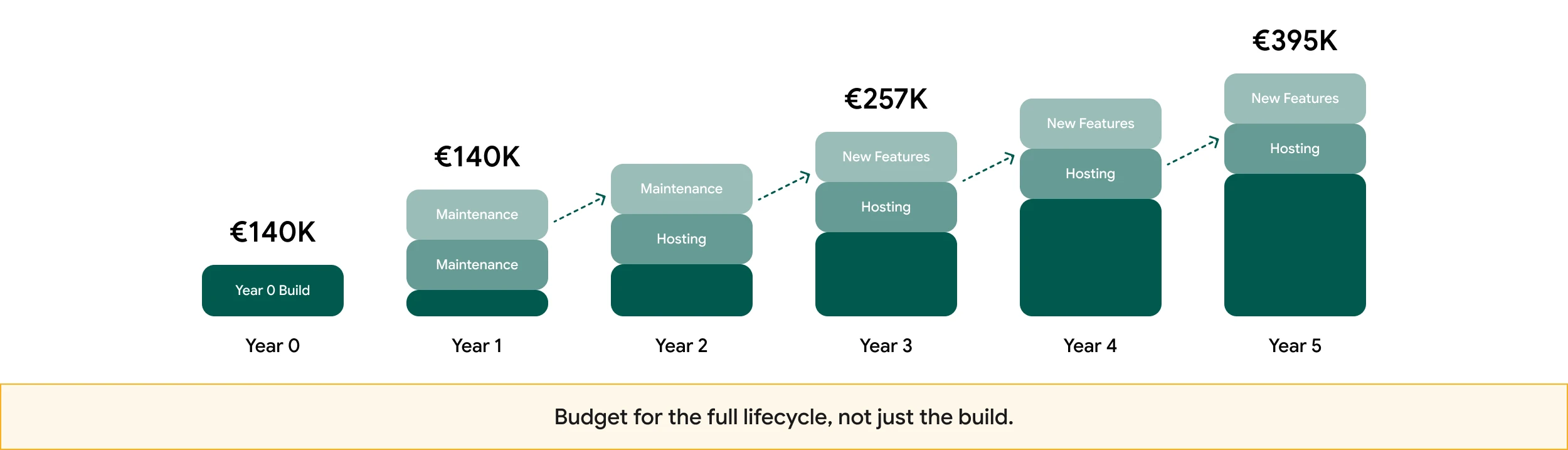
A platform costing €140,000 to build typically reaches €257,000 at three years and €385,000 at five years when maintenance, hosting, and feature development are included. These figures are from the companion guide, How Much Does EdTech Software Development Cost?.
The critical budgeting mistake is treating the build cost as the total cost. The platform does not stop needing investment when it launches. Security patches, accessibility updates, operating system and browser compatibility, and user-driven feature requests are ongoing, and they start from day one of launch.
How do you launch and iterate?
Launch is not the end of the build. It is the beginning of learning from real users.
Soft launch with a pilot group. Start with 20 to 50 users in a controlled setting: a single school, one department, or a small cohort of learners. This pilot surfaces usability issues, workflow gaps, and integration problems before they affect a larger user base. EduSmart Planner, built by Square Root Solutions for CJ Fallon, used this approach to refine the AI-powered curriculum planning tool before expanding to 250+ schools and 4,500+ teachers.
Instrument everything. Build analytics into the platform from the MVP stage. Track not just page views and logins, but learning outcomes: completion rates, assessment scores, time to mastery, and engagement patterns. These metrics drive feature prioritisation for every subsequent release.
Plan the feedback loop. Establish a structured process for collecting, prioritising, and acting on user feedback. In education, the feedback comes from multiple stakeholder groups (learners, teachers, administrators, parents) who often have competing priorities. The product roadmap must balance these perspectives against technical constraints and commercial objectives.
Iterate in two-week cycles. After launch, maintain a rhythm of fortnightly releases. Each release addresses the highest-priority issues from user feedback, analytics insights, and the feature backlog. This cadence keeps the platform responsive without creating the instability that comes from daily deployments.
Frequently asked questions
How much does it cost to build an online learning platform?
In the Irish market, an MVP typically costs €25,000 to €60,000. A mid-scope platform with multi-role access, assessment, and integrations runs €60,000 to €140,000. A commercial-grade platform sits between €140,000 and €300,000. The full five-year cost of ownership, including maintenance, hosting, and feature development, adds 80% to 175% to the initial build cost.
How long does it take to build an online learning platform?
A basic LMS takes 12 to 16 weeks after discovery. A mid-complexity platform takes 16 to 22 weeks. An AI-powered or adaptive learning platform takes 20 to 30 weeks. These timelines assume a completed Discovery Sprint. The companion guide, How Long Does It Take to Build an EdTech Platform? [PLACEHOLDER: insert squareroot.ie/blog/how-long-does-it-take-to-build-an-edtech-platform once live], covers timelines in detail.
What technology stack should I use?
The right stack depends on your platform's requirements, but common patterns in the Irish EdTech market include Next.js or Nuxt for web frontends, Flutter or React Native for mobile, Node.js or NestJS for backend services, and PostgreSQL for data. Cloud infrastructure is typically AWS or Azure. The technology choice should be driven by the learning model and the team's expertise, not by trends.
Do I need a mobile app from day one?
Not always. If your learners will primarily access the platform on desktop (common in corporate training and higher education), a responsive web application may suffice for the MVP. If your learners are students accessing content on phones (as with Leaving Cert Plus) or educators using tablets in the field (as with Mosaic), mobile is a day-one requirement. Let the user research from discovery guide the decision.
What is the biggest mistake founders make when building learning platforms?
Building too much before getting user feedback. The most expensive mistake is spending six to nine months and €150,000+ on a feature-complete platform, only to discover that learners do not use it the way the team expected. An MVP launched at 12 to 16 weeks with a pilot group of 20 to 50 users reduces this risk dramatically.
Square Root Solutions builds custom learning platforms for EdTech founders across Ireland and the UK. From AI-powered adaptive learning to early years documentation, every platform starts with a Discovery Sprint two weeks to map the learning model, the architecture, and the budget before the build begins.