



Every EdTech founder hits the same wall. You have a validated idea, a waitlist of schools or universities, and three agencies quoting you numbers that range from €25,000 to €300,000 for what sounds like the same product. The spread is not a sign that someone is lying. It is a sign that the question 'how much does it cost' is doing too much work.
The real question is not what EdTech software costs. It is what your specific platform needs to do in the first six months, who it needs to work with, and what happens when one of those needs changes after development starts. Get those three things clear and the budget stops being a guess.
This piece breaks the cost down by what drives it, not by what vendors quote you. It is built from what we see across builds at Square Root Solutions, cross-referenced with publicly available pricing from development agencies globally.
Key takeaways
The range is real, but the question is wrong. Custom EdTech platforms cost between €25,000 and €300,000+, but that range only narrows once you define the platform type, integration requirements, and compliance obligations.
Platform type sets the floor. A basic LMS starts around €25,000. An AI tutoring platform with adaptive learning starts closer to €80,000. A full learning experience platform with analytics, gamification, and multi-tenancy starts at €120,000.
Integrations are the hidden multiplier. A single integration (SSO, payment gateway, video conferencing) adds €3,000 to €20,000 depending on complexity. Most platforms need three to five.
Ireland and UK compliance adds 15 to 30 per cent. GDPR, FERPA, and accessibility requirements (WCAG 2.1 AA) are not optional for education products, and they cost real development hours.
An MVP-first approach saves €30,000 to €100,000 upfront and gets you into schools faster, but only if the MVP is scoped around the right problem, not the easiest features to build.
What type of platform are you building?
This is the first question and the one that determines everything after it. The cost of EdTech software is not one number. It is a matrix, and the row you sit in depends on what the platform does.
Platform type | Typical cost range | Build timeline |
|---|---|---|
Learning management system (basic) | €25,000 to €60,000 | 12 to 16 weeks |
Learning management system (mid-complexity) | €60,000 to €150,000 | 16 to 22 weeks |
Assessment platform | €40,000 to €120,000 | 16 to 20 weeks |
Corporate training platform | €40,000 to €150,000 | 14 to 18 weeks |
AI tutoring platform | €80,000 to €250,000 | 20 to 30 weeks |
Learning experience platform (full) | €120,000 to €300,000+ | 22 to 32 weeks |
Student information system | €80,000 to €200,000 | 20 to 28 weeks |
These ranges come from publicly listed pricing across agencies including RaftLabs and Cleveroad, cross-referenced with our own project experience. They assume a team of two to five developers working at mid-market rates.
The mistake founders make here is not choosing wrong. It is choosing too broadly. A founder who says 'I am building an LMS' will get quoted €25,000 to €150,000 because that label covers everything from a course player with a login page to a multi-tenant enterprise system with SCORM compliance and real-time analytics.
Pro tip. Before you ask for quotes, write down the five things your platform must do on day one. Not the twenty things it could eventually do. Five. That list is worth more than any feature specification document for getting a realistic number.\
What actually drives the cost up?
The platform type sets the floor. Everything else is what pushes you from the bottom of the range to the top. Four factors account for most of the difference.
1. User interface and design
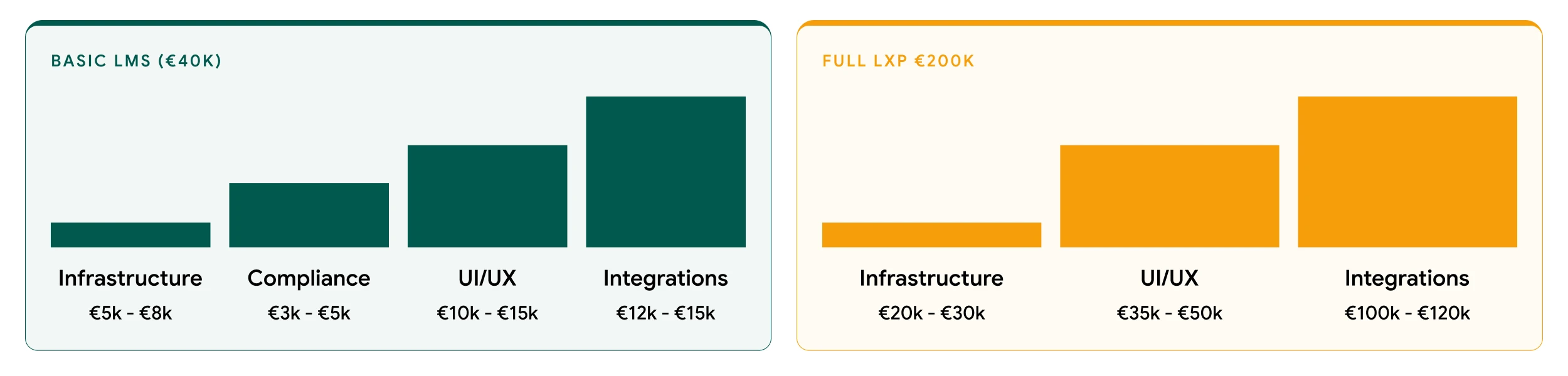
UI/UX design adds €10,000 to €50,000 to any build. That range covers everything from wireframes (80 to 200 hours) through to a full design system with animations and WCAG 2.1 accessibility compliance (500 to 800 hours, according to Cleveroad's LMS cost breakdown).
The trap here is treating design as a cosmetic layer. In education, the interface is the product. A teacher who cannot find the assessment builder in three clicks will not complain. They will stop using the platform.
2. Integrations
Every integration adds €3,000 to €20,000 in development cost. Most EdTech platforms need at least three.
Integration type | Typical cost | Why it matters |
|---|---|---|
SSO / SCIM (Okta, Azure AD) | €5,000 to €12,000 | Schools will not adopt a platform that requires a separate login |
Payment gateway (Stripe, PayPal) | €3,000 to €8,000 | Required for any B2C or marketplace model |
Video conferencing (Zoom, Jitsi) | €8,000 to €20,000 | Building video from scratch takes 200 to 400 hours; integrating Zoom takes 4 to 20 |
SCORM / xAPI | €5,000 to €15,000 | Non-negotiable for any platform selling into corporate L&D |
MIS / SIS (Aladdin, VSware) | €5,000 to €15,000 per system | Irish and UK schools run on these; without them, your product is invisible |
Pro tip. In Ireland, there is no equivalent of Wonde or Groupcall to aggregate MIS connections. You integrate with Aladdin and VSware individually. Budget for both if you are targeting Irish schools.
3. Compliance and accessibility
Regulated industries pay 15 to 30 per cent more in development costs. For EdTech, the three frameworks that matter are GDPR (adds 40 to 80 development hours), FERPA if you are selling into the US (30 to 60 hours), and WCAG 2.1 AA accessibility (60 to 120 hours).
These are not optional. The Irish Data Protection Commission enforces GDPR actively, and any platform storing pupil data in Ireland or the UK is subject to it.
4. Hosting and infrastructure
Initial infrastructure setup runs €8,000 to €25,000, with ongoing costs of €500 to €15,000 per month depending on scale. The cost is driven by data residency requirements (Irish and UK schools often require EU-hosted data), redundancy, and whether the platform needs to handle peak loads during exam periods.
How much should you spend on an MVP?
The MVP question is where most budgets either get saved or wasted. An MVP-first approach covers 40 to 60 per cent of the final feature set and typically saves €30,000 to €100,000 compared to building the full platform in one pass, according to Cleveroad.
But that saving only materialises if the MVP is scoped correctly.
MVP approach | Typical cost | Timeline |
|---|---|---|
Basic LMS MVP | €20,000 to €50,000 | 3 to 4 months |
Mid-level LMS MVP | €50,000 to €80,000 | 4 to 5 months |
Assessment platform MVP | €30,000 to €60,000 | 3 to 4 months |
The mistake is building the MVP around the easiest features rather than the riskiest assumption. If your product's value proposition is 'AI-generated lesson plans that teachers actually use,' the MVP needs to include the AI lesson plan feature, not a course library with plans to add AI later.
Pro tip. The EduSmart Planner team built their AI lesson planning feature into the first version, not the third. That decision is why 4,500+ Irish teachers adopted the platform: the feature that mattered was the feature they shipped first.
Where does your development team sit, and why it matters
Developer rates vary two to three times by region, and the gap is real.
Region | Senior developer rate (per hour) |
|---|---|
US and Canada | $100 to $200+ |
Western Europe (Ireland, UK) | €80 to €150 |
Eastern Europe | $50 to $80 |
South and Southeast Asia | $25 to $60 |
A €150,000 budget buys roughly 1,000 hours from an Irish or UK team, 2,000 hours from an Eastern European team, or 3,000 hours from a South Asian team. The arithmetic is straightforward. The decision is not.
For EdTech products serving Irish and UK schools, three factors push against the cheapest option: time zone alignment with schools for user research and testing, understanding of the Irish curriculum, MIS landscape, and GDPR requirements, and the ability to sit in the same room as a school principal during a pilot.
That does not mean you must hire locally for every role. It means the people making product decisions need to understand the market the product serves. Offshore development works when the specification is precise. It fails when the specification is still being discovered, which is most of the time in early-stage EdTech.
The costs nobody puts in the quote
Hidden costs add 20 to 40 per cent to the initial estimate. That is not an exaggeration. It is what Cleveroad's LMS cost analysis reports, and it matches what we see.
Cost item | Range | When it hits |
|---|---|---|
Annual maintenance | 15 to 20% of initial build cost | Year 1 onwards |
User training and rollout | €5,000 to €20,000 | At launch |
Data migration (clean data) | €2,000 to €8,000 | Pre-launch |
Data migration (SCORM or restructuring) | €10,000 to €30,000 | Pre-launch |
Localisation (per language) | €2,000 to €8,000 | Post-launch |
Marketing (B2C, first year) | €20,000 to €80,000 | Post-launch |
Unplanned year-one support | €10,000 to €30,000 | Year 1 |
The one that catches most founders is maintenance. A platform that costs €100,000 to build costs €15,000 to €20,000 per year to maintain. That is not a bug. It is the cost of keeping dependencies updated, patching security vulnerabilities, and adapting to changes in the platforms you integrate with.
How to keep the budget from growing after development starts
Scope creep is not a character flaw. It is a signal that the brief was not specific enough. Three practices reduce it.
Fix the brief before writing code. The most expensive code is the code that solves the wrong problem. A two-week scoping engagement that maps the learner context, the content model, and the integration requirements costs a fraction of a rebuild at week sixteen.
Use design systems. A shared design system cuts design hours by 30 to 50 per cent across the build. It also means every new feature looks like it belongs in the same product, which matters more in education than in most sectors because teachers notice inconsistency.
Use ready-made integrations where they exist. Building video conferencing from scratch takes 200 to 400 hours. Integrating Zoom or Jitsi takes 4 to 20. The maths is obvious, but founders still build from scratch when they fear losing control. The control you lose is almost always control you did not need.
Still working through budget decisions?
A Discovery Sprint maps your platform's specific requirements, integration needs, and compliance obligations before any development begins. It turns a €25,000 to €300,000 range into a number you can actually plan around.
Build vs buy: when off-the-shelf is the right answer
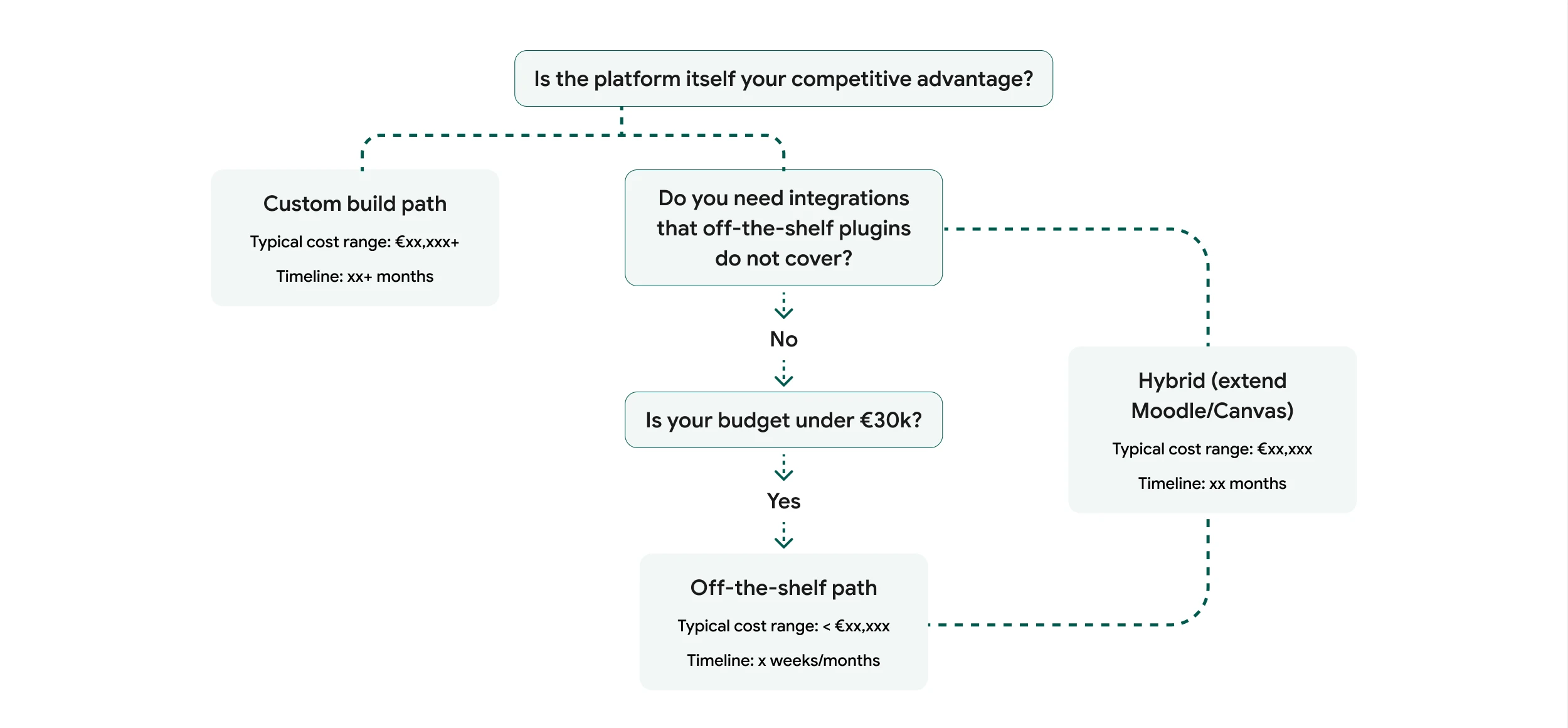
Not every EdTech product needs to be built from scratch. The decision depends on how much of your value is in the platform itself versus the content or method it delivers.
Factor | Custom build | Off-the-shelf (Moodle, Canvas, Thinkific) |
|---|---|---|
Cost | €25,000 to €300,000+ | €200 to €1,200/month (SaaS) or €15,000 to €100,000 (implementation) |
Time to market | 3 to 12 months | 2 to 8 weeks |
Differentiation | Full control | Limited to configuration |
Integrations | Built to your spec | Plugin ecosystem, may not cover niche needs |
Scaling | Designed for your load | Designed for general load |
Build custom when the platform is the product: when the learner experience, the assessment logic, or the adaptive engine is what sets you apart. Use off-the-shelf when the platform is the delivery vehicle and the content is the product.
The hybrid option is worth considering if your budget is below €30,000. Extending Moodle or Canvas with custom modules gives you a working platform in weeks and lets you validate the product before committing to a full build.
What a realistic EdTech budget looks like in practice
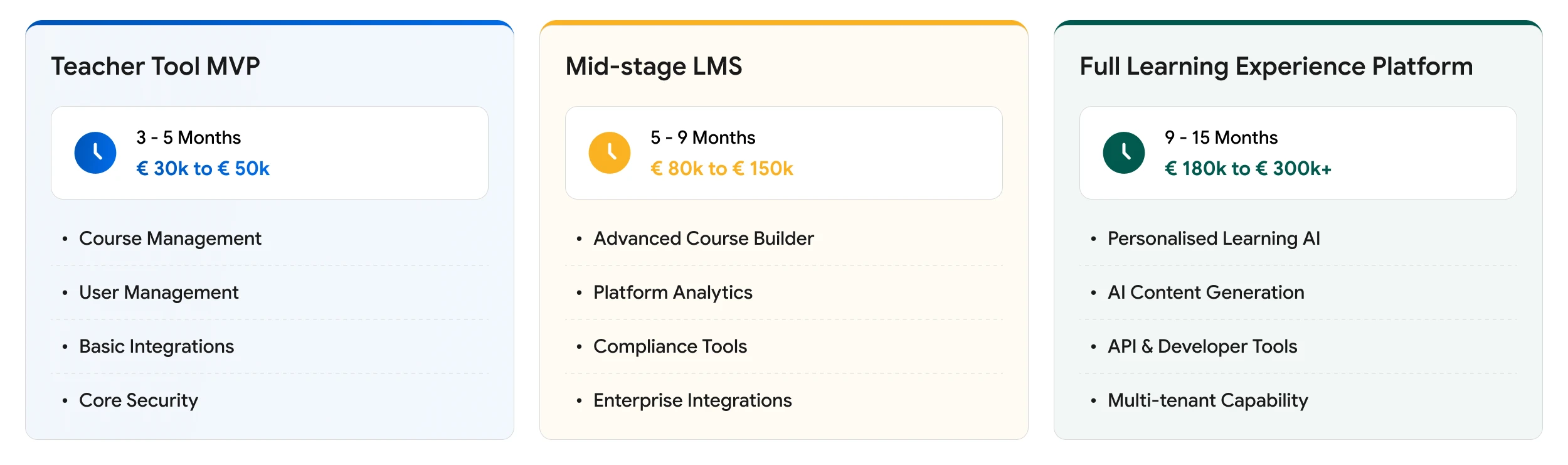
Abstract ranges are useful for orientation. Concrete examples are useful for planning. Here are three budget profiles based on the types of builds we see most often.
Profile 1: Teacher tool MVP (assessment or planning) Budget: €30,000 to €50,000. Timeline: 3 to 4 months. Team: 2 developers, 1 designer. Includes: core feature (assessment builder or planning tool), basic user management, one MIS integration (Aladdin or VSware), GDPR compliance. Does not include: AI features, analytics dashboard, mobile app.
Profile 2: Mid-stage LMS for corporate or higher education Budget: €80,000 to €150,000. Timeline: 5 to 8 months. Team: 3 to 4 developers, 1 designer, 1 QA. Includes: course management, video integration, assessment engine, reporting dashboard, SSO, SCORM compliance, multi-language support. Does not include: AI tutoring, gamification, white-labelling.
Profile 3: Full learning experience platform Budget: €180,000 to €300,000+. Timeline: 8 to 14 months. Team: 4 to 6 developers, 2 designers, 1 QA, 1 DevOps. Includes: adaptive learning engine, real-time analytics, gamification, multi-tenancy, full accessibility compliance, multiple integrations, mobile apps. Does not include: AR/VR features, proprietary AI models.
Frequently asked questions
How much does a basic LMS cost to build?
A basic LMS with course management, user accounts, and a content player typically costs €25,000 to €60,000 and takes 12 to 16 weeks. That figure assumes a team of two developers and covers core functionality without advanced features like AI, gamification, or complex reporting. Adding each of those pushes the build into the €60,000 to €150,000 range.
Should I build an EdTech MVP or a full platform?
Start with an MVP if you are still validating the product with real users. An MVP covers 40 to 60 per cent of features, costs €20,000 to €80,000, and ships in 3 to 5 months. Build the full platform only once you have confirmed which features drive adoption. The risk of building everything first is spending six months and €150,000 on features nobody uses.
Why do EdTech development quotes vary so much?
Three reasons: the platform type (a basic LMS and a full LXP are different products), the team's location (US rates are two to three times Eastern European rates for comparable seniority), and what is included in the quote. Some agencies exclude design, infrastructure, and post-launch maintenance. Always ask what is not in the number.
What are the ongoing costs after launch?
Plan for 15 to 20 per cent of the initial build cost per year in maintenance. On a €100,000 build, that is €15,000 to €20,000 annually. Add user training (€5,000 to €20,000 at launch), hosting (€500 to €15,000 per month), and unplanned support (€10,000 to €30,000 in year one). The total first-year cost after launch is typically 30 to 50 per cent of the build cost.
Do I need to hire locally for EdTech development?
Not necessarily, but the people making product decisions need to understand the market. For Irish and UK EdTech, that means understanding the curriculum, the MIS landscape (Aladdin, VSware, SIMS), GDPR obligations, and how schools actually buy and adopt software. Development can be distributed; product strategy cannot.
Square Root Solutions builds EdTech platforms for founders who have already identified the problem and need a team that understands how Irish and UK schools, universities, and training bodies actually work. If the numbers in this piece have narrowed your range but not answered your specific question, that is what the first conversation is for.