


On a school day in Wicklow, thirty phones go into locked pouches before the first bell and stay there until the last. Getting there took what Presentation College Bray's principal, Martin Locke, called "the biggest policy review we've had in at least 20 years." By national timelines, that school was already ahead of the deadline.
Since June 2025, every recognised primary school in Ireland has been required to ban pupil access to personal mobile phones for the length of the school day, and every post-primary school has been required to restrict it. State funding covered the storage hardware. It did not touch the deeper disruption: to procurement, to compliance workflows, to a decade of product assumptions about how software reaches a teenager during school hours.
That gap is where this piece sits. Not whether the ban works (the evidence on that is genuinely unsettled) but what a state-mandated removal of the device EdTech has spent a decade designing around actually means for the companies still building.
Key takeaways
The policy runs on circulars, not legislation. Ireland's ban sits on Department of Education circulars and conditional funding, a lighter and more reversible mechanism than England's now-statutory approach. Founders should not assume it will harden into law.
Procurement was decentralised, not centralised. A planned national pouch tender was cancelled on legal advice. Every school now buys its own storage solution, turning this into a 700-plus-school sales problem rather than one framework contract.
The evidence is genuinely split. A peer-reviewed Lancet study found no wellbeing or attainment benefit from bans. Other academic work finds a real, if modest, effect on bullying, focus and test scores. Neither extreme survives contact with the literature.
The children's rights critique is official, not fringe. Ireland's own Ombudsman for Children called blanket bans not in the best interest of children. Vendors need to design around this position, not dismiss it.
The opportunity is software, not hardware. With storage vendors already dominant in early-adopter schools, the commercial opening is in consultation tooling, exemption management, compliance reporting and parent communication.
Enforcement by hardware alone does not hold up. Northern Ireland's own pilot evaluation found dummy phones and damaged pouches within a single academic year.
This is act one, not the whole story. Commentary is already framing phone bans as the first of three connected waves, with a backlash against 1:1 device and EdTech mandates predicted for 2027.
What does the policy actually require
Primary schools must ban personal mobile phone access outright, for the full school day. Post-primary schools carry a lighter obligation: restrict, not necessarily eliminate, reflecting that older students retain more say over how their own school implements it. Both tiers are set out in Circular 0044/2025 and its companion circulars, and both carry a procedural requirement that is easy to miss in the headlines: schools must develop their policy in consultation with parents, students and staff, building on existing structures like parents' associations and student councils.
Budget 2025 set aside €9 million for post-primary schools to buy storage (pouches or lock boxes) at roughly €25 per pupil. Minister Helen McEntee formally issued the national guidance in June 2025, confirming schools could not redirect that funding toward anything else. Exemptions remain for pupils with SEN (Special Educational Needs), disability, or documented medical needs, and the restriction does not apply to the commute to and from school.
By August 2025, 380 post-primary schools had applied for the funding and 304 had already been paid, roughly half of Ireland's 730 post-primary schools engaging with the scheme within a year of announcement. That figure is now more than a year old. Anyone building a pitch around uptake numbers should verify the current figure before quoting it.
Why did the government press ahead against contested evidence
Because the strongest opposing evidence arrived after the political commitment was already made.
The University of Birmingham's SMART Schools study, published in The Lancet Regional Health in February 2025, surveyed 1,227 students across 30 English secondary schools and found no significant difference between ban and non-ban schools on mental wellbeing, anxiety, attainment, disruptive behaviour, physical activity or sleep. Restrictive policies did cut in-school phone use by around 40 minutes a day, but students largely made up the difference once they left school grounds, so total daily use barely moved. The study found that total daily phone and social media time, not school policy, was what actually correlated with worse outcomes.
Ireland's government proceeded regardless. Other research points in the opposite direction. A 2024 meta-analysis by Bottger and Zierer, pooling five quantitative studies, found a small but statistically significant positive effect from bans, concentrated more in bullying and social wellbeing than in academic performance. A separate working paper by Beland and Murphy at the London School of Economics found phone bans raised test scores by roughly 6.4% of a standard deviation, with low-achieving students gaining about twice as much as their peers.
Northern Ireland's own pilot (nine to ten schools, roughly 8,000 pupils, independently evaluated by King's College London) found real teacher-reported gains in focus, fewer disruptions and fewer safeguarding incidents, but pupil-reported wellbeing barely moved, and researchers documented dummy phones and damaged pouches within the year. Ireland's Ombudsman for Children published its own consultation with thirteen to seventeen year olds in September 2025, concluding that a blanket ban is not in the best interest of children and that phones serve real learning, health-monitoring and communication functions those students felt nobody had asked them about.
The honest synthesis, and the one worth building a product strategy on: there is reasonable evidence that phone restrictions improve what a teacher can observe in a classroom (focus, disruption, safeguarding call-outs) and weak to no evidence they move the wellbeing and attainment numbers a parent actually cares about. Products pitched on either extreme are pitching against the literature.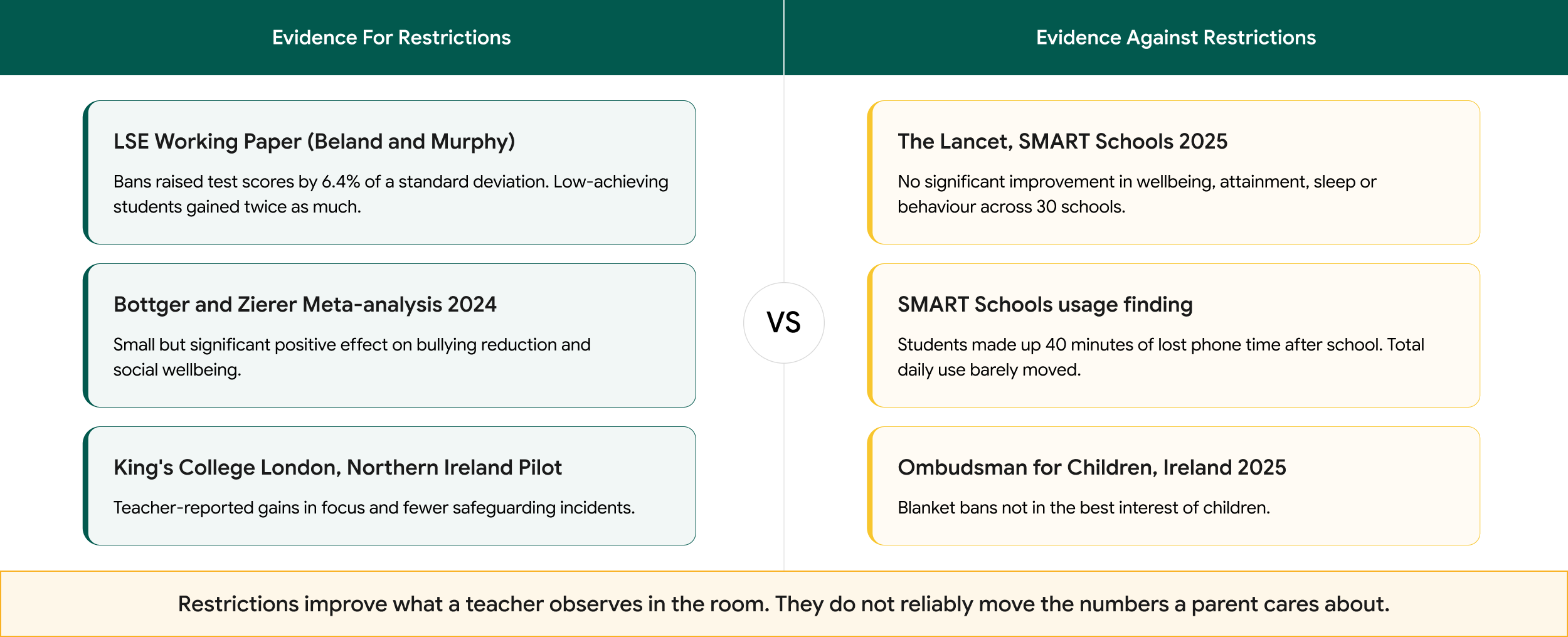
The procurement problem nobody is positioning for
Ireland was supposed to run this centrally. A national tender for a single pouch supplier was cancelled in January 2025 on the advice of the Chief State Solicitor's Office, and schools were told to find whatever storage solution works best for them. That single decision reshaped the entire commercial landscape: instead of one framework agreement, Ireland now has roughly 700 individual post-primary buying decisions, each made by a Board of Management with no central playbook.
Into that gap stepped Yondr, the global pouch vendor already active in 38 countries, with Irish case studies at Presentation College Bray, St Raphaela's and Alexandra College well ahead of the national mandate. Yondr does not sell a pouch. It sells a programme: policy development, staff and parent onboarding, ongoing support. That is the correct read of a fragmented, relationship-driven market, and it is the model any vendor entering this space now needs to match rather than compete against on hardware alone.
The funding restriction compounds the fragmentation. Schools were explicitly told the €25-per-pupil allocation can only be spent on storage, not on anything adjacent. Any commercial pitch that blurs the line between compliant hardware spend and adjacent software spend puts a school's funding compliance at risk. Meanwhile the mandated consultation step (parents, students, staff, before a policy is finalised) is currently handled the way most school administration still is: letters, surveys, a meeting of the parents' association. Nobody has built the workflow for it yet.
Where the real product opportunity sits
The pouch market is close to saturated by an incumbent. The software layer around the policy is not.
Four gaps stand out.
Consultation and policy-communication tooling for the mandated community-consultation step, which is currently ad hoc in almost every school running the process.
Exemption and consent management for SEN and medical cases, handled manually, school by school, with real safeguarding stakes if it is done badly.
Funding-compliance reporting tied to the restricted-spend rule, since schools now have a specific, auditable reason to want proof they spent public money correctly.
Parent-communication infrastructure that replaces the function a personal phone used to serve during the school day, the single use case the Ombudsman's youth consultation surfaced most consistently, and the one every school office is currently handling by improvisation.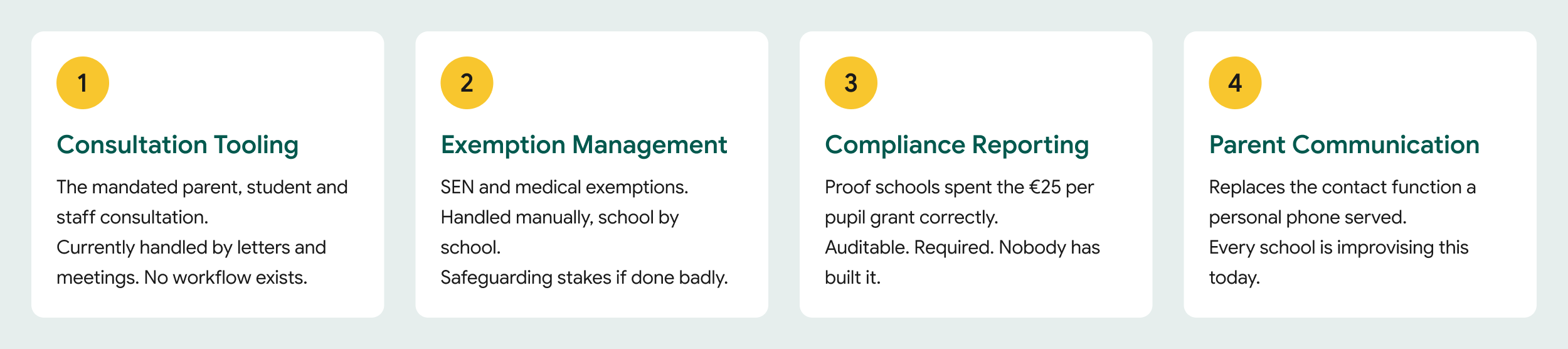
There is a fifth, adjacent opportunity that is arguably bigger: AI-policy compliance. Ireland published national guidance on AI in schools in October 2025, established an AI in Schools External Advisory Taskforce in April 2026, and is running State Examinations Commission rules on AI use in coursework that are already contentious. A school navigating a new phone policy and a new AI policy in the same eighteen months is a school that wants one vendor who understands both, not two separate procurement conversations.
Working out which of these compliance surfaces your product needs to speak to on day one and which can wait?
We offer a complimentary Discovery Sprint assessment: a mapped view of where your current product sits against the phone-free policy requirements and what to build before the next academic year.
The risks EdTech founders should prepare for
Political and evidentiary volatility. A product pitched on "the science says bans work" is one contested headline away from an awkward sales call. The Lancet null result is already circulating in Irish teachers' unions and national press.
Rights-based reversal risk. Because Ireland chose circulars over legislation, a change of minister or sustained pressure from the Ombudsman's position could soften the policy considerably faster than it could in England, where the mechanism is now backed by statute. Vendors betting on permanent, hardening restriction are betting on the wrong jurisdiction's trajectory.
A 700-school sales problem, not a framework contract. Anyone modelling a national rollout on a single procurement conversation is modelling the wrong market.
Vendor concentration. Yondr's existing scale and Irish reference schools make it the incumbent to differentiate against, not the gap to ignore.
Enforcement claims that do not survive scrutiny. The Northern Ireland pilot documented workarounds inside a single year, under close evaluation, in well-resourced pilot schools. Any pitch that treats a locked pouch as a solved enforcement problem is making a claim the best available evidence does not support.
Funding-line risk. Blurring compliant storage spend with adjacent software spend is not just a messaging problem. It can jeopardise a school's ability to draw down public funding at all.
How product teams should actually respond
Start with architecture. Anything a student touches during the school day should default to school-managed, admin-visible, web-first design (a laptop cart, a browser, a login through the school's existing Google Workspace or Microsoft 365 tenancy) rather than a personal-device-native app. Keep phone-native UX for what the policy does not touch: asynchronous, out-of-school, parent-facing communication.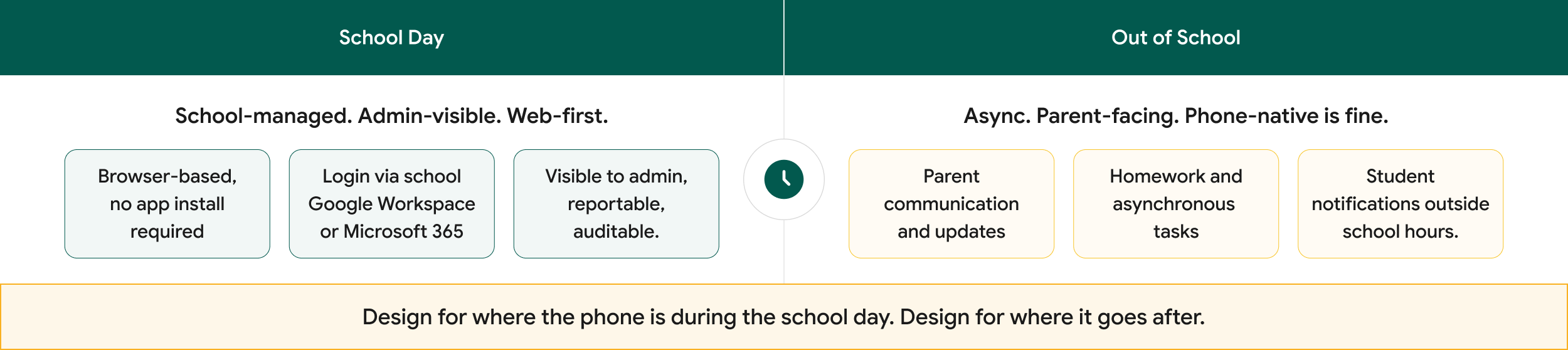
Build consent and exemption workflows as a first-class feature, not a year-two add-on. Schools now have a live, funded, auditable reason to want them. A product that treats SEN and medical exemptions as an afterthought is asking for the same criticism the policy itself has faced. EduSmart Planner, the AI curriculum platform built for CJ Fallon, is an example of the underlying pattern that matters here: admin, teacher and school interfaces designed from the outset to sit alongside whatever each school already runs, rather than assuming a single onboarding flow fits all 700 of them.
Do not overclaim the evidence in positioning. Cite the Lancet null result and the KCL pilot's teacher-reported gains in the same sentence. A nuanced position is more credible with an increasingly evidence-literate buyer, not less differentiated.
Watch Northern Ireland's public consultation (running to roughly November 2026) as the leading indicator for whether the lighter Irish approach eventually hardens into something closer to England's statutory model.
Get ahead of the scrutiny before it arrives. Commentary is already describing 2025's phone bans as the first of three connected waves: social media age limits next, then a predicted 2027 backlash against 1:1 device programmes and mainstream EdTech generally, driven by the same parents and teachers who pushed for phones to be locked away asking why laptops get a pass. A vendor that publishes its own evidence base, data-handling posture and exemption design now is negotiating from a position schools will recognise later.
The Wicklow school that spent a year rebuilding its policy from scratch did not do it because the evidence was settled. It did it because the deadline was real and the disruption was coming either way. That is the more useful lesson for EdTech builders than any verdict on whether the ban itself works: the mechanism, the timing and the procurement gap are the parts of this story that are actually certain, and they are the parts a product roadmap can be built on today.
Frequently asked questions
What does Ireland's phone-free schools policy actually require?
Primary schools must ban pupil access to personal mobile phones for the full school day. Post-primary schools must restrict use, with more flexibility over implementation. Both circulars require schools to consult parents, students and staff before finalising their policy, and neither applies to the commute to and from school.
Is there a law banning phones in Irish schools, or is it just guidance?
It is administrative guidance, not legislation. The policy runs on Department of Education circulars (0044/2025 and companions) backed by conditional funding, not a statute. This is a materially lighter and more reversible mechanism than England's, where a duty to have regard to phone-free guidance has been in force under the Children's Wellbeing and Schools Act since June 2026.
How much funding did the Irish government provide for school phone storage, and what can it be spent on?
€9 million in Budget 2025, paid out at roughly €25 per post-primary pupil, and legally restricted to pouches or lock boxes. Schools cannot redirect the money toward other needs, and the government cancelled a planned national supplier tender in early 2025, leaving each school to procure its own solution.
Does research show that banning phones in schools improves wellbeing or grades?
The evidence is genuinely mixed. A 2025 Lancet study of 30 English schools found no significant improvement in wellbeing, attainment, sleep or behaviour from bans. A separate LSE working paper found bans raised test scores by roughly 6.4% of a standard deviation, with the largest gains among low-achieving students. Neither result should be treated as the final word.
What did Ireland's Ombudsman for Children say about the policy?
In a September 2025 report based on consultation with teenagers aged 13 to 17, the Ombudsman for Children's Office concluded that blanket bans are not in the best interest of children and called for a more rights-based approach that accounts for the learning, health-monitoring and communication functions phones serve for some students.
What product opportunities does the phone-free schools policy create for EdTech companies?
The clearest gaps are in the software layer around the policy: consultation and policy-communication tooling, SEN and medical exemption management, funding-compliance reporting, and parent-communication infrastructure. AI-policy compliance is a closely adjacent, arguably larger opportunity running on the same timeline.
Should EdTech founders expect Ireland to legislate a phone ban the way England has?
Not on current evidence. Ireland has stayed with administrative circulars while England moved to a statutory duty and Northern Ireland is mid-consultation. Ireland's own children's rights watchdog has already pushed back on blanket bans, which makes a move toward harder legislation less likely in the near term than a possible softening.
If your product still assumes a student's personal phone is in the room, this is the most useful moment to audit that assumption. The policy gap described above, consultation tooling, exemption management, compliance reporting, parent communication, is opening now and will be much harder to enter in twelve months once the first vendors have established Irish references.
Read next: what Irish schools and universities actually expect from EdTech software before they buy, including the compliance baseline and the unwritten checklist that kills deals after a strong demo. What Irish Schools and Universities Expect From EdTech Software Before They Buy
Or, if you want to map where your product sits against the phone-free policy requirements and the adjacent AI-policy surface before your next Irish pitch, we offer a complimentary Discovery Sprint assessment. Book a Discovery Sprint