



There is a checklist Irish schools and universities work through when they evaluate EdTech software, and roughly half of it is not written down anywhere. The written half is the RFP. The unwritten half is what kills deals in week six, after the demo went well and the technical review passed.
For a vendor coming into the Irish market, or an Irish EdTech founder pitching for a first serious institutional deployment, the gap between the two lists is what decides whether the first customer becomes ten and whether the first pilot becomes a paid contract.
This is a piece about both halves. What is on the RFP, what is not on the RFP but should be, and what Irish buyers actually want to see before they sign.
Key takeaways
The buyer is not one buyer. Primary schools, post-primary schools, ETBs and universities each run different procurement processes, with different decision-makers, different budgets and different constraints.
Compliance is the price of entry, not a differentiator. GDPR (General Data Protection Regulation, the EU data protection law), EU data residency, DPIA (Data Protection Impact Assessment) support and a clean sub-processor list get you into the room. They do not get you the contract.
Deals die on the unwritten checklist. Support hours in Irish time, references from Irish institutions, and a payment model that fits a school budget cycle matter more than most vendors realise.
Procurement calendars are set by the academic year. For schools, decisions cluster in spring and summer. For universities, capital budgets close on their own financial year, often out of sync with the classroom calendar.
"We already sell in the UK" is not a shortcut. Different data protection regulator, different procurement frameworks, different reference dynamics, different pricing tolerance.
Getting bought is easier than getting sold. Irish institutions call their peers. Six delighted schools with named references is worth more than any deck.
What "expects" actually means here
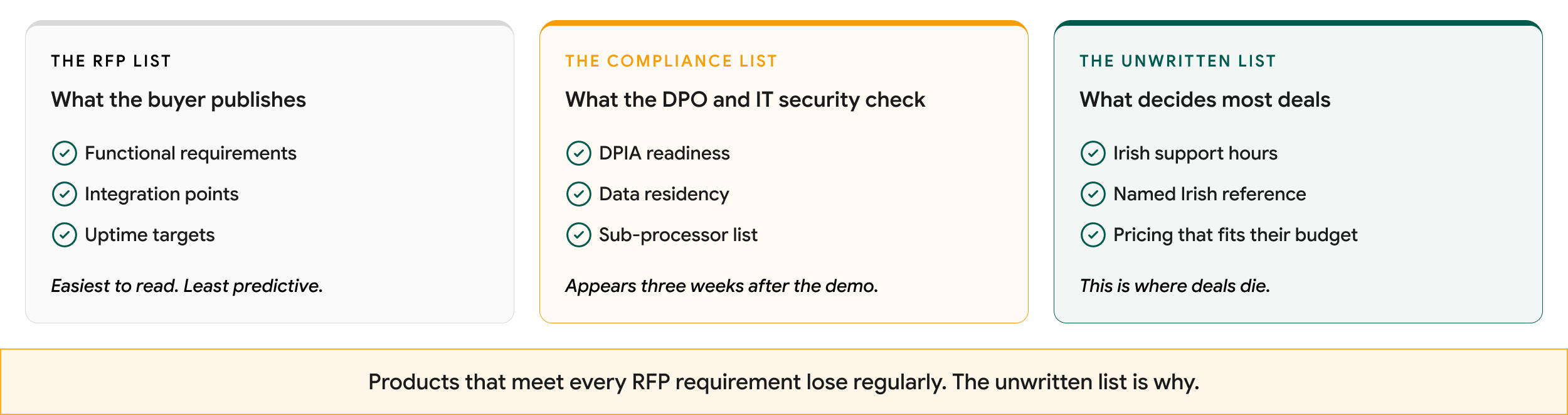
The word "expects" hides three separate lists, and vendors who conflate them are the ones who lose deals they thought were closed.
The RFP (Request for Proposal, the formal document institutions publish when inviting vendors to bid for a contract) list is what the buyer publishes: functional requirements, integration points, uptime targets, reporting features. It is the easiest list to read and the least predictive of the outcome. Products that meet every RFP requirement lose regularly.
The compliance list is what the buyer's DPO (Data Protection Officer), IT security team and finance controller check before signing. Some of it appears in the RFP. Much of it appears three weeks after the demo, when the vendor discovers a DPIA is required and there is no template ready.
The unwritten list is the one that decides most deals. It covers things the buyer takes as obvious. Support in Irish business hours. A reference they can phone. A pricing model that fits a line in a budget they already have. A contract clause that lets them exit if their student numbers drop.
Every subsequent section in this piece is really about which list the item lives on.
Who is actually making the decision
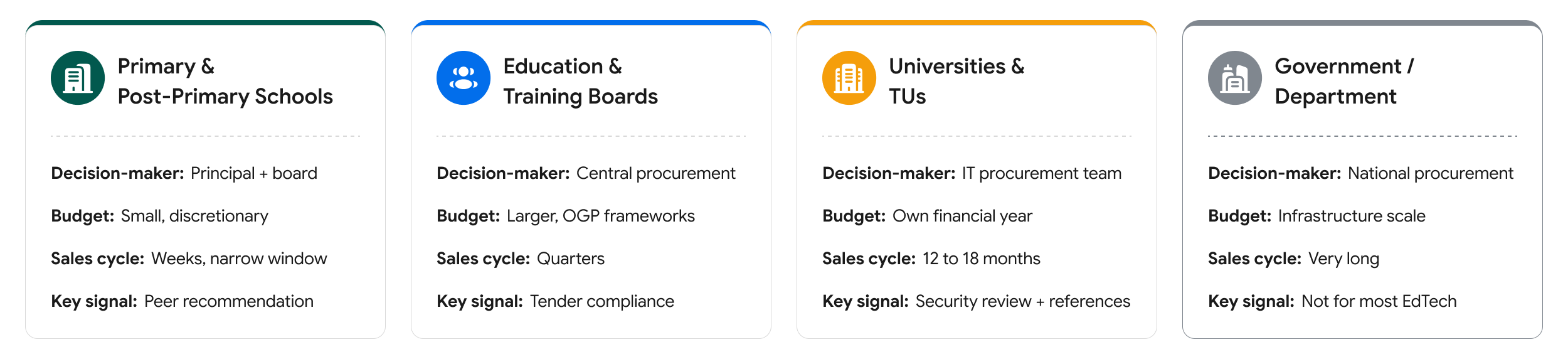
Ireland has four distinct EdTech buyers, and the sales motion for each is different.
Primary and post-primary schools are individual institutions. In most cases the principal, the deputy principal and a nominated teacher form the buying committee, with the board of management approving anything material. Budgets are small and discretionary spend is tight. Peer recommendation carries more weight than any other channel. Sales cycles are short in absolute terms but sit inside a very narrow window each year.
ETBs (Education and Training Boards, the sixteen regional statutory bodies that run further education, adult education and apprenticeships) buy at a different scale. An ETB may cover dozens of centres and thousands of learners. Their procurement runs through the OGP (Office of Government Procurement) frameworks where possible, and above-threshold tenders where not. Sales cycles are measured in quarters, not weeks.
Universities and institutes of technology (many now grouped into Technological Universities) have dedicated IT procurement teams, established security review processes, and their own financial year that is often out of sync with the academic year. The decision-maker is rarely one person. Sales cycles routinely run twelve to eighteen months from first contact to signed contract.
Department-level buying exists but is rare and slow. When it happens, it tends to be procurement of national infrastructure rather than individual EdTech products.
If your product is priced for one buyer type and you are pitching another, the mismatch will surface late and painfully. The safest first step is to name your buyer before you name your feature set.
The compliance baseline: what has to be true before you are in the room
Seven items will be checked in every serious Irish procurement conversation. If any are missing, the deal does not progress regardless of how good the product is.
GDPR compliance with an Irish-relevant data protection notice. The regulator is the DPC (Data Protection Commission), not the UK's ICO (Information Commissioner's Office). Language that references the wrong regulator signals a vendor who has not localised.
EU or EEA (European Economic Area) data residency. Data held in the US, even with Standard Contractual Clauses, will slow a deal in schools and often kill it in universities. The default expectation is data in an EU region.
A completed DPIA template you provide to the buyer. The buyer is legally responsible for the DPIA. Vendors who make it easy win. Vendors who send back "the customer needs to do that" lose.
A published sub-processor list. Which third parties touch the data. Kept current. Notification process for changes.
Cyber insurance at a level appropriate to the contract value. Increasingly asked for by universities and ETBs, occasionally by schools.
A recognised security certification or equivalent evidence. ISO 27001 or Cyber Essentials Plus is the common ask. If you do not have either, a completed security questionnaire with named controls will substitute for smaller deals.
Safeguarding-aware handling of any product used by under-18s. Age-appropriate design, no third-party advertising, clear position on parental consent, and evidence you have thought about it before the buyer asked.
None of this is a differentiator. It is the floor. Vendors who treat it as a differentiator are usually the ones missing something on the unwritten list.
What actually kills deals that passed the RFP
The failures cluster in the same handful of places, and none of them appear on the RFP.
Support hours that do not overlap the Irish school day. A ticket raised at 9am Dublin time that gets a first response at 4pm Pacific is a ticket the deputy principal will remember at renewal.
No named Irish reference. "We work with schools in Australia and Canada" is not a substitute. The first question the buyer asks their peer is "who else here uses this?"
Free tier that changes without warning. Schools have been burned. Any freemium model needs a written commitment on what stays free and for how long.
Data leaving the EU. Even if legally defensible, the perception risk is enough to end conversations.
Sub-processor list not disclosed on request. Read as a sign the vendor does not know its own supply chain.
Contract that auto-renews with a long notice period. Common in enterprise SaaS, unwelcome in Irish schools and universities. Twelve-month terms with clear opt-out beat multi-year lock-ins.
Training treated as an optional add-on. For most Irish school buyers, training is not a line item they can add later. It is part of what they thought they were buying.
Sales handled entirely remotely. Universities and ETBs will meet remotely, but the presence of an Irish-based commercial contact, even part-time, changes how the vendor is perceived. Peer institutions ask each other whether the vendor "actually shows up."
Roadmap that assumes UK terminology. Referring to "Year 7" instead of "First Year," or to "SIMS" instead of "the school MIS," signals a product built for elsewhere. Small things, but they accumulate.
Each of these is a real reason a real vendor has lost a real Irish deal. None of them are on the RFP.
Within six months of your first serious Irish pitch and not sure how many of these you actually have covered?
A Discovery Sprint with SQR will map exactly where your product and your commercial model sit against each item, and what to fix before the deal is in front of a buyer. We offer this as a complimentary assessment.
The pricing model Irish buyers actually pay
Pricing is where the difference between "we sell in the UK" and "we sell in Ireland" shows up most clearly.
Per-pupil pricing is the most common shape for primary and post-primary schools in both markets, but Irish price tolerance sits well below UK equivalents on a like-for-like basis. A per-pupil price that works in an English academy trust of eight thousand pupils will not work in an Irish primary school of two hundred and forty.
Per-institution pricing works well for smaller Irish schools where the pupil-based number becomes rounding-error revenue. A flat annual fee that fits inside the discretionary line the principal already spends against is often more sellable than a per-head model that requires a board conversation.
Per-user pricing for staff-facing tools (planning, admin, professional development) is well understood by Irish buyers and rarely resisted.
Consumption-based pricing is a hard sell. Schools and universities budget annually and dislike bills that vary month to month. If your product genuinely has to be consumption-priced, provide an annual cap.
Free pilots are expected in higher education and common in ETBs. In primary and post-primary schools, a free pilot is fine, but the paid contract that follows needs to be structured to survive one bad term. A school that hits a rough patch and cannot exit will not renew, and will tell its peers.
Pro tip. Getting the pricing model wrong is more expensive than getting a feature wrong, because it takes eighteen months to notice. The right time to test pricing assumptions against the Irish market is before the first pilot, not after the first renewal conversation.
Procurement calendars and why they set your sales calendar
The academic year runs the buying process, and the calendar is less flexible than most vendors expect.
Primary and post-primary schools make most of their buying decisions between February and June, for deployment in the following September. Pitching in November means either a January conversation or an eight-month wait. Pitching in July means September at the earliest and often the following February.
ETBs work to a rolling procurement calendar but tie major decisions to their annual planning cycle. First contact in October for a spring decision is a reasonable rule of thumb.
Universities are the outlier. Their capital and operational budget cycles do not align neatly with the classroom calendar. Many Irish universities set their financial year end at 30 September, which means budget planning happens in spring and summer for the following academic year. Getting on a budget line means being in the conversation before the budget is drafted, not after.
The peak-term risk applies to all buyers. If your product has any student-facing component, its worst technical stress happens in the same fortnight every year: the start of the school year in late August and early September, and the start of second term in January. Buyers who have been burned know to ask about this. Vendors who cannot answer well lose.
If you time your first serious Irish sales push for October with a target of December pilots, you have chosen the worst possible cycle. Better to plan the campaign for February to April with September go-live targets, and use the intervening months to build the references and the compliance artefacts you will need.
What good preparation looks like
The EdTech products that have reached genuine scale in the Irish school market share a recognisable pattern, and it is not product quality. It is that the compliance work and the pricing model were treated as product, not paperwork, before the first deal was signed.
EduSmart Planner, built with CJ Fallon, sits in more than 100 Irish schools because CJ Fallon already had thirty years of relationships with those schools before the software existed. The product was designed for the specifics of Irish curriculum structure, and the sales motion inherited institutional trust. GDPR compliance was in place from day one. Sub-processors were clearly named. Pricing fitted a budget line schools already had. That is not a shortcut most EdTech founders can copy, but it is the shape of what "bought, not sold" looks like when it works.
The pattern across the platforms SQR has built for the Irish market is consistent. Compliance was ready before the buyer asked. Pricing fitted the buyer's existing budget line. A named Irish contact answered the phone. References were current, local, and willing to speak. The product did not require the buyer to explain it to their board.
What to have ready before your first serious Irish pitch
If you are within six months of your first paid Irish deployment, work through this list.
1. A DPIA template, filled in for a representative deployment. The buyer will need it. Making them draft it is the difference between a two-week review and a two-month one.
2. A current sub-processor list on your website. Not in a PDF sent on request. Public, dated, and updated.
3. Data residency evidence. Which region, which provider, which certification.
4. At least one Irish reference willing to take a call. From the same segment. Named, not anonymous.
5. A pricing option that fits a line the buyer already spends against. Not a bespoke quote every time.
6. A stated support window that overlaps Irish business hours. With a named channel and a response time you can defend.
7. A training plan included in the price. Delivered by a person, at least for the first cohort.
8. A twelve-month contract as the default. Longer options available. Not the only option.
9. A localisation pass on your marketing copy. Irish year names, Irish institution types, correct regulator, correct qualifications framework.
Half of this list is product decisions. Half is commercial. All of it costs more to fix in month eighteen than to build in month three.
Frequently asked questions
Do Irish schools actually check GDPR compliance in detail, or is it a tick-box?
They check. Since GDPR came into force, and particularly since a series of high-profile enforcement actions in the education sector across Europe, DPC awareness is high in Irish schools and universities. A vendor that cannot produce a DPIA template on request is a vendor that does not get short-listed.
Does Irish language support matter for EdTech products sold to Irish schools?
For most products sold into English-medium schools, no. For products sold into Gaelscoileanna (all-Irish primary schools) and Gaelcholáistí (all-Irish post-primary schools), yes, and there is a small but active market where Irish-language support is a genuine requirement. For products used across the general system, an Irish-language interface is a nice-to-have that occasionally moves a deal.
Is a UK reference useful when selling to Irish schools?
Useful but not sufficient. Irish buyers will listen to a UK reference for product quality but will still want an Irish reference for procurement fit, support responsiveness and cultural fit. The first Irish customer is the hardest sale. Every one after is easier.
How much should I budget for the compliance and localisation work before I can sell in Ireland?
For a vendor already selling in the UK or another EU market, the marginal cost is usually a few weeks of engineering plus a legal review. For a vendor coming from the US, budget more, because data residency and DPIA readiness often require infrastructure work.
Do universities and ETBs use the same procurement rules as central government?
They use the same OGP frameworks where those frameworks apply, and follow the same public procurement thresholds. In practice, individual institutions have their own procedures on top and timelines are institution-specific.
Can I sell to Irish universities without a local presence?
Yes, but it is harder. A named local contact, an Irish support number, and evidence of existing Irish deployments each compress the sales cycle. None are strictly required. All are noticed.
What is the biggest single mistake vendors make when they enter the Irish market?
Assuming Ireland is a smaller version of the UK. It is not. The regulator, the procurement rules, the reference dynamics and the pricing tolerance are all different, and each of them can independently kill a deal that would have worked across the Irish Sea.
If you are building for Irish schools and universities, the compliance and commercial decisions described above are easier to make in month three than in month eighteen. The architecture and integration layer underneath all of this is where most of the technical complexity sits.
Read next: how MIS integration works in practice in the Irish market, what breaks in late August, and what your product needs to handle before the first school goes live. MIS Integration for EdTech: Why Late August Decides Whether Schools Stay With Your Platform
Or, if you want to map where your product currently sits against the compliance baseline and the unwritten checklist before your first Irish pitch, we offer a complimentary Discovery Sprint assessment. Book a Discovery Sprint