



Every Irish EdTech company is, whether it has designed for it or not, running two calendars at once. One is the fiscal calendar its investors and finance function think in. The other is the academic calendar its customers actually live by, and only one of those two can move to suit the business.
Most B2B software treats a delayed release as a bad sprint. In education, a delayed or broken go-live in the first week of September is a different category of problem entirely. Schools cannot revert to a previous system mid-term. Parents notice within days. And the state has statutory data returns due on a date no vendor set and no vendor can push back.
The founders who build engineering, product, sales and customer success around the academic calendar consistently outperform those who treat it as a sales team's problem to manage around.
Key takeaways
The Irish school year has one clean entry point, not several. Most schools reopen in a rolling two to three week window around the start of September, and every other break in the calendar is either too short or too risky for a major go-live.
September is where the money crystallises, not just the timetable. Capitation and ICT grant funding are calculated against September enrolment counts, so a school's real spending power for new software is only knowable once the census lands.
A broken go-live in September is not a support ticket, it is a compliance incident. Schools carry statutory reporting obligations that a vendor outage can put at risk. The UK's Bromcom outage in September 2025 and the 2026 cyberattack on Northern Ireland's C2K network both show what a calendar-concentrated failure actually costs.
Renewal decisions are made months before the contract's nominal end date. Annual churn on district-level EdTech contracts runs between 15% and 30%, concentrated in late spring, when schools are finalising the following year's digital learning plan.
Five functions need to run on the academic calendar, not the fiscal one. Engineering, product, sales, customer success and compliance each need a distinct academic-year rhythm. Treating any one of them as calendar-agnostic creates risk the others cannot absorb.
Why the Irish academic calendar is a fixed constraint, not a scheduling inconvenience
It is fixed because no single actor controls all of it, and the parts that are fixed are fixed by statute rather than by convention. The Department of Education and Youth standardises the main breaks through an annual circular (most recently Circular 0018/2026), and that circular applies to every recognised primary and post-primary school including Gaelscoileanna and DEIS (Delivering Equality of Opportunity in Schools, the Department of Education programme targeting schools with the highest concentrations of students from disadvantaged communities) schools.
What the Department does not fix is a single start date. The school year begins in the week that contains 1 September, but each school sets its own reopening date within that window. This means "go live for the new year" is not one date on a national calendar. It is a rolling two to three week window that a vendor's implementation team has to service across every customer at once, each with its own exact reopening day.
Higher education runs a parallel logic: Irish universities time major platform changes to complete before semester one begins, never mid-semester, for the same underlying reason. A partial migration during live teaching has no acceptable fallback.
What this means for your product roadmap: your release window for anything that touches attendance, timetabling, or student data is not a week. It is a multi-week operational surge across your entire customer base, happening simultaneously, with no ability to stagger.
Which weeks can an Irish school actually go live in
Fewer than the calendar suggests. Most of what looks like a mid-year implementation opportunity is unsuitable for anything beyond minor configuration.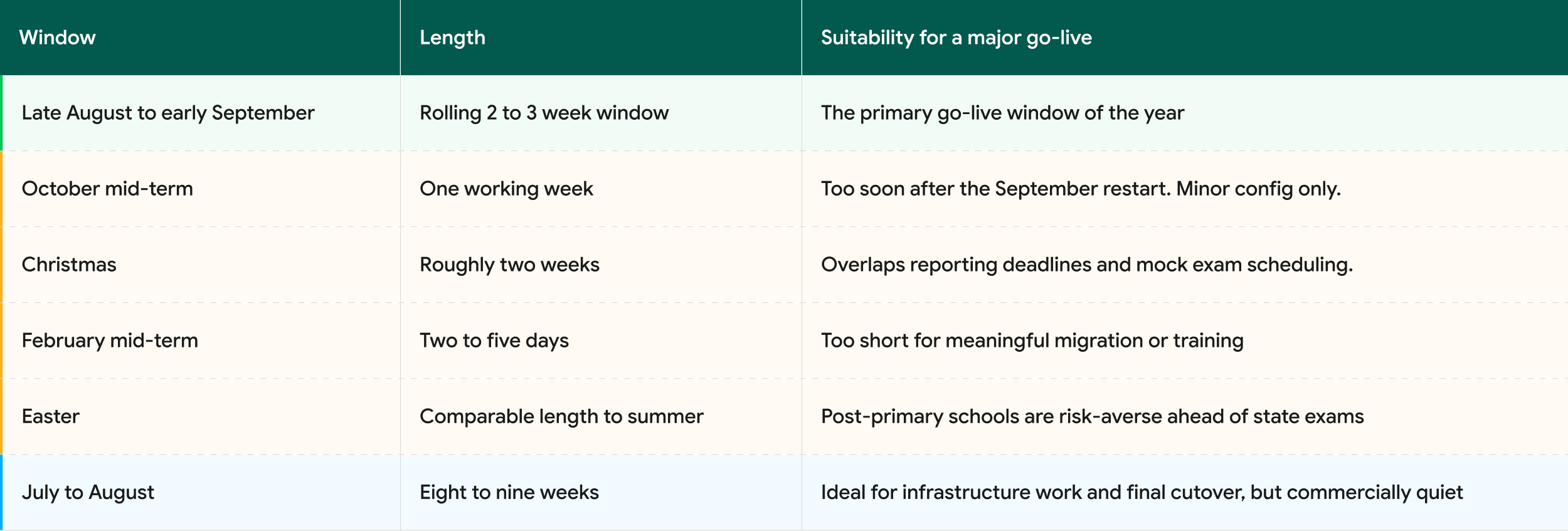
Compass Education's migration guidance plans onboarding with all data cleaned, validated and signed off ahead of March exams or a summer switch, ruling out mid-year moves for anything touching exam-sensitive data.
Every documented Irish higher education VLE (Virtual Learning Environment, the platform universities use to deliver course content and manage student learning) migration follows the same shape: evaluate during one academic year, cut over cleanly at the boundary, never mid-term.
Why September decides the money as much as the timetable
State funding for schools is keyed to September enrolment, not to a fiscal quarter or a vendor's preferred renewal date.
The core capitation grant (€224 per pupil at primary level from September 2025) is paid in instalments tied to the school year. For 2026/27 the Department moved the first instalment into September, with the second in January and a balancing payment in June.
The funding actually available for new software is a separate, smaller, ring-fenced pool. The primary ICT (Information and Communications Technology) grant combines a €2,000 basic payment with a per-pupil rate of €25.33 for mainstream pupils, €30.40 for pupils with special educational needs, and €27.86 in DEIS schools. SEN (Special Educational Needs) funding is calculated against enrolment on 30 September of the prior year. The post-primary ICT grant carries the same €2,000 basic structure plus a per-student rate, and it is explicitly use-it-or-lose-it: any balance unspent at year end has to be reconciled and reported.
The practical result is a funding sequence that looks nothing like standard SaaS billing. A school's real spending power for a given tool is only knowable once its September enrolment is confirmed, yet the software ideally needs to be live before the year starts to be useful for that year's attendance and timetabling.
Vendors who build contracts around a "commit in spring, pay after the September census" pattern are working with the funding cycle. Vendors who assume a calendar-year SaaS billing pattern are working against it.

Pro tip. If a school's budget conversation stalls in June or July, it is not usually reluctance. It is arithmetic. The ring-fenced ICT envelope often cannot be confirmed until the September count lands, so a payment schedule that does not ask for cash before then closes more deals than a discount does.
What happens when your product is not ready for the September restart
It stops being a vendor problem and becomes a school's regulatory problem. Schools carry statutory data obligations, including the mandatory September return and the POD (Primary Online Database, the national database recording student data at primary level in Ireland) return, that do not move because a supplier's platform is degraded. The school, not the vendor, carries the exposure if those returns are late or wrong.
The clearest cautionary evidence comes from the UK's MIS market. Bromcom's cloud platform suffered reported outages between 4 and 9 September 2025, with some days recording severe degradation for over nine hours, leaving schools unable to access timetables, pay suppliers, or respond to safeguarding concerns. Ireland has its own version of this risk at national infrastructure scale: the 2026 cyberattack on Northern Ireland's C2K network disrupted access for hundreds of thousands of pupils and teachers, with more than 300 schools joining a recovery webinar and roughly 80% of post-primary schools back online after the initial disruption.
Neither incident was an Irish EdTech vendor's failure, but Irish IT directors and ETB (Education and Training Board, the regional bodies running vocational and community schools in Ireland) leaders do not need Ireland-specific incidents to factor that risk into their renewal conversations. A vendor asking to touch a school's core systems is scrutinised more closely now than it was five years ago.
For EdTech founders, the lesson is structural. If your product touches attendance, timetabling, or statutory reporting, September is not a release window. It is a stability guarantee. Every engineering decision made in the preceding twelve months is either contributing to that guarantee or eroding it.
Working out whether your platform's architecture is built for the September spike or for an average week?
We offer a complimentary assessment as part of our Discovery Sprint: a mapped view of where your current build sits against the September readiness bar and what to prioritise before the next academic year.
How engineering and product teams should plan releases around a calendar they cannot move
By inverting the standard SaaS release cadence rather than importing it. Continuous deployment and ship-and-iterate-in-production treats every week as roughly equal risk. That assumption is actively dangerous for a product schools depend on for statutory returns.
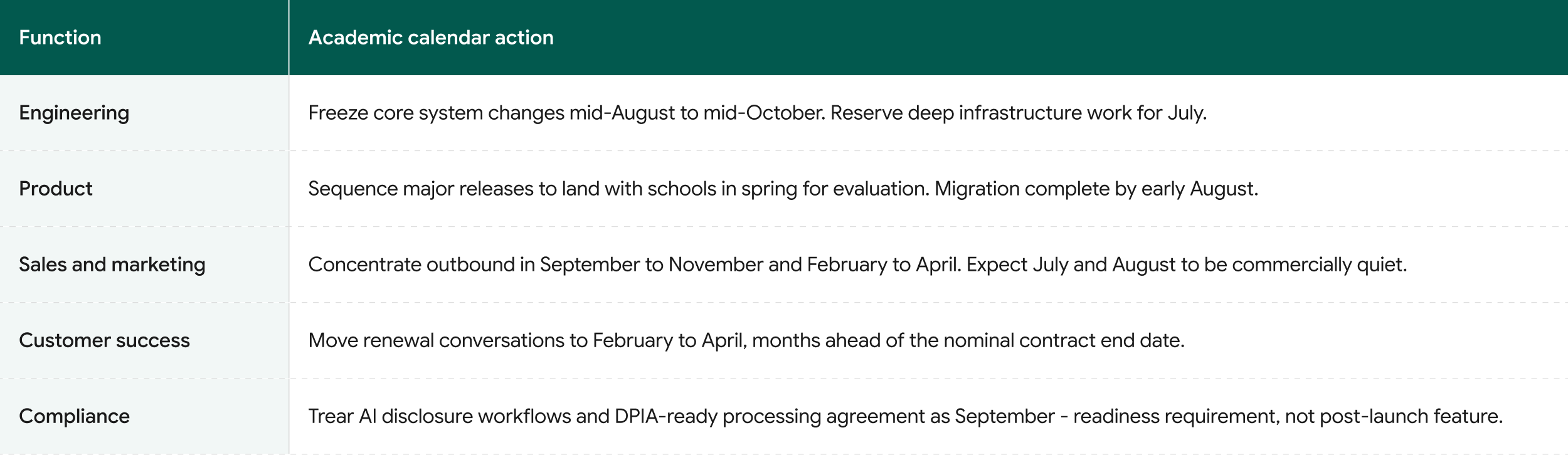
The safer pattern is a de facto change freeze from mid-August through the September census and into October mid-term, roughly eight to twelve weeks in which any team shipping schema changes or UI overhauls to attendance, timetabling, or communications is trading a marginal feature gain against the one moment every customer needs the product to work simultaneously.
That freeze only works if the unglamorous infrastructure work (schema migrations, security hardening, major version upgrades) happens in the window schools are least available: July, and to a lesser extent the Christmas break.
Two compliance surfaces now sit inside that same September readiness bar. The Department's October 2025 Guidance on Artificial Intelligence in Schools introduces a "4P" framework (Purpose, Planning, Policies and Practice) and requires students to disclose AI-generated content in coursework from the 2025/26 school year. And the DPC's (Data Protection Commission's) December 2024 Data Protection Toolkit for Schools places a direct obligation on schools to have an Article 28 processing agreement in place with any third-party vendor before deployment. Both need to be finished products before the summer procurement window opens, not promises made during it.
Pro tip. The clearest early sign that a product was not built for the September spike is a support queue that grows faster than the user base. If ticket volume in the first week of term outpaces enrolment growth, the architecture is what needs fixing, not the support rota.
What "ready for September" actually looks like in practice
It looks like architecture decisions made months before the restart, built specifically for the week everything happens at once rather than for an average week.
One of the platforms we built for an Irish international education provider needed to hold up to 1,500 concurrent students during peak summer programmes without the attendance and welfare systems staff rely on falling over. The modular, mobile-first architecture was designed around that specific spike rather than an average day, and the platform now handles peak season with zero downtime while cutting report-generation time for admin teams from two hours to two minutes.
EduSmart Planner, the AI curriculum platform we built for CJ Fallon, was designed specifically to solve the real-time problem that comes with scale: updating the status of thousands of schools' long-term and short-term plans without a backend bottleneck. It now runs across more than 100 Irish schools and 2,000 teachers, with schools reporting roughly 75% of time saved in curriculum management.

When the renewal conversation with an Irish school should actually happen
Months before the contract's nominal end date, not when the renewal notice is due to go out. School budget cycles finalise the following year's spending well ahead of a contract's formal expiry, and by the time a renewal reminder lands close to that date, the decision has often already been made without the vendor in the room.
That mismatch has a measurable cost. Annual churn on district-level EdTech contracts runs between 15% and 30%, with the heaviest losses concentrated in late spring, the same window in which Irish schools are finalising their digital learning plan spend ahead of the September census. The renewal, upsell, and "are we still the right fit" conversation all need to happen in roughly February to April, because that is when the proportion of the following September's ICT grant available for a renewal is actually being decided.
Pro tip. If a customer success team's renewal pipeline is organised by contract end date rather than by academic term, it is tracking the wrong calendar. The real decision date is usually two to four months earlier than the paperwork suggests.
What to do now: mapping five functions against the academic year
Rather than treating the academic calendar as a sales team's constraint to work around alone, map all five functions against it before writing the next roadmap.
Not every EdTech company runs on this exact clock. A platform built for professionals studying for accountancy and tax exams alongside a full-time job follows the exam calendar of its professional body rather than the September school year. Calendar-native means the calendar your actual customer runs on, not a generic school-year assumption applied by default. For anyone building for Irish schools, though, the evidence points the same direction consistently: the academic calendar is not a constraint to design around once and forget. It is close to the whole operating model.
Frequently asked questions
Why do Irish schools all need new software at the same time of year?
Because the school year has one main entry point: a rolling window around the start of September. Every other break in the calendar is either too short for meaningful migration and training, or falls too close to State exams and mock exam scheduling to be a safe implementation window.
When does the Irish school year officially start, and who decides the exact date?
The Department of Education and Youth standardises the main breaks through an annual circular, but it does not fix a single start date. The year begins in the week containing 1 September, and each school sets its own reopening date within that window.
How is Irish school ICT funding structured, and when does it actually land?
Core running costs are covered by the capitation grant, while digital learning tools draw on a smaller, ring-fenced ICT grant calculated per pupil and tied to September enrolment figures, including a separate rate for SEN and DEIS pupils. Both funding lines are only fully known once the September census is confirmed.
What is the SMIS framework, and how does it affect how vendors sell into Irish schools?
The SMIS (School Management Information System) framework, run through HEAnet (the national education and research network operator for Ireland), is a standing panel of approved suppliers that individual schools re-run as mini-competitions rather than a single national tender won once. A vendor's product, support SLAs, and September-readiness track record are re-evaluated school by school on an ongoing basis.
What happens if an EdTech vendor's software is not ready for the September restart?
The risk shifts to the school. Mandatory statutory returns, including the September return and the Primary Online Database, do not move to accommodate a vendor outage, and comparable incidents in the UK and Northern Ireland's school MIS market show how quickly a technical failure during that window becomes an operational and reputational crisis.
When should an EdTech company start its renewal conversation with an Irish school?
Roughly February to April, months before the contract's formal end date. That is when schools finalise the following year's digital learning plan and ICT grant allocation, and a renewal conversation that starts only when the paperwork says the contract is ending is usually too late to influence the decision.
Should EdTech companies release major product updates during the school year?
Generally no, particularly not between mid-August and the October mid-term, or in the weeks before State exam coursework deadlines. The safer pattern is to reserve substantial infrastructure and feature work for July, when schools are least available for feedback but also least exposed to disruption risk.
The academic calendar is not the sales team's problem. It is the product's architecture, the engineering release schedule, the customer success calendar, and the compliance checklist, all at once.
If your roadmap, funding model, or renewal calendar is not yet built around the Irish academic year, read next: how MIS integration, the technical layer underneath all of this, actually works in practice and what breaks in late August when it is not right. MIS Integration for EdTech: Why Late August Decides Whether Schools Stay With Your Platform
Or, if you want a view of where your current product sits against the September readiness bar before the next academic year, we offer a complimentary Discovery Sprint assessment: a mapped view of your architecture, your release calendar, and your compliance posture against what Irish schools will actually need from you in week one of term. Book a Discovery Sprint