AI Integration Services for Existing Software and Secure Workflow Automation

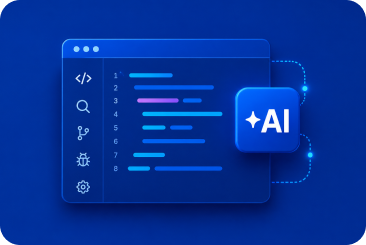
Square Root Solutions helps Irish businesses integrate AI into CRM, ERP, SaaS, legacy software, and internal workflows without replacing core systems. Our AI integration services in Ireland include secure intelligent workflow automations, workflow automation, RAG systems, copilots, and API-based AI architecture that reduce manual work, improve reporting, and support GDPR-aligned AI adoption.

Let’s Discuss!

What AI Problems Do Irish Businesses Hire Our AI Integration Company to Solve?

Irish businesses hire our AI integration company to solve manual workflows, workflow bottlenecks, weak reporting, disconnected systems, and slow approvals. Our embedding artificial intelligence services apply business automation, AI-driven insights, and reporting automation to improve workflow visibility, reduce admin overhead, and support faster business decisions.

Manual Workflow Automation Across Admin, Reporting, and Approval Processes

Our AI software integration specialist team in Ireland applies AI workflow automation to repetitive admin tasks, approval routing, reporting cycles, and spreadsheet-heavy processes. This helps Irish businesses improve process consistency, reduce manual data entry, lower human error, and speed up daily operations.

AI-Driven Operational Insights From Existing Business Data

Our Generative AI integration services turn existing business data into AI-powered business intelligence, predictive analytics, and intelligent dashboards. This helps businesses identify trends, detect operational issues, improve forecasting accuracy, and make data-driven decisions with more confidence.

How Do We Integrate AI Into Existing Software Without Replacing Everything?

We help businesses integrate AI into existing software through APIs, middleware, and controlled integration layers. This supports AI system integration with current tools, extends existing workflows, supports legacy software, and reduces infrastructure replacement costs with minimal operational disruption.

AI Integration With CRM, ERP, SaaS, and Internal Business Tools

We connect AI with CRM APIs, ERP workflows, SaaS platforms, and internal business tools through middleware and webhooks. This helps businesses synchronise systems, automate cross-platform workflows, centralise business data, and improve API connectivity.

Legacy Software Integration With APIs, Data Sources, and Existing Infrastructure

We support legacy AI integration with ETL pipelines, API wrappers, database connectors, and secure data mapping. This helps businesses modernise older systems, unify disconnected data, reduce technical debt, and maintain operational continuity.

Who We Help with Intelligent Workflow
Automation Services in Ireland

Square Root Solutions provides AI integration services for Irish businesses that want to add AI to existing software, automate workflows, improve reporting, and reduce manual work without replacing core systems.

Our services are best suited for enterprises, D2C brands, and small businesses that already use CRM, ERP, ecommerce, SaaS, reporting, or internal workflow tools and want practical AI features connected to their current operations.

AI Integration Services for Enterprises

We support enterprise businesses that need scalable AI integration across CRM, ERP, SaaS platforms, legacy software, internal systems, and complex operational workflows. Enterprise AI system integration can help large organisations automate approvals, improve reporting, strengthen operational visibility, connect disconnected systems, and deploy AI workflows with access controls, audit trails, and governance planning.

Common enterprise use cases include:

  • AI-powered integration with CRM, ERP, SaaS, and internal systems
  • GDPR-aware AI deployment planning with access controls and audit trails
  • Enterprise workflow automation across departments
  • AI copilots, RAG systems, internal knowledge search, and operational dashboards
  • Support for legacy software, middleware, APIs, and complex integrations

AI Integration Services for D2C Companies

We help D2C companies integrate AI into ecommerce platforms, CRM systems, support tools, marketing workflows, reporting dashboards, and internal operations. These integrations can help brands improve customer support, speed up response handling, automate repetitive workflows, personalise customer interactions, and create better visibility across sales, support, and operations.

Common D2C use cases include:

  • Website AI chatbots and customer support automation
  • AI-powered reporting, customer insights, and operational dashboards
  • CRM, ecommerce, and marketing workflow automation
  • AI copilots for customer service and operations teams
  • Cross-platform integrations for ecommerce, SaaS, support, and analytics tools

AI Integration for Small Businesses

We support small businesses that want practical AI automation without rebuilding their full technology stack. AI-powered automation can help smaller teams reduce admin work, automate approvals, improve reporting, connect existing tools, and use AI assistants for daily operations while scaling the rollout around budget, priorities, and internal capacity.

Common small business use cases include:

  • Approval and admin workflow automation
  • CRM and SaaS integrations through APIs, middleware, or controlled data syncs
  • AI assistants for internal operations and document handling
  • AI reporting and dashboard integrations
  • Phased AI rollout based on business priorities, budget, and data readiness

What AI Integration Consulting Services
Our Team Deliver?

Our AI integration consulting services include enterprise AI workflows, AI chatbots, RAG systems, AI copilots, and AI agents that automate support operations and improve operational intelligence. These services help businesses deploy scalable AI architectures, streamline workflows, and safely integrate AI into daily business operations.

AI Chatbot, Copilot, and Support Assistant Integration for Business Workflows

We build AI integration solutions with LLM chatbots, AI copilots, and support assistants that use CRM history, workflow context, and approved business data. These systems automate support responses, improve customer engagement, and support conversational automation across internal and customer-facing operations.

Secure RAG System Integration Using Approved Internal Business Knowledge

We develop secure RAG systems with vector databases, embeddings, and document indexing that answer from approved internal business knowledge. These platforms improve response reliability, reduce AI hallucinations, and support company-wide access through controlled data retrieval and traceable responses.

AI Agent Integration With Business Tools, Approval Flows, and Internal Systems

We connect AI agents with business tools, workflow triggers, approval systems, and audit trails to automate operational tasks safely. These systems support workflow governance, approval validation, and operational traceability while helping businesses coordinate complex processes with greater control.

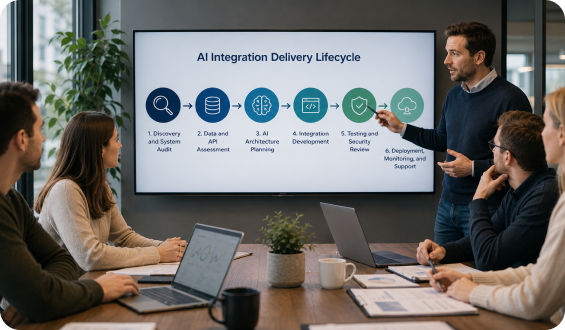
How Does Square Root Solutions Manage AI Integration From Discovery to Deployment?

Square Root Solutions follows a 6-stage intelligent workflow automation process covering workflow audit, architecture design, development, testing, deployment, and post-launch optimisation. This structured approach reduces implementation risk, keeps your existing systems running without disruption, and gives your team visibility at every stage of the rollout. On average, our clients move from discovery to a working AI pilot in 6-10 weeks, with full enterprise deployment completed in 12-20 weeks depending on system complexity.

1

Workflow Audit & AI Readiness Assessment

We begin every engagement with a structured discovery phase before any code is written. Our team audits your current workflows, existing software (CRM, ERP, SaaS tools, legacy systems), data sources, and API infrastructure to identify where AI can deliver measurable value.

Why this matters: 67% of AI projects that fail do so because of poor data readiness or unclear use-case scope (McKinsey, 2024). Our discovery phase eliminates both risks before development begins.

This phase produces a written AI Readiness Report covering:

  • Automation gaps and workflow bottlenecks ranked by impact
  • Data quality assessment and any preparation required before integration
  • API availability, access constraints, and legacy system compatibility
  • GDPR compliance considerations under Articles 5, 25, and 32, including data minimisation, privacy by design, and security of processing
2

AI Architecture Design & Integration Planning

Once the audit is complete, our engineers design a scalable AI architecture tailored to your existing software environment. We do not build generic solutions; every architecture is mapped to your specific tools and workflows.

You receive a documented integration architecture and phased delivery roadmap before development starts so scope, timeline, and budget are agreed before a single line of code is written.

This phase covers:

  • API orchestration strategy (REST, GraphQL, webhooks, middleware layers)
  • Model selection and LLM routing including OpenAI GPT-4o, Azure OpenAI, and open-source models where data privacy requires on-premise deployment
  • RAG system design using vector databases such as Pinecone or Weaviate for internal knowledge retrieval
  • Middleware and integration layer planning for CRM platforms (HubSpot, Salesforce), ERP systems (SAP, Microsoft Dynamics), and custom SaaS tools
  • Modular architecture to support phased rollout and future AI expansion
3

AI Integration Development & Build

Our engineering team builds the AI-powered automation using sprint-based delivery, with working software reviewed at the end of every two-week sprint. You see progress continuously not at the end of a long development phase.

All development follows GDPR-aligned data handling practices, with access controls, data minimisation, and processing records built in from the start not added as an afterthought.

Typical build activities include:

  • LLM API integration and prompt engineering for chatbots, copilots, and automation workflows
  • ETL pipeline development for legacy systems with structured or unstructured data
  • Embedding pipelines and document indexing for RAG-based knowledge systems
  • AI agent development with tool-calling, approval logic, and audit trail integration
  • Webhook and event-driven triggers for cross-platform workflow automation
4

Testing, Validation & Sandbox Deployment

Before any AI workflow touches your live systems, we validate it in a controlled test environment that mirrors your production setup. This step protects operational continuity and catches integration issues before they affect your team or customers.

We do not move to deployment until UAT is passed and you have signed off on results. No surprises.

Our testing process covers:

  • Functional testing of every AI workflow trigger, output, and edge case
  • Hallucination testing and response accuracy validation for RAG and LLM outputs
  • Load and performance testing to confirm the integration handles real-world data volumes
  • Security and access-control testing against your permission rules and GDPR requirements
  • User acceptance testing (UAT) with a pilot group from your team before full rollout
5

Controlled Rollout & Production Deployment

We deploy AI integrations using a phased rollout, starting with a limited pilot group before expanding to the full team or customer base. This approach reduces risk, allows real-world validation, and gives your team time to adapt without operational disruption.

Most clients see measurable workflow improvements, including reduced manual processing time and faster approval cycles within the first four weeks of production deployment.

Deployment activities include:

  • Staged release to pilot users with monitoring active from day one
  • Deployment pipeline configuration for automated, repeatable future releases
  • Integration monitoring setup using logging, alerting, and performance dashboards
  • Rollback plan documented and tested before go-live
6

User Training, Performance Monitoring & Continuous Optimisation

Deployment is not the end of the engagement, it is where we begin optimising. Our team trains your staff on the AI tools they will use daily, monitors system performance, and improves outputs based on real usage data.

Clients who complete our post-launch optimisation programme report an average 30–40% improvement in AI workflow efficiency compared to go-live benchmarks, as AI outputs are refined to match real operational patterns.

Post-launch support includes:

  • Role-specific user training sessions (admin, end-user, and IT-team tracks)
  • AI output monitoring tracking accuracy, response quality, and workflow completion rates
  • Prompt and model tuning based on observed performance gaps
  • Cost optimization reviewing LLM token usage and infrastructure spend to keep AI operating costs predictable
  • Monthly performance reviews during the first 90 days post-launch

Ready to start?

Our process begins with a free AI Integration Discovery Call — a 60-minute session where we review your current workflows, identify your highest-value automation opportunities, and confirm whether AI integration is the right fit for your business right now.

Which Industries Do You Support With AI
Integration Services in Ireland?

Our embedding AI services in Ireland support healthcare, finance, SaaS, logistics, manufacturing, and professional services businesses. We help companies automate industry-specific workflows, connect existing software, support regulated environments, improve operational efficiency, and build practical AI solutions for daily business operations.

Educational Technology

Arts and Social Networking

Real Estate

Tourism and Cultural Heritage

Transport

Digital Finance Solutions

Lifestyle and Wellbeing

Sports Technology

Hospitality

Entertainment

Why Do Irish Businesses Choose Square Root Solutions as an AI Integration Company Over a Generic Software Agency?

Irish businesses choose Square Root Solutions as their AI integration company because we combine AI consulting services, software engineering, AI architecture, and workflow automation with structured delivery planning. We help businesses integrate AI into existing systems, reduce AI implementation risk, and support long-term operational scalability through enterprise-focused deployment.

10+ years of software engineering experience across enterprise systems integration.

API-first AI system integration architecture for CRM, ERP, SaaS, and legacy systems.

GDPR-aligned AI implementation workflows with structured governance controls.

Sprint-based delivery process with deployment visibility and operational risk reduction.

Post-launch AI optimisation support for workflow efficiency and scalable enterprise AI deployment.

Start Your AI Integration Project With
Our Ireland-Based Team

Irish businesses start with an AI-powered automation discovery workshop, workflow assessment, and readiness audit. Our AI integration services review business processes, identify automation opportunities, validate AI use cases, and create a structured roadmap before implementation begins.

AI Integration Discovery Call for Workflow, System, and Data Review

Our discovery call reviews current workflows, operational challenges, existing software systems, data readiness, and automation goals. This helps assess workflow bottlenecks, identify integration opportunities, and confirm implementation feasibility.

AI Integration Roadmap With Scope, Timeline, Architecture, and Delivery Plan

We create an AI integration roadmap with milestone planning, workflow-priority mapping, technical requirements, and a phased implementation strategy. This helps businesses estimate delivery timelines, reduce implementation uncertainty, and prepare scalable rollout activities across operational teams.

FAQ

Yes. AI integration can work directly with your existing CRM without replacing it. We connect AI capabilities to your CRM through its native API, using permission-based data access so AI tools only read or write what your rules allow.

This means AI assistants, copilots, reporting automation, workflow triggers, and CRM-based AI summaries can operate inside your current CRM environment instead of requiring a separate system.

We have integrated AI with HubSpot, Salesforce, Microsoft Dynamics 365, Pipedrive, and Zoho CRM. If your CRM has an API, AI integration is usually feasible. For legacy CRMs with limited API access, we can build middleware wrappers to create secure connectivity without modifying your core system.

Most straightforward CRM AI integrations are live within 4–8 weeks from discovery sign-off. More complex integrations involving multiple systems, legacy platforms, custom middleware, or security reviews may take longer.

AI integration services in Ireland typically cost between €8,000 and €75,000+, depending on scope, system complexity, security requirements, data readiness, and the number of workflows being automated.

As a general guide:

Project type Typical cost Timeline
Single-workflow AI automation, chatbot integration, or standalone copilot connected to one data source €8,000–€20,000 4–8 weeks
Multi-system AI integration, such as CRM + ERP, CRM + internal knowledge base, RAG system build, or AI agent with approval workflows €20,000–€45,000 8–16 weeks
Enterprise AI integration across multiple platforms, legacy system modernisation, or full AI workflow automation across departments €45,000–€75,000+ 16–24 weeks

These ranges usually cover discovery, architecture, development, testing, and deployment. They may not include third-party software licences, AI model usage fees, cloud hosting, CRM/ERP licence costs, or post-launch optimisation unless specified in the proposal.

The final cost depends on the number of systems involved, API access, data quality, workflow complexity, security controls, compliance needs, and whether middleware or legacy system connectivity is required.

A discovery workshop produces a detailed scope, timeline, and fixed-price proposal before development begins, so you have a committed budget rather than a rough estimate.

Most AI integration projects take 6-20 weeks from discovery to production deployment, depending on complexity, data readiness, API access, and internal approval requirements.

Project type Timeline Examples
Simple AI integration 4–8 weeks Single AI workflow automation, chatbot connected to one knowledge source, or AI reporting layer on an existing dashboard
Multi-system AI integration 8–14 weeks AI copilot connected to CRM and internal documents, RAG system with document indexing, or AI agents with approval logic
Enterprise AI integration 14–20+ weeks Enterprise-wide AI integration, legacy software modernisation, or phased rollout across departments

The main factors that extend AI integration timelines are data readiness issues, API restrictions, legacy system complexity, security reviews, compliance approvals, and stakeholder sign-off.

Timelines are usually faster when API access is available early, source data is clean, user roles are defined, and security requirements are agreed before development starts.

Our discovery phase identifies these factors before development begins, so the timeline in your proposal reflects your actual environment rather than a best-case estimate.

No. You do not need perfectly clean data before starting AI integration. You need enough reliable data for the first use case, plus a clear understanding of which data is accurate, incomplete, duplicated, outdated, or unsuitable for automation.

Most businesses start with messy, inconsistent, or partially structured data. The key is to assess data quality before development begins, rather than trying to fix every data issue upfront.

Our discovery phase includes a data quality assessment that identifies:

  • Which data sources are reliable enough to use immediately
  • Which fields need mapping, standardisation, or light cleaning
  • Where data gaps could reduce AI output quality
  • Which data issues matter for your specific AI use case

For RAG systems and AI knowledge bases, document accuracy and freshness usually matter more than database cleanliness. For CRM integrations and workflow automation, field consistency, API access, and reliable trigger data matter most.

In practice, many projects begin with the cleanest, most useful subset of data to prove the AI integration works. The integration can then expand as data quality improves through normal business operations.

Yes. Phased AI delivery is the recommended approach for many businesses, especially when integrating AI into live systems for the first time.

A phased AI integration usually starts with one high-value pilot, validates the outputs with real users, and then expands into more workflows, systems, and departments once the business case is proven.

Phase Timeline What happens
Phase 1 — Pilot Weeks 1-8 One high-value use case, limited to a small user group. This proves the integration works, validates AI outputs, and builds internal confidence.
Phase 2 — Expansion Weeks 9–16 Additional workflows, more users, or connection to a second system using the validated architecture from Phase 1.
Phase 3 — Scale Weeks 17+ Full deployment, advanced AI features, multi-step automation, AI agents, predictive reporting, and ongoing optimisation based on usage data.

This staged approach manages budget, reduces disruption to live operations, and gives teams time to adapt to AI-assisted workflows. It also allows Phase 1 ROI to be reviewed before committing to Phase 2 investment.

Yes. Square Root Solutions provides AI consulting before development, and every AI integration engagement begins with a fixed-scope consulting phase before build work starts. We do not move into development until we have completed a workflow audit, confirmed AI readiness, validated the use case, and agreed a structured implementation roadmap with your team.

Consulting area What it covers
AI readiness assessment Reviews your existing software, data, APIs, and workflows to confirm what AI can realistically automate.
Use case validation Tests proposed AI features against your data, systems, and operational constraints.
Risk and compliance review Identifies GDPR, data sovereignty, security, and approval considerations before architecture decisions are made.
Implementation roadmap Defines phases, milestones, timelines, resources, and budget ranges in writing.

This consulting phase typically takes 2–3 weeks and is scoped as a fixed-price engagement. The output is a practical roadmap your team can use to evaluate, present internally, and approve before committing to full development.

Yes. We build and integrate AI chatbots into business websites, connecting them to your CRM, internal knowledge base, product data, support documentation, and approved website content so responses are specific to your business rather than generic.

A typical website AI chatbot integration includes:

Component What it does
LLM-powered response generation Uses an appropriate AI model selected for performance, cost, data residency, and compliance requirements.
RAG retrieval layer Connects the chatbot to approved sources such as product pages, FAQs, support articles, pricing information, and internal documents.
CRM integration Logs conversations, captures lead data, and triggers follow-up workflows.
Human escalation Routes uncertain or sensitive queries to a human agent with full conversation context.
GDPR-aware data handling Applies retention rules, access controls, and limits on personal data storage.

For websites with strong support documentation, AI chatbots can reduce repetitive enquiries and help teams respond faster. Deflection rates should be measured during pilot deployment, then improved through conversation review, knowledge-base updates, and prompt optimisation.

Yes. AI can be used to automate internal staff workflows such as admin tasks, data entry, approval routing, reporting, document processing, CRM updates, and internal knowledge retrieval.

This is often a high-ROI AI use case for businesses because it focuses on repetitive tasks that already follow defined rules or use existing company data.

Internal workflow AI use case
AI copilots Embedded into CRM, ERP, or project management tools to surface relevant information, draft responses, and suggest next actions.
Internal knowledge-base search Uses RAG to let staff ask plain-language questions and receive answers from approved policies, SOPs, and documents.
Approval automation Reviews submissions against defined criteria, routes them to the right approver, and flags exceptions.
Reporting automation Aggregates data from multiple systems and generates weekly or monthly reports.
Document processing Extracts key fields from invoices, contracts, or forms and writes them to the correct system record.

AI workflow automation works best when the process is repetitive, the data source is accessible, and the decision rules are clear. For sensitive workflows, human approval, audit logs, and exception handling should be included before launch.

For targeted tasks, businesses can often reduce manual processing time, but the actual saving should be measured during a pilot using your own workflows, data quality, and team adoption.

Yes. We support both OpenAI and Azure OpenAI integration, and help you choose the right option based on your data, compliance, cost, performance, and infrastructure requirements.

Option Best suited for
OpenAI API Businesses that want direct access to current OpenAI models, fast implementation, flexible deployment, and cost-efficient token usage.
Azure OpenAI Organisations already using Azure, Microsoft 365, Dynamics 365, Microsoft identity, or enterprise governance controls.
Open-source or self-hosted LLMs Use cases where sensitive data must remain inside your own infrastructure or private cloud.

Azure OpenAI is often preferred for Irish enterprise clients with stricter governance, private networking, monitoring, Microsoft enterprise agreements, or regulated data workflows. However, model availability and regional deployment options should be checked for the specific model and deployment type before architecture is finalised.

We also support integration with open-source and self-hosted models such as Mistral, Llama, and Gemma where data sensitivity, infrastructure control, or sector-specific requirements make self-hosting the better option.

Yes. We provide structured post-launch AI support covering performance monitoring, output tuning, cost management, user adoption, and ongoing optimisation.

Support option Best suited for What it includes
Retainer support Businesses actively scaling AI workflows Performance monitoring, output quality reviews, prompt and model tuning, usage analysis, cost optimisation, and a monthly review call.
Time-and-materials support Businesses with internal technical teams Ad-hoc issue resolution, new feature additions, periodic audits, and specialist support when needed.

After launch, we monitor and improve:

  • AI output accuracy and hallucination rates
  • Workflow completion rates
  • LLM token usage and infrastructure costs
  • User adoption and workflow bypass rates
  • Prompt, model, and retrieval performance

Post-launch support is especially important during the first 3–12 months, when AI workflows are being tested against real operational data. Efficiency improvements should be measured against agreed go-live baselines, such as completion rate, manual intervention rate, cost per workflow, and output quality.

Let's discuss your
requirements!

What’s Next?

  1. Get in Touch: Once we receive your request, we’ll schedule a meeting to discuss your project.

  2. Free Consultation: Our team will review your requirements and, if needed, sign a mutual NDA to ensure confidentiality.

  3. Project Insights: We’ll provide tailored recommendations and initial feedback to guide your project’s direction.

  4. Free Proposal: You’ll receive a detailed proposal with clear deliverables and timelines.