

Industry Served: E-Commerce & Delivery
Hitch, A Peer-to-peer Delivery Platform That Turns Existing Journeys Into Earning Opportunities
Connecting Users Who Need Items Delivered with Drivers Already Heading in the Right Direction
Delivery Without the Detour
Discuss your projectTraditional delivery services require a driver to go to a collection point, pick up an item, and travel to a destination the entire journey exists solely for that delivery. Hitch was founded on a different premise: that on any given day, thousands of people are already making journeys with empty space in their vehicles, and thousands of others need items transported along those exact same routes.
The idea was conceived by Anthony Kelly in Moville, Co. Donegal a region where long distances between towns make flexible, route-based delivery particularly valuable. Rather than building another courier network, Hitch connects drivers with delivery opportunities that fit naturally into the trips they are already planning, with no significant route change required. Drivers earn from journeys they would make regardless; users get flexible delivery at competitive rates.
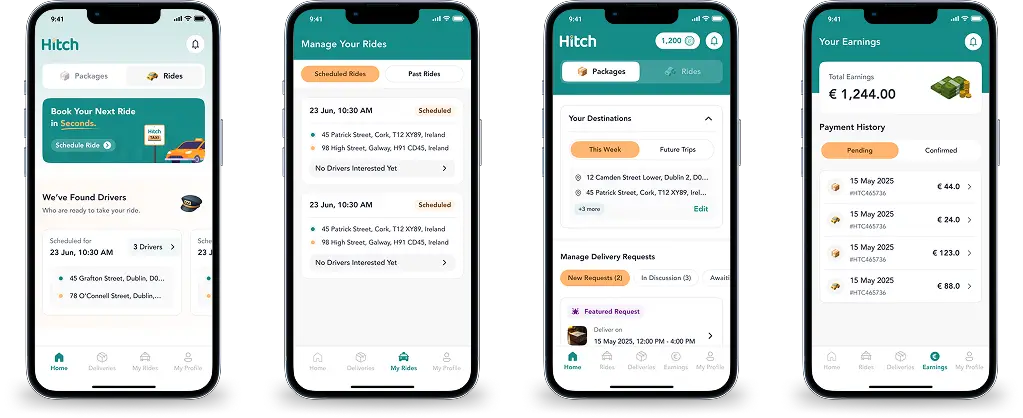
We were the development partner for Hitch, building two separate mobile applications one for users posting delivery requests, one for drivers browsing and accepting jobs along their routes along with an admin panel for the Hitch team to manage the platform.
Project Challenges & Needs
Route-based Matching, Not Locationbased Matching
Standard delivery platforms match by proximity. Hitch required a fundamentally different model: matching delivery requests to drivers based on whether the pickup and drop-off fall along a route the driver has already declared they are travelling, not just whether a driver is nearby right now.
Two Distinct Apps for Two Distinct User Roles
The needs of a user posting a delivery request and a driver browsing jobs along their route are different enough that a single app serving both would compromise both experiences. Two purpose-built apps were required, with entirely separate workflows and UX patterns for each role
Negotiation Before Commitment
Unlike a fixed-price booking flow, Hitch operates on an offer model: drivers send offers to users, users accept or decline, and both parties need to agree details before a delivery is confirmed. The platform needed in-app chat to support this negotiation without either party sharing personal contact information.
Secure Payments Between Strangers
Cash or bank-transfer payments between unknown parties create risk on both sides. Users needed payment held securely until delivery was confirmed complete, and drivers needed confidence that payment would be released reliably on completion — requiring an escrowstyle payment flow built into the platform.
Trust Between Unfamiliar Users
Users are entrusting items to drivers they have never met; drivers are accepting responsibility for items from users they know nothing about. The platform needed a trust layer profile verification, ratings, delivery history to give both parties enough confidence to transact with a stranger.
Platform Oversight at Scale
The Hitch team needed visibility across active users, deliveries and disputes without being involved in every transaction. An admin panel was required to manage user accounts, review reported issues and monitor platform activity without creating an operational bottleneck.
Our Solution
We built two mobile apps (iOS and Android) and a
web-based admin panel,
delivering:
The two-app architecture was a deliberate choice: a driver's workflow entering a route, browsing matched requests, managing active deliveries is different enough from a user's that a unified app would have forced compromises on both sides. Building separate apps allowed each experience to be optimised for the specific tasks each role actually performs.
Interfaces We Developed

User App (iOS & Android)
Used by people sending items, from posting a request through to delivery confirmation:
- Registration and profile setup with identity verification
- Delivery request creation: pickup and drop-off locations, item description, dimensions, photos and preferred time window
- Incoming offer review: driver profile, rating, vehicle details and proposed price visible before acceptance
- In-app chat with the driver once an offer is accepted
- Secure payment: card details stored, payment authorised on acceptance and released on delivery confirmation
- Real-time delivery status tracking with push notifications at each stage
- Delivery history with past requests, driver details and receipts
- Post-delivery rating and review for the driver
- Support and dispute reporting within the app
Driver App (iOS & Android)
Used by drivers to find delivery jobs that fit their existing journeys
- Driver registration with vehicle details, licence information and profile photo verification
- Route entry: origin, destination and travel date, used to surface matching delivery requests
- Matched delivery request list showing jobs whose pickup and drop-off fall along the declared route
- Request detail view: item description, photos, size, delivery window and user rating
- Offer submission with proposed price and message to the user
- In-app chat with the user once the offer is accepted
- Active delivery management: mark as collected, en route and delivered
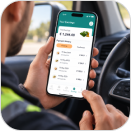
- Earnings history with per-delivery breakdown and payment status
- Stripe Connect onboarding for direct payment to driver bank account
- Post-delivery rating of the user

Admin Panel
Platform management for the Hitch team:
- User and driver account management, including verification status and suspension controls
- Delivery oversight: live and historical view of all jobs across the platform with status, value and parties involved
- Dispute and report management with resolution tools
- Rating and review moderation
- Payment transaction records and payout history
- Platform analytics: registrations, active users, deliveries completed, revenue and geographic distribution
- Push notification broadcast tools for platform-wide announcements
Key Features & Capabilities
Route-based Job Matching
Drivers enter their planned route & the app surfaces delivery requests whose collection and drop-off points fall along that path. No detour is required the platform is designed around journeys already being made.
Offer and Negotiation Flow
Drivers propose their own price for each job; users review the offer alongside the driver's profile and ratings before accepting. In-app chat allows any remaining details to be agreed before commitment, keeping the negotiation entirely within the platform.
Escrow Payment Model
Payment is authorised when a user accepts an offer & released to the driver only when the delivery is confirmed complete. Neither party carries financial risk from the transaction users know they will not be charged unless the item arrives, & drivers know payment is secured before they collect.
Mutual Ratings and Reviews
Both users and drivers rate each other after every completed delivery. Ratings are visible on profiles before an offer is accepted, giving both parties a transparent history to judge trustworthiness before committing to a transaction with someone new.
Driver Stripe Connect Payouts
Drivers onboard through Stripe Connect, linking their bank account directly. Earnings are paid out automatically on delivery confirmation with no manual processing required drivers see a clear breakdown of completed jobs and pending payments within the app.
Real-time Delivery Tracking
Users follow their delivery through status updates collected, en route, delivered with push notifications at each stage. The driver marks progress from within their app, keeping the user informed without requiring direct contact between the parties
Outcomes And Impact
A New Earning Model for Drivers
Platform
Drivers earn from journeys they are already making, with no vehicle repositioning, no dedicated courier runs and no upfront cost. The platform creates income from capacity that would otherwise go unused on every trip.
Flexible Delivery for Rural Communities
Access
In areas where courier services are infrequent or expensive, Hitch surfaces local drivers already making the relevant journey. The route-based model is particularly well suited to rural and semi-rural areas where the platform launched.
Trust Built Into Every Transaction
Safety
Verified profiles, mutual ratings, in-app-only communication and escrow payment mean both parties transact with structural protections in place no cash exchanges, no personal contact details shared, and a clear record of every completed delivery.
Technologies Used to Develop the Solution
Mobile App

React Native
Two separate cross-platform apps user and driver each built for iOS & Android from a single codebase per app.
Backend

Node.js
API layer managing user accounts, delivery requests, route matching, offer flow, chat and payment orchestration.
Database

PostgreSQL
User profiles, delivery records, route data, offer history, ratings and transaction records.
Payments

Stripe & Stripe Connect
Escrow-style payment hold on booking, automatic release on delivery confirmation, & direct bank payouts to drivers via Stripe Connect.
Real-time Chat

WebSockets
Persistent in-app messaging between user and driver throughout the offer and delivery lifecycle.
Maps & Routing

Google Maps API
Location autocomplete, route visualisation and route-proximity matching between driver journeys and delivery requests.
Notifications

Firebase Cloud Messaging
Push notifications for offer received, accepted, collected, en route and delivered status updates for both user and driver.
Storage

Cloud Object Storage with CDN
Item photos, driver profile images and vehicle documentation stored securely and served reliably across regions.
Security

Encryption & Secure Auth
Data encrypted at rest and in transit, with JWT-based authentication and role separation between user, driver and admin accounts.
Get in touch
Share a few details about what you're building, and we'll take it from there.