

Industry Served: HealthTech
MetamedMD, Secure Remote Communication For People Living With Atrial Fibrillation
A Mobile App Connecting Patients with Cardiology Care Teams Real-time Episode Reporting, Symptoms Tracking and Secure Messaging, Outside of Clinical Settings
Keeping Patients Connected Between Clinic Visits
Discuss your projectAtrial fibrillation is a condition that does not announce itself on a schedule. Episodes arrive unpredictably at home, at work, in the middle of the night and the gap between what a patient experiences and what their care team knows about it can be significant. Clinic visits happen intermittently; the rest of the time, patients are largely on their own in managing symptoms, tracking their condition and knowing when to act.
MetamedMD was built to close that gap. It is a secure mobile platform designed explicitly for people with atrial fibrillation, providing a trusted communication channel between patients and their cardiology care teams without serving as a diagnostic tool or medical device. The platform does not give medical advice it gives patients a structured, secure way to report what they are experiencing and gives health workers the visibility to respond.
We were the development partner for MetamedMD, building the full mobile application and web panel across three user roles: patients, healthcare workers, and the platform's super admin.
Project Challenges & Needs
Episode Reporting With A Clinical Response Window
When a patient is having an AF episode, the response needs to be timely. The platform required a real-time reporting mechanism with a countdown timer, ensuring health workers acknowledge and respond before the window closes not hours later.
Structured Patient Onboarding With Clinical Eligibility Checks
Patients arrive through two routes ED referral and direct sign-up. Health workers must verify clinical conditions (AF diagnosis, vital sign ranges, troponin results, patient consent) before admitting anyone to the platform, with ineligible patients automatically moved to an admission log.
Longitudinal Symptom Monitoring
Monthly symptom scoring was required a structured questionnaire with a 0–50 scoring scale, automated monthly reminders, and a graphical tracker showing trends over time. Missed months had to be recorded as zero to maintain data continuity.
Security Without Friction
Healthcare data demands strict access controls. Every login for both patients and health workers required two-factor OTP authentication. Account approvals, password resets and data deletion all needed structured, auditable workflows rather than simple selfservice actions.
Patient Acuity Management At A Population Level
Health workers needed to manage a list of patients across three acuity levels high, medium and low with the ability to reclassify patients, filter by condition, and get an at-glance count of who sits in each category at any moment.
Medication, Test And Appointment Management
Patients needed structured tools to log test results (ECG, blood, echo, sleep studies and more), manage medication reminders with weekly scheduling, and track upcoming and past appointments all feeding back into the health worker's view of each patient's record.

Our Solution
We built a cross-platform mobile app (iOS and Android) and a web-based admin panel, delivering:
Interfaces We Developed

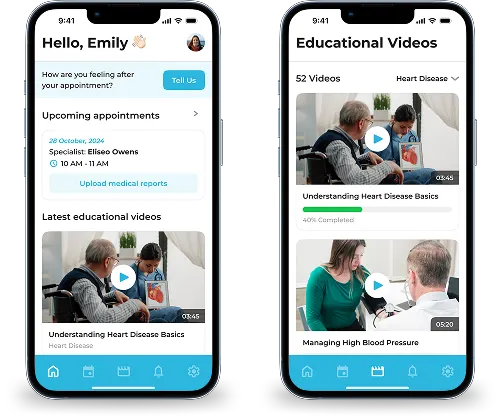
Patient Mobile App (IOS & Android)
Used by patients to manage and communicate their condition between clinic visits:
- Episode reporting: symptom selection, image upload, timed submission with real-time health worker response visible in-app
- Episode history with archived records, filterable by date range
- Monthly symptoms tracker: 10-question scored assessment (0–50), trend graph, filterable history
- Personality score: one-time Type A/B questionnaire
- Medical history: condition-by-condition questionnaire submitted to health worker
- Test upload: eight test types, date, description and image per submission; health worker comments visible on detail screen
- Medication reminders: drug search, weekly schedule with up to three reminders per drug per day, editable and deletable
- Appointments: upcoming and past views, set by health worker with push notification on creation
- Secure messaging: compose, inbox and sent, with image attachment
- Procedures and exercise/lifestyle: YouTube-embedded video content by category
- Profile: CHADS2VASC, diagnosis, MRN, ECG thumbnail, next of kin, GP, weight, height
- Two-factor OTP authentication on every login; account deletion with reason and password confirmation
Health Worker Web Panel
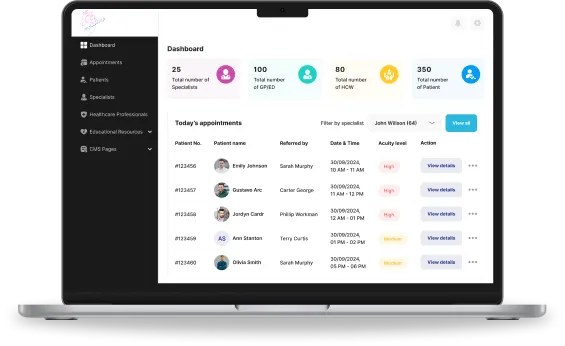
Used by cardiologists, nurses and clinical staff to manage and monitor their patient list:
- Outpatient dashboard: full patient list with high/medium/low acuity counts, colour-coded by condition, with bulk status change
- Patient detail tabs: patient info, medical history, episode history, test history, symptoms history, personality score
- CHADS2VASC score entry and update per patient
- Episode management: active episode queue with timed response, temporary solution library, archive view
- Patient management: separate lists for ED-referred and direct sign-up patients, each with the eightpoint eligibility check and onboard/admit/admission-log workflow
- Admission log: admitted and discharged patient records with discharge summary and status filter
- Appointment creation with patient search, date/time picker, doctor name, and patient notification
- Calendar: date-based note-taking for the health worker's own use
- Secure messaging: compose to specific patient, inbox, sent, reply
- Two-factor OTP on every login
Super Admin Web Panel
Platform management for the MetamedMD team:
- Health worker account approval and rejection
- App version management: iOS and Android version numbers, forced and optional update controls, version history log
- Content management: About Us, Terms & Conditions, Privacy Policy, FAQ, Education and How It Works pages delivered as webviews
- Temporary solutions library: pre-set responses available to health workers during active episode management
- Episode data configuration: symptom options and scoring parameters managed from admin
- Medical history and symptoms questionnaire management
- Contact Us query management with close notification to users
Key
Features & Capabilities
Real-Time Episode Reporting
When a patient reports an episode, a countdown timer starts and the health worker's queue updates immediately. The health worker selects a temporary care guidance from the library or writes a custom response; the patient sees it in real time. Once the patient marks the episode as done, it moves to the archived record.
Clinical Eligibility Onboarding
Before any patient is admitted to the platform, a health worker works through an eight-point clinical checklist covering AF confirmation, vital sign ranges, laboratory results and patient consent. All conditions must be checked; a single No routes the patient to the admission log rather than the active patient list
Monthly Symptom Scoring
Each patient completes a 10-question symptom assessment every month, rated on a 0–5 scale for a maximum of 50 points. The platform sends reminders from three days before the end of the month, records missed months as zero, and surfaces the trend as a graph filterable by quarter, half-year or year.
Patient Acuity Dashboard
Health workers see their full patient list segmented by acuity high, medium and low with a colour-coded count per category. Patients can be reclassified individually or in bulk at any time, with the dashboard updating to reflect the latest status immediately.
Two-Factor Authentication On Every Login
Every login by any user patient or health worker requires a 4-digit OTP sent to the registered email, valid for 60 seconds with a three-attempt limit. No session is accessible without completing this step, regardless of how recently the user last logged in.
Medication Reminder Scheduling
Patients set reminders per drug, per day of the week and per time of day. Up to three reminders per drug per daily session can be configured, with push and email notifications delivered at the scheduled time. Reminders continue weekly until the patient edits or deletes them.
Test Upload And Clinical Review
Patients upload test reports across eight categories blood tests, ECG, chest X-ray, stress test, echocardiogram, coronary CT, coronary angiogram and sleep studies. Health workers review the image and description in the patient's record and can add a clinical comment visible to the patient on the test detail screen.
Admission Log And Discharge Workflow
Patients who do not meet eligibility criteria are held in an admission log rather than onboarded to the active patient platform. Health workers manage their status (admitted/discharged), add discharge summaries, and the log maintains a permanent record of each entry regardless of outcome.
Outcomes And Impact
Episodes Responded To In Real Time
Clinical
The timed episode reporting flow means health workers are alerted and respond to active AF episodes within a defined window, replacing a process that previously had no structured channel outside of the emergency department.
A Longitudinal Record For Every Patient
Data
Monthly symptom scores, episode history, test results and medication records accumulate over time in a single structured record, giving health workers a view of a patient's condition that extends well beyond what a clinic visit alone can capture.
Clinically Safe Onboarding
Safety
The structured eligibility checklist ensures no patient accesses the platform without clinical review, and the admission log captures those who need in-person care rather than remote monitoring keeping the platform appropriate for the patients it serves.
Technologies Used To Develop The Solution
Mobile App

Flutter (Dart)
Cross-platform iOS and Android app from a single codebase, with nativequality performance on both platforms.
Web Panel

Next.Js (TypeScript)
Admin and health worker web panel, server-rendered for fast load and reliable performance.
Backend

Node.Js
API layer covering authentication, patient records, episode management, messaging and notification dispatch.
Database

PostgreSQL
Patient records, episode history, symptom scores, test results, medication reminders, appointments and audit data.
Authentication

OTP / 2FA
4-digit OTP sent to registered email on every login for all user roles, with 60-second expiry and three-attempt limit.
Notifications

Push (FCM) & Email (SMTP)
Episode alerts, medication reminders, appointment notifications and monthly symptom check reminders across push and email.
Storage

Cloud Object Storage
Test report images, ECG uploads and profile attachments stored securely with access control per user account.
Security

Encryption & RBAC
Data encrypted at rest and in transit, with role-based access separating patient, health worker and admin permissions throughout.
App Distribution

App Store & Google Play
Deployment to both stores on client accounts, with in-app version update management (forced and optional) controlled from the admin panel.
Get in touch
Share a few details about what you're building, and we'll take it from there.