


A founder ships an MVP in two weeks with Bolt. The screens look clean; the signup flow works, the demo lands, and the first paying customers arrive. Then a user changes a single number in the URL and sees another customer's account. Days later, the team discovers an admin API that accepts any logged-in request and a live API key sitting in JavaScript that every visitor downloads.
None of those failures showed up in the demo. All of them are now production incidents.
This guide focuses on the gap between "it works" and "it is safe to put real people's data behind it." Lovable, Bolt, Cursor, v0, and Replit are excellent tools for getting from ideas to working product quickly. Square Root Solutions Ireland also uses AI-assisted tools like Cursor and Claude Code internally where they fit the job. The question is never whether these tools are good. The real question is whether the application they helped you ship is ready for real users, personal data, payments, and public traffic.
The sections below explain where AI-generated code tends to break, the GDPR and EU AI Act exposure that Irish founders should understand, and the specific checks to run before your first paying customer depends on the product.
Are Lovable, Bolt, Cursor, v0, and Replit Good for Building MVPs?
Yes, for many founders, they are. AI code generation tools such as Lovable, Bolt, Cursor, v0, and Replit make it much faster to turn an idea into a working prototype. A founder can test product market fit, gather user feedback, and refine features without waiting months for a first version.
That speed creates real value. Square Root Solutions Ireland also uses AI-assisted tools like Cursor and Claude Code during suitable parts of software delivery because they simplify repetitive work and accelerate early development. The practical lesson is simple: AI produces a useful starting point, while experienced engineering teams decide whether the result is ready for production.
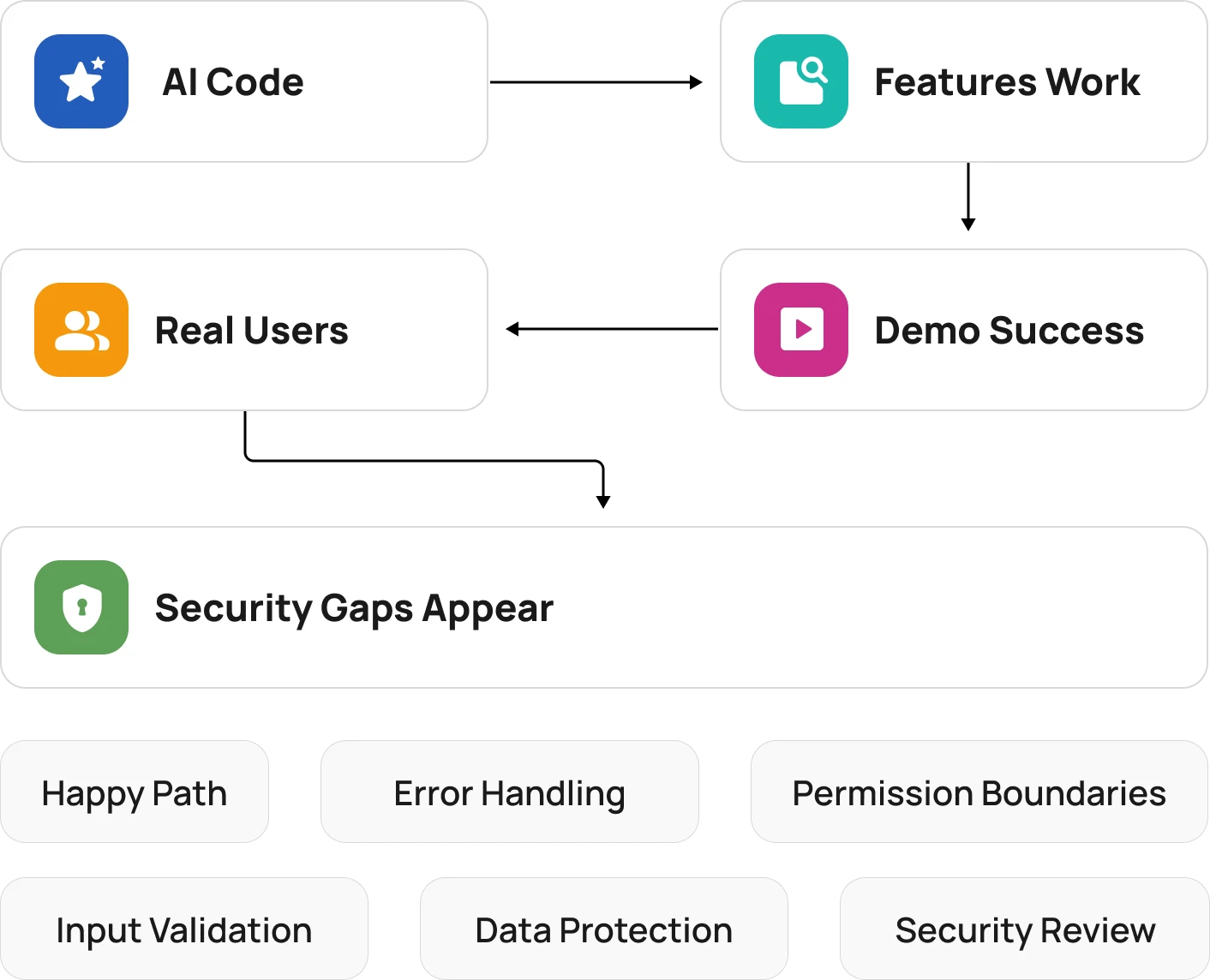
The challenge usually appears after the prototype succeeds. An application may display the correct screens and complete user actions, yet still contain hidden gaps in authentication, access control, or data handling. For example, an AI-generated admin panel might hide management options in the interface but leave the underlying API open to any authenticated user.
In many software projects, founders assume that a working feature is also a safe feature. Architecture reviews often prove otherwise. Senior engineers usually examine how requests move through the system, how permissions are enforced, and how sensitive data is protected before recommending a production launch.
AI tools remain an excellent way to build and validate ideas. They should be viewed as accelerators for development, not as a replacement for production review, security assessment, and operational planning when real customers and personal data are involved. 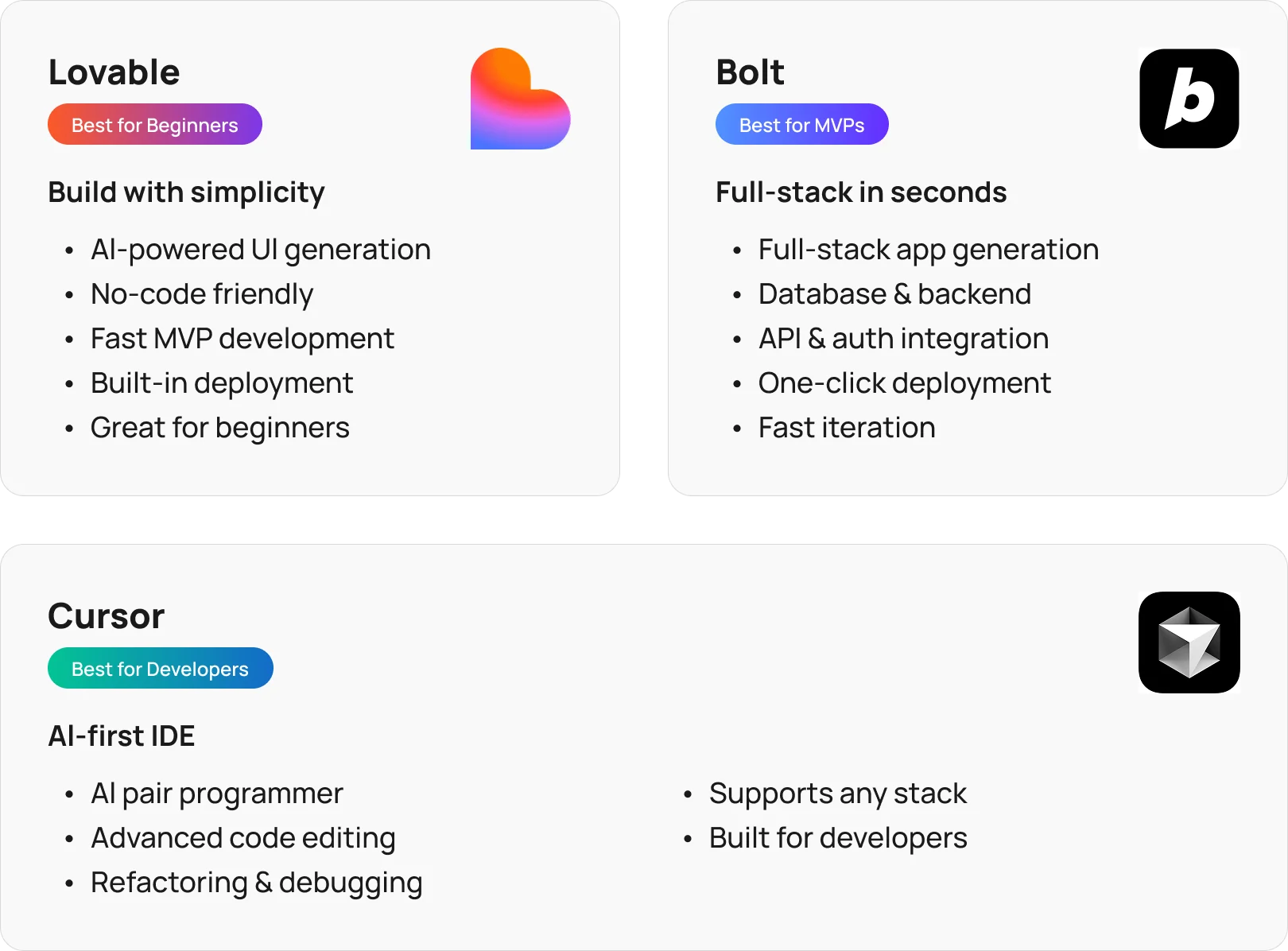
Why Can an AI-Built App Work in a Demo but Fail a Security Review?
A successful demo proves that features work. It does not prove that users, data, and APIs are protected. That difference often surprises founders who build an MVP quickly with AI-assisted tools and then prepare for a public launch.
During investor presentations or internal testing, people usually follow expected paths. Real customers behave differently. They forget passwords, upload unexpected files, refresh pages repeatedly, and try actions in a different order. Attackers actively search for weak points that normal testing never reaches.
One common delivery observation is that security reviews focus on what happens behind the interface rather than what appears on the screen. A dashboard may display only standard user options, yet the underlying API could still accept administrator requests because permission checks exist only in the user interface. In that situation, the application works correctly during a demo while remaining unsafe in production.
The practical lesson is simple: visible functionality should never be treated as evidence of production readiness. Experienced engineering teams review authentication, authorisation, data access, request validation, and error handling before recommending launch because hidden implementation details often create the biggest risks.
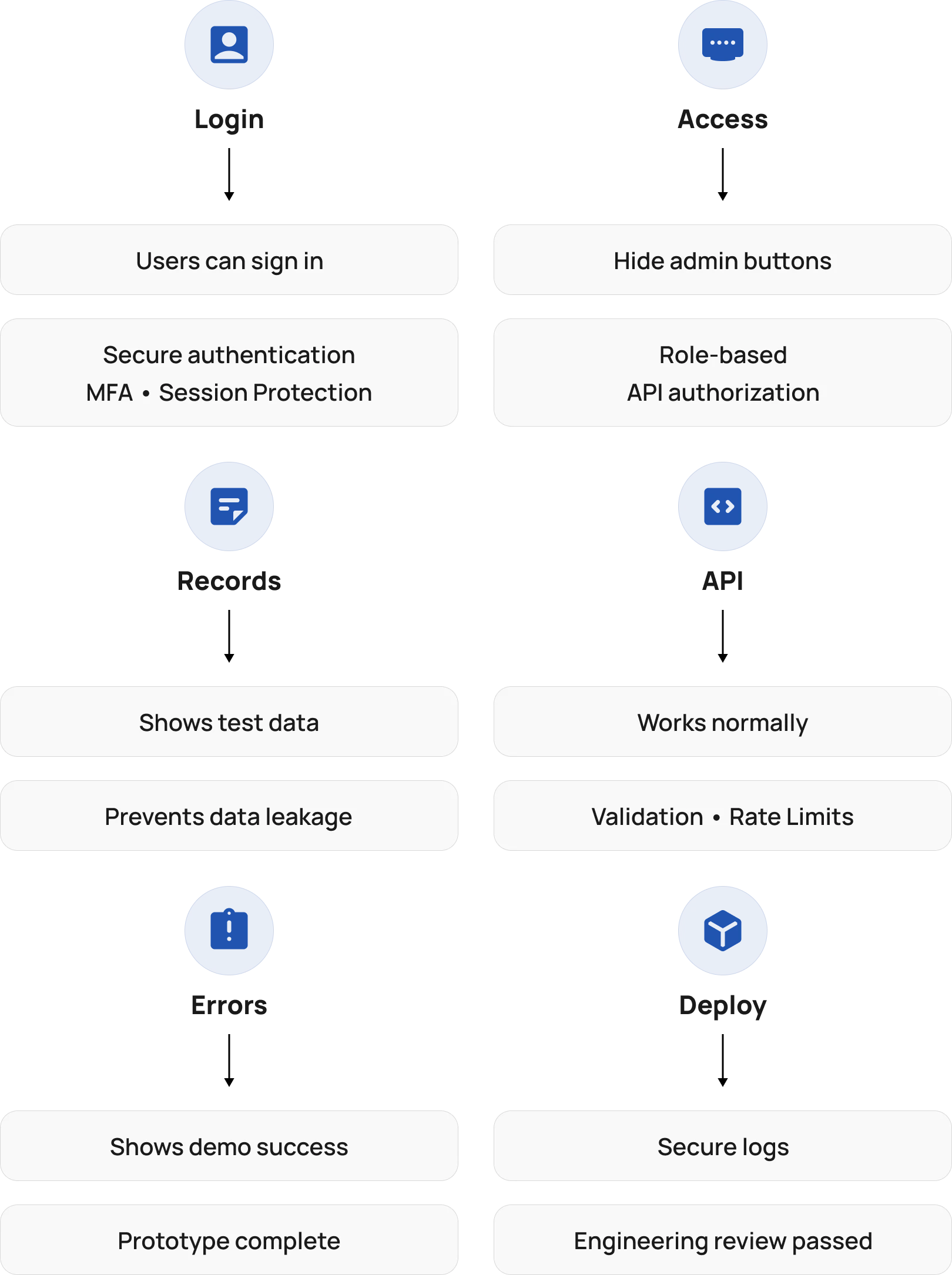
Area | Demo-ready application | Security-ready production application |
User login | Allows users to sign in successfully | Verifies identity and protects sessions with secure authentication controls |
Access control | Hides admin buttons in the interface | Enforces role checks in every API request |
Customer records | Displays expected data during testing | Prevents one user from accessing another user's information |
API behaviour | Returns successful responses for normal requests | Validates input, limits abuse, and rejects unauthorised actions |
Error handling | Shows features working during demonstrations | Records failures safely without exposing sensitive information |
Deployment confidence | Appears complete after prototype testing | Passes engineering review before serving paying customers |
In many software projects, architecture reviews reveal issues that users never notice during demonstrations. A simple example is an API endpoint that returns the correct response but skips ownership checks, allowing one customer to retrieve another customer's record by changing an identifier in the request. Problems like these explain why production review remains an essential step even after an AI-built application appears ready to launch.
What Security Gaps Commonly Appear in AI-Generated Code?
AI-generated applications often succeed because they make common development tasks faster. Security reviews exist for different reasons. They look for hidden assumptions that appear only after real users; public traffic, and sensitive data enter the system.
In many software projects, engineers discover that the feature itself works exactly as expected while the protection around it remains incomplete. The practical lesson is straightforward: a successful demo should start a security review, not replace one.
Security gap | Real AI-generated example | Business impact | Recommended review |
Authentication gaps | An admin API accepts requests even though only the screen is hidden from normal users. | Unauthorised users may gain privileged access. | Verify authentication on every protected endpoint. |
Authorisation issues | The user interface disables an action, but the API still performs it when called directly. | Users may perform actions outside their role. | Enforce permission checks on the server, not only in the interface. |
Insecure Direct Object Reference (IDOR) | Changing /api/users/123 to /api/users/124 displays another customer's profile. | Personal information can be exposed to other users. | Confirm ownership before returning records. |
Exposed secrets | An OpenAI API key or database password appears inside client-side code or a public repository. | Attackers may misuse services or access sensitive systems. | Move secrets to secure server-side configuration. |
Missing input validation | A search box accepts unfiltered input that later executes unwanted script content. | User sessions or stored data may be compromised. | Validate and sanitise all external input. |
No rate limiting | A login endpoint accepts unlimited requests from the same source without delay. | Automated attacks become easier and service availability may suffer. | Apply request limits and monitoring. |
Weak password storage | Passwords are stored with outdated hashing methods or plain text during testing. | Account credentials become easier to recover after a breach. | Use modern password hashing and secure credential handling. |
Dependency vulnerabilities | An AI-generated project installs an outdated library with a publicly known security issue. | Attackers may exploit weaknesses that already have documented fixes. | Review dependencies and update vulnerable packages before launch. |
Another delivery observation appears during architecture reviews. AI-generated code often focuses on making the happy path succeed first. Error conditions, unusual requests, and permission boundaries may receive less attention until experienced reviewers examine the implementation. That is why senior engineering review remains an important step before real customers trust an AI-built application with personal data or business operations.
Why Do Secrets, API Keys, and Database Credentials Get Exposed?
One common delivery issue appears when an AI-generated application connects successfully to external services during development. To make the feature work quickly, API keys, database passwords, or access tokens may end up directly inside source code instead of secure server-side configuration.
At first, everything seemed fine. The integration works and the prototype behaves as expected. The risk appears later when the repository is shared; the code is published accidentally, or client-side files expose credentials that anyone can inspect through a browser.
A simple example is an AI-generated payment integration that stores a live API key in a JavaScript file downloaded by every visitor. Another example is a configuration file committed to version control, with production database credentials still present. In both situations, the application works correctly while exposing sensitive information that should never leave a protected environment.
Experienced engineering teams usually review secrets management before launching because fixing exposed credentials after release often requires rotating keys, updating integrations, and investigating possible misuse. The practical lesson is straightforward: convenience during development should never become permanent production configuration.
Before deploying an AI-built application, founders should confirm that:
API keys are stored in secure server-side environment variables.
Database credentials never appear in public repositories.
Client-side code does not expose private tokens.
Separate credentials exist for development, staging, and production environments.
Unused or test credentials are removed before launching.
This review takes relatively little time compared with the disruption caused by replacing compromised credentials after customers start using the application.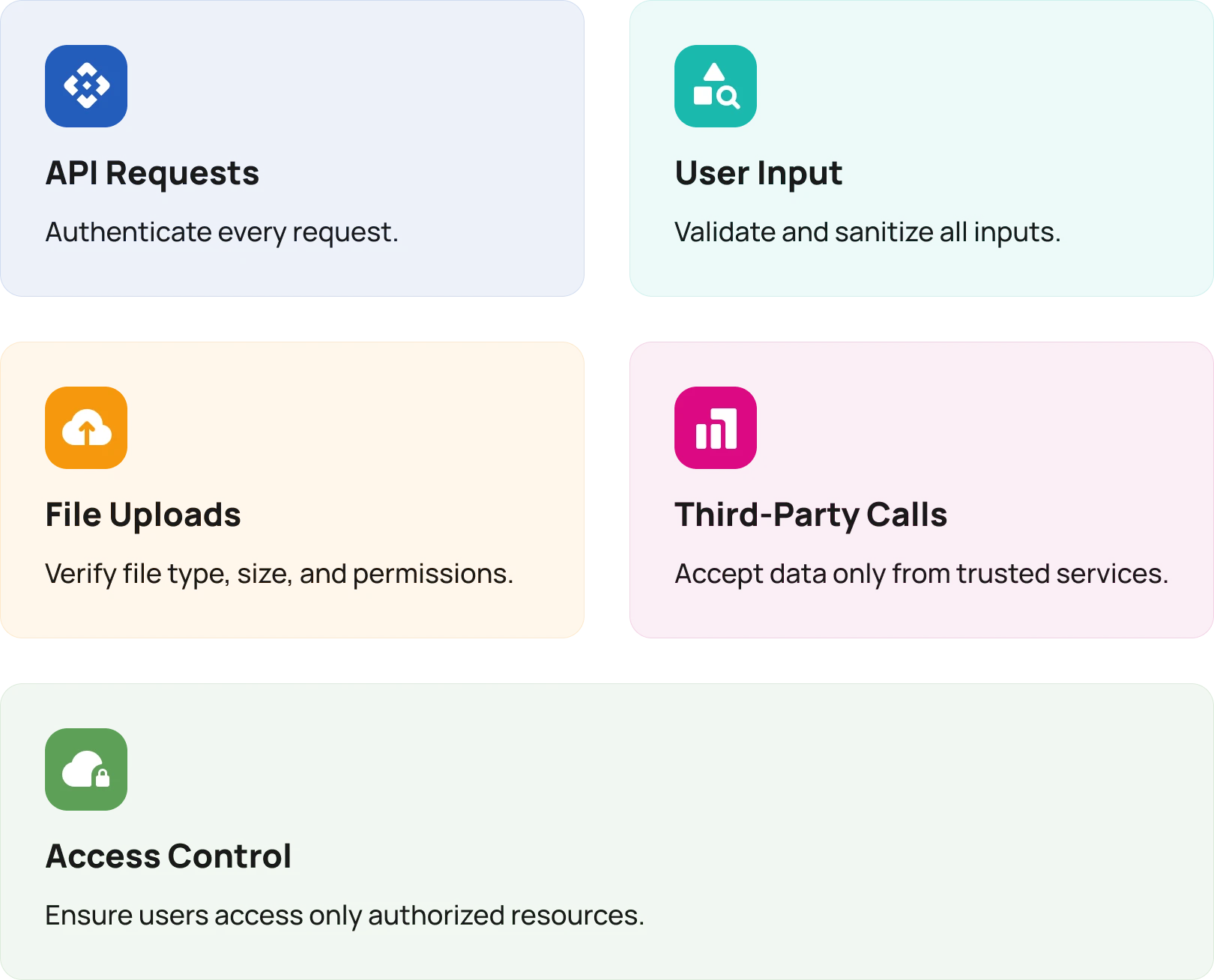
Which API, Input Validation, and File Upload Risks Should Founders Fix?
AI-built apps often move quickly from idea to working endpoint. That speed helps during prototyping, but it can leave user input, API calls, and file uploads under-checked. A feature may work during testing while still accepting unsafe requests from real users.
Founders do not need to understand every technical detail. They need to know where trust enters the system. Forms, APIs, file uploads, browser requests, and third-party calls all create places where the app must check what is allowed before it acts.
Risk | How it appears | Why it matters | Fix or review step |
XSS | A comment field accepts script-like content and later displays it to other users. | A user session or page content may be affected. | Validate input and encode output before display. |
SQL injection | A search field sends raw text directly into a database query. | Private records may be exposed or changed. | Use parameterised queries and review data access code. |
CSRF | A logged-in user can trigger an unwanted account action from another page. | User actions may happen without clear consent. | Add CSRF protection for sensitive actions. |
CORS misconfiguration | The API accepts browser requests from any website. | External sites may interact with private endpoints. | Restrict trusted origins before launch. |
No rate limiting | A login or signup endpoint accepts unlimited repeated requests. | Abuse, spam, or service disruption becomes easier. | Add request limits and monitoring. |
File upload vulnerability | The app accepts any file type and stores it without checks. | Unsafe files may reach storage or users. | Restrict file types, size, scanning, and storage access. |
A practical example appears in many AI-generated apps: the upload feature accepts a profile image, but the code checks only whether a file exists. It does not verify file type, file size, storage permissions, or download access. The feature works in a demo, yet it creates avoidable risk once real users begin uploading content.
The best review pattern is simple. Check every place where outside data enters the app, confirm what the app accepts, and reject everything else. That rule keeps security understandable for founders and actionable for engineers before the first paying customer arrives.
What Non-Security Production Issues Can Still Break the App?
Security is only one part of production readiness. An AI-built application may pass a security review and still struggle once real customers begin using it because the supporting operational layers were never prepared.
One common delivery issue appears after launching when the first unexpected error occurs. The application returns a generic failure message, but no logs explain what happened. Developers cannot identify the cause quickly; support teams cannot answer customers, and recovery takes longer than necessary.
In practice, production incidents often expose monitoring gaps before they expose software bugs. Experienced delivery teams usually discover that recovery procedures matter as much as deployment because quick diagnosis reduces downtime and limits customer impact.
The same pattern appears with scalability. A page may load instantly during testing with twenty records but become noticeably slower when thousands of users generate larger datasets. For example, an AI-generated dashboard may request information through repeated database queries instead of retrieving it efficiently, creating unnecessary delays as usage grows.
Before launch, founders should also review the operational foundation behind the application:
Logging records important events without exposing sensitive data.
Monitoring alerts the team when performance or availability changes.
Automated backups protect business information from accidental loss.
CI/CD pipelines provide controlled deployments and repeatable releases.
Automated tests confirm that changes do not break existing features.
A staging environment allows validation before production deployment.
A rollback plan enables the previous stable version to be restored quickly if a release causes problems.
The practical lesson is straightforward: a production application should be easy to operate as well as easy to use. Features attract customers, but logging, monitoring, testing, backups, and controlled deployments often determine how confidently the business can support them over time.
What GDPR, EU AI Act, and Irish Hosting Risks Should Founders Check?
For Irish founders, launch risk does not stop at code security. An AI-built app may pass basic testing and still create data protection issues if it stores personal data without clear controls, uses US-default hosting, or adds AI features without reviewing risk.
GDPR matters when the app stores, processes, shares, or displays personal data. That can include names, emails, customer records, uploaded files, payment details, support messages, or analytics data. A working prototype may collect this information before the founder has defined data minimisation, cookie consent, right-to-erasure handling, or breach notification steps.
The EU AI Act also matters when AI features influence users, automate decisions, generate content, or support business workflows. Founders do not need to panic, but they should understand what the AI feature does, what data it uses, and whether a human should review the output before the app acts.
Risk | How it appears | Founder action | Review needed |
GDPR data exposure | The app stores user profiles without clear access rules or deletion handling. | Map what personal data the app collects and why. | GDPR-aware data review |
Weak cookie consent | Analytics or tracking runs before the user gives clear consent. | Review cookie banners, consent records, and tracking tools. | Privacy posture review |
No right-to-erasure process | A user asks for account deletion, but data remains across databases or backups. | Define deletion steps before launch. | Data lifecycle review |
Missing breach process | The team has no plan for detecting or reporting a data incident. | Create an incident response path. | Breach readiness review |
US-default hosting | EU customer data sits in a non-EU region without review. | Check whether AWS Ireland, OVHcloud, or EU hosting fits the product. | Data residency review |
Missing DPA or DPIA | Vendors process data, but agreements or risk checks are not documented. | Confirm DPA needs and assess whether DPIA applies. | Compliance documentation review |
EU AI Act uncertainty | The app uses AI for scoring, filtering, recommendations, or workflow actions. | Identify the AI use case and its user impact. | AI risk review |
Possible NIS2 relevance | The app supports an essential or important service. | Check whether the business falls within NIS2 scope. | Sector risk review |
A useful rule is simple: if the app handles real EU customer data, hosting and privacy choices become product decisions, not admin tasks. Many AI tools make deployment fast, but founders still need to know where data sits, who can access it, how users can exercise rights, and what happens if something goes wrong.
This section is not legal advice. It gives founders a practical launch lens. Before the first paying customer arrives, the team should confirm data location, access controls, privacy notices, vendor agreements, AI feature risk, and incident handling. Those checks make the product easier to trust and easier to support after launch.
What Should Founders Do Before Their First Paying Customer?
The best time to review an AI-built application is before customers depend on it. Small fixes made during preparation often cost far less than emergency changes after sensitive data, payments, or business operations move into production.
Many experienced delivery teams follow a simple principle: review trust boundaries before feature lists. A new feature can wait for the next release, but weak authentication or exposed customer data can damage confidence from the first day.
Use this checklist before opening the application to real users.
Checkpoint | Why it matters | Pass or fail signal | Next action |
Authentication review | Confirms that only authorised users can sign in. | Every protected endpoint requires valid authentication. | Review login flows and session management. |
Access control review | Prevents users from performing actions outside their role. | API requests enforce server-side permissions. | Verify role checks beyond the user interface. |
Security audit | Identifies hidden vulnerabilities before launch. | Critical findings are resolved or documented. | Complete an application security review. |
Secrets management | Protects API keys and credentials. | No sensitive values appear in repositories or client code. | Move secrets to secure environment configuration. |
EU hosting review | Supports data residency decisions. | Personal data is stored in approved locations. | Confirm infrastructure and cloud regions. |
Privacy posture | Supports GDPR readiness. | Data collection, retention, and deletion are documented. | Review privacy processes and user rights. |
Monitoring and logging | Simplifies diagnosis after deployment. | Errors and important events are recorded correctly. | Enable alerts and operational dashboards. |
Dependency review | Reduces avoidable software risk. | Libraries are current and known issues are assessed. | Update or replace vulnerable packages. |
Backup and recovery | Protects business continuity. | Recovery procedures are tested and documented. | Verify backup schedules and restoration steps. |
Senior engineering review | Provides independent production validation. | Experienced reviewers confirm launch readiness. | Resolve remaining high-priority findings. |
Another practical observation comes from production releases. Founders often focus on whether the application works today, while senior engineers focus on how it behaves when something unexpected happens tomorrow. That difference explains why security reviews, monitoring, rollback planning, and recovery procedures receive so much attention before launching.
If several checkpoints remain incomplete, delaying the public release for a short period is usually a better decision than fixing preventable issues after paying customers to arrive. The goal is not perfection. The goal is to understand the remaining risks and reduce them before the application becomes part of everyday business operations.
How Can Square Root Solutions Ireland Help Move an AI Prototype Into Production?
Many founders reach the same point. The prototype works, early feedback is positive, and the next question becomes whether the application is ready for real customers. That is usually where an independent engineering review provides the most value.
Square Root Solutions Ireland works with businesses that need to understand what an AI-built application already does well and what should be improved before production deployment. The goal is rarely to discard existing work. In many cases, experienced engineers review the codebase, identify priority risks, and recommend targeted improvements that protect users while preserving development progress.
A typical Production Readiness Audit or AI Code Review Sprint examines areas such as authentication, access control, API security, secrets management, dependency health, GDPR considerations, hosting decisions, monitoring, logging, backups, and operational readiness. The review also helps founders separate critical launch blockers from lower-priority improvements that can be scheduled after release.
Another practical lesson from software delivery is that early review usually costs less than emergency recovery. Small architecture adjustments made before public launch are often easier than redesigning systems after customer data; integrations, and business workflows depend on them.
If your application was built with Lovable, Bolt, Cursor, v0, Replit, or another AI-assisted development tool, an independent assessment can provide a clearer picture of production readiness. It can also highlight were security, compliance, scalability, or governance improvements will reduce long-term operational risk.
For founders who want structured guidance before launching, a Discovery Sprint or AI Code Review Sprint offers a practical way to evaluate the application, prioritise fixes, and move from a working prototype to production software with greater confidence.
Frequently Asked Questions
Is Lovable production-ready?
Lovable can produce a working prototype quickly, but production readiness depends on more than working features. Before launching, review authentication, access control, API security, logging, monitoring, and data protection to confirm the application is suitable for real users.
Can I deploy a Bolt app to paying customers?
You can, but the application should first pass a security and production review. A prototype that works during testing may still contain hidden issues such as missing role checks, exposed secrets, or incomplete operational controls.
Does Cursor generate secure code?
Cursor can accelerate software development, but generated code should still go through human review. Experienced engineers typically validate authentication, permissions, dependency on health, and input handling before production deployment.
What is an AI MVP security audit?
An AI MVP security audit reviews an AI-built application for issues that could affect users, data, or business operations. It commonly includes authentication, authorisation, API security, secrets management, dependency review, and production readiness checks.
Does GDPR apply to an AI-generated app in Ireland?
Yes. If an AI-generated application processes personal data belonging to people in Ireland or the European Union, GDPR obligations still apply regardless of how the software was created.
Should I host my AI-built app in Ireland or elsewhere in the EU?
The right choice depends on your product and regulatory requirements, but founders handling EU customer data should review data residency and hosting decisions before launch. AWS Ireland and OVHcloud are examples of infrastructure options that support EU-based deployments.
Do vibe-coded apps need penetration testing?
Many do. If the application stores customer information, processes payments, exposes public APIs, or supports business workflows, penetration testing can identify security issues that routine functional testing may not detect.
Who should review an AI-built app before launch?
An experienced software engineer or security review team should assess the application before production deployment. Independent review helps identify hidden risks that may not appear during prototype development or internal demonstrations.